
A New Duality: Acid Communism Vs Ac(r)id Fascism
When recalling the body of Mark Fisher’s work, it is worth bearing in mind that his mix of both pessimism and optimism regarding the near impossibility of overcoming capitalism (and therefore the slight possibility) predated our current political era. Fisher took his life in January 2017, a tragedy which permeated the British theoretical left, unfortunately dividing it since in a curiously British and very online turf war over his memory. Fisher had credited capitalism as affecting mental health, and with the UK having voted to leave Europe in 2016, and Trump winning the US presidential election later that year, a profound rightward turn was evident in his last months. His death presaged a downward spiral in left morale that has played out in the years since, with only occasional respite.
For the right, political events are met with raucous jeering when they are perceived as positive and hateful invective when seen negatively. People of the left are often no less emotional, if it needs saying. However, their emotional response to political events tends to range from jubilation to depressive despair, the latter felt acutely by sensitive people in these dire times. We can’t know what Fisher would have made of the possibilities for overcoming capitalism in the near-decade since he passed. We do know, however, that the shift from neoliberalism (Slavoj Žižek’s “capitalism with a friendly face”) to technofascism (effectively neoliberalism with the mask off, plus AI-enhanced surveillance) has brought about a new strain of capitalism with potentially hitherto unforeseen potential to express its disdain for community and life. If we on the left were to have kept a bingo card of likely political outcomes in the 2020s, an overturning of Roe vs.Wade, plus an unabashed white supremacist US Presidency intent on reviving McCarthyism for the digital age was not likely on it. Neither was a brazen US Imperialism that sat on the fence regarding Russian expansionism, and set Greenland and maybe even Canada in its sights. Nor the unabashed personal enrichment of the President and his circle through financial speculation around his own messaging. While the notion that the US government might give a mandate to the world’s richest man to slash public spending would have seemed pure caricature. This is not to mention the criminalization of Pro-Palestine protest in the UK, the entry into government of the populist far-right in Italy and Finland, and the winning of a regional election by the German far-right AfD (Alternative für Deutschland). [1]
So the question is, if capitalism was very nearly insurmountable as Fisher published Capitalist Realism in 2009, what cause for positivity, if any, do we have today?
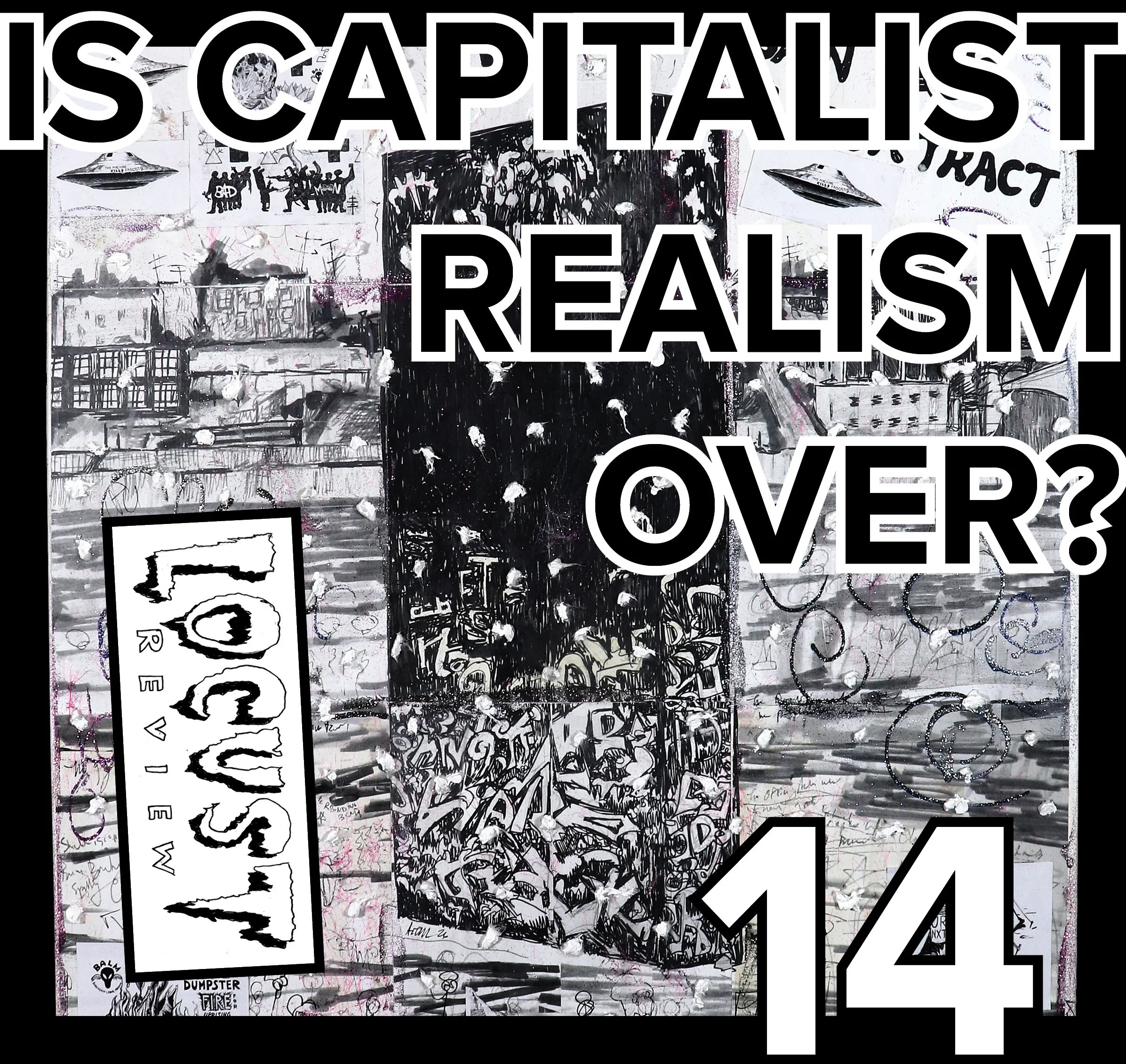
This essay by Mike Watson will appear in Locust Review 14, “Is Capitalist Realism Over?”
The passing of the conservative vs neoliberal dualism, which has upheld the status quo across the western world since the collapse of soviet communism — and the simultaneous erosion of a socialist alternative — has wrong-footed us all. That is to say, we may have long wished precisely for the destruction of the thirty-year-old New World Order declared by George H.W. Bush (the senior), and the ensuing Third Way politics of Bill Clinton-Tony Blair. However, we couldn’t foresee the effect of neoliberalism’s genteel and hypocritical platitudes to civilization giving way to the gloves-off pugilism of the Trumpian right. We might ask whether this distinction really matters. After all, tokenistic gestures to minorities and vague platitudes to ethical values were only ever a smokescreen for gross inequalities of wealth and power. However, when the mask and gloves come off to reveal open contempt for weakness and the willingness to act upon that contempt with brute force (the destruction of Gaza, the brutal treatment of ICE detainees), a distinct difference can be seen (and felt). This is not to say that liberalism and conservatism were better than Trumpism, but rather to drive home that they were a precursor to what by now can justifiably be called a new variant of fascism. Unfortunately though, we gain very little from such a realization. Indeed, where at best it might be seen as a wake up call, many leftists are burying their heads.
“Why use the ‘f’ word?” people often ask: “It seems crass and cheapens discourse”; “It refers to a particular historical moment.” Well, like that other, four-lettered, f-word, when it’s being evoked with urgency and passion, it’s often time to listen-up, rather to patronise. When we say “f-ing this, f-ing that”, it’s for lack of other words that do justice to the obscenity evoked, so we reach for a signifier of the wordlessness. True, the obscene f-word can be overused to the point of losing all effect. In filmic cliche, it's the first-choice adjective for addicts and members of subversive subcultures, indicating a sense of wild abandon, and therefore supposed untrustworthiness. Curiously, the seven-lettered f-word, fascism, has also long been associated with cultural outsiders, applied by them to a wide variation of authority figures from policemen, to teachers, to psychiatrists, civil servants to shopkeepers, bank clerks, and simply parents. On this basis, we might well disregard the current prevalence of the term fascism in political discourse as hysterics — a curse word for the barely politically literate.
Seen otherwise, dropouts and addicts map the periphery of society, not the central terrain (much like sailors, who are among the most prodigious “f---ers” among us). As such, they have a wide overview and are well positioned to give advanced warning when things go awry. Given this, the prevalence in use of both the four and seven letter f-words among them might be due to their acute sensitivity to tough societal conditions. Only now is society generally catching up with these canaries in the coal mine and using “fascism” to describe the power elite across the west.
Protest in southern Illinois (USA) after ICE murders in Minneapolis (2026)
Extreme political signifiers are a sign of a breakdown in sense, even (or especially) when they are used rationally and in line with their true meaning. This point brings us to a consideration of what fascism really is, and it runs contrary to colloquial understanding (which may account for some people’s reticence to use the term). Put simply, if we wait for governments to assume absolute control before concluding they are fascist, we may miss its coming altogether, finding ourselves languishing in cells, camps, ghettos, or bombed out cities before we have time to piece together the picture. Indeed, the attempt to piece together anything might be the mistake, for fascism is the erosion of sense as much as of liberty — as such, it easily evades detection and comprehension. Our biggest mistake in this era might reside in people’s inclination to oppose the strict, rules-based domination of fascism to the unfettered freedom and irrationality of the post ‘60s left.
This distinction once counted for something. From the McCarthy era House Un-American Activities Committee to the Parental Advisory labels emblazoned on album sleeves from the mid ‘80s (and still ongoing) there is a rich history of conservatives becoming apoplectic over fairly innocuous cultural signs. These moments have historically delivered hilarious exchanges, with creative anti-establishment figures running rings around staid and unimaginative conservatives. Testifying in front of the House Un-American Activities Committee in 1947, the playwright Bertolt Brecht was asked if he had written the poem translated as Forward, not Forgotten (otherwise known as Solidarity Song). [2] He replied: “No. I wrote a German poem, but that is very different from this thing.” [3] This quip showed there are nuances to creative production that evade the rigid certainty which the show trials sought to convey to the American public.
Similarly, when called to the Senate House Committee in 1985 to oppose proposals for Parental Advisory notices on record sleeves, musician Frank Zappa was asked whether he felt it would be appropriate to remove child age recommendations from toys:
"Mr. Zappa, toy boxes say ‘suitable for 5–7 years of age or 8–15,’ which gives you some guidance. Do you object to that?"
Zappa replied:
"In a way I do, because that means somebody in an office someplace is making a decision about how smart my child is."
Hawkins responded:
"Well, I’d be interested to see what toys your kids have."
To which Zappa retorted: "Well, c’mon over to the house and I’ll show ’em to you." [4}
Countering conservatives was easy when it amounted to pointing out the ludicrousness of their staid positions.
Countering today’s fascism is altogether more difficult, and while Brecht returned to post-fascist Germany straight after his trial, indicating an unease with conservative America, and a fear of rebuke, he’d likely see Trump’s administration as an even trickier — and more dangerous — adversary than that of Harry Truman. Truman spoke in whole sentences and made plausible justifications for his actions. They were often wrong, by any measure of the left, but they had inner coherence, at least.
In his introduction to the unfinished Acid Communism, Fisher points to ‘60s era television as having a psychedelic quality, highlighting the BBC’s 1966 adaptation of Alice in Wonderland. As Alice grapples with the perverse authority of the adults that inhabit a parallel world, the film “exposes the bizarreness, the inconsistency, of what had been taken for common sense” in the usual world.
Power is always a case of imposing a matrix of sense onto chaos and acting as an authoritative key-holder to that arbitrary sense. The key to holding on to power is making its mechanisms indecipherable to subordinates. Historically, obfuscation has been achieved by varied means, from “bread and circuses,” to religion, to the output of the culture industry. Today, the internet has threatened all matrixes of sense, even some very necessary ones. At the time of drafting this piece, a conspiracy theory was gaining traction online which stated that gravity will become suspended for a period of 7 seconds on August 12th, propelling anything not fixed to the earth to careen off into the air, before plummeting down again, thereby injuring or killing millions of people and animals while damaging incalculable amounts of property. [5] The conspiracy theory prompted NASA to issue a statement pointing out the scientific fallacy of the theory, stating “gravity does not just switch off.” Aside from there being a forecast Lunar eclipse across Europe that day, it otherwise passed without incident. Such instances would present a humorous diversion from more serious matters, yet there is nothing to laugh about in the total erosion of truth. To be sure, the notion of untethering the human narrative from a few dominant texts and theories sounds thrilling. Willful disregard for reality holds a sure promise. We get to challenge the humdrum of a life lived in moderation, dutifully bound to work, exploding its shades of grey into a kaleidoscopic realm of boundless potentiality, releasing the imagination and libido from the bounds of dominant reason. The trouble is, post-truthism achieves no such thing, delivering only competing degrees of nonsense aimed at supporting the political status quo. Even as pure entertainment, memetic conspiracy theories are degraded. They are to Hollywood movies, what “soylent green” is to food.
The sci-fi movie Soylent Green (1973), set in 2022, depicts a dystopian world where the masses live in abject poverty due to high unemployment and resource-shortage. They are barely sustained on “soylent” — a coarse block made of soy beans and lentils that comes in two varieties, Red and Yellow. A Green new variant, coming in wafer form, becomes widely sought out due to its marginally better taste.
Soylent Green is ostensibly made from ocean plankton, yet the film’s central character Robert Thorn (played by Charlton Heston) reveals it to be made from humans, leading him to shout the famous line “Soylent Green is people! We’ve got to stop them somehow!” as he is taken away for treatment following a fight with Soylent Corporation stooges.
ChatGPT is made of people!!! Still from Richard Fleischer’s 1973 film, Soylent Green.
Carol Sturka (Rhea Seehorn) investigates Human Derived Protein (HDP) in Vince Gilligan’s Pluribus (2025).
Vince Gilligan's sci-fi series Pluribus was clearly influenced by Soylent Green. Its main character, Carol Sturka, finds herself one of only a few people who have not mysteriously succumbed to a giant hive mind: A situation that came about when scientists recreate an alien RNA sequence transmitted to them from outer space. The virus breaks out of its laboratory, leading infectees to lose any sense of self, acting and thinking in subservience to the greater entity of which they are part. Such non-conflictual living appears above all as banal — yet beneath the cosy vibes of passive communal life exists a dark secret. As Sturka discovers by breaking into a warehouse, a key sustenance of the humans serving the hive mind is not flavored milk — as it appears — but “Human Derived Protein,” made from the many humans who died in the transition into the hive mind.
Banality is similarly a feature of our current descent into further servitude. Our forebears said evil is banal, but still we were unprepared for the crushing weight of the everyday as it unfolds parallel to the shifting tectonic plates of history pursuing the darkest timeline. Politicians gather (like generals… in their masses) and pull levers that threaten to shift ethical poles and move continental thought patterns, leaving collateral damage in all four corners. A future army is set on the march. It might be made up of drones. It will be comprised of killers... Back home your son wants a particular dish, cooked in some specific way. The drains are blocked, in some anomalous way. The algorithms of war pump more data. The real estate magnate botches another sales pitch. It doesn’t matter — he’s not selling anyhow. He’s stealing. Meanwhile, you’ve got a lesson to teach, a bill to pay, a podcast to record, a meme to post, a pizza to cook… all as global techno fascism comes rolling in.
The thing about banality is there’s no questioning it. Adventures and disasters give you reason to doubt the veracity of an event. When something is a shock, it might be real, but never feels enduringly so. Shocks are aberrations that time will heal. Today, as the constant drip of news relays a World Spirit intent on turning toward barbarousness, the trouble is we find no need to pinch ourselves to see if we are dreaming.
When, at the end of Apocalypse Now, Marlon Brando’s Colonel Kurtz sits shaven headed in the corner of a dark cave, recounting “the horror, the horror”, we see a mind broken by a rupture with all ethical norms. A carnivalesque frenzy of bloody excess. Today the horror is in the normalcy of the unfolding terror. It’s not that it’s not bad, it’s just procedurally bad, ploddingly malevolent, incompetently yet reliably evil. Predictable, even.
Bertolt Brecht in front of the US House Un-American Activities Committee (HUAC) in 1947; Apocalypse Normal; America dreaming of a drone army.
To be sure, in respect of the last few decades, it can be said that political speech has become exponentially both more aggressive and stupider — yet only in keeping with an existing hockey stick curve. So yes things might be worse, but only insofar as we knew they would be, based on our median level assumptions about where things were already headed. These assumptions reflected the existing tendency in political communication plus the trend towards dumbed-down language brought about by mediatic advances. Increased production and diffusion of increasingly varied media, consumed at an increasing pace, has led to greater demands on audience attention. The result is an audience constantly changing information sources, often interrupted involuntarily, leading to fragmented discourse and the impossibility of any one message predominating.
In this light, Trump is the communicator the establishment can get away with, speaking in increasingly disconnected sound bites that often lack even an inner coherence, let alone any semblance of even subjective logic. Within the particular historical circumstance we find ourselves in — both hideous and entirely humdrum — Trump rises to the top, as he is the immovable signifier in a vacuum of sense, like a rapidly pivoting banshee at the center of a chaotic informational storm. His wealth and celebrity gave him this status at a time when the Republicans needed a figure who would be relatable to a fractured right wing. His instant name-recognizability and associated signifiers (Trump Tower, etc) made him the clear choice by default. Now, he is the two-time President of the world’s leading military superpower in a time of intense realignment, and the leader of a fundamentalist Christian crusade in a time of otherwise faltering belief systems. Finally, he is a centrifugal force drawing the irrational forces of white supremacy and fascism as a bulwark to shore up the defenses of an also irrational neoliberalism against the threat of socialism.
Trump’s berserker rants are in this context the entirely predictable response of a dying system (capitalism) attempting to both concentrate energy and power and maintain business as usual for financial speculators by distracting the public with an acerbic mix of outright gobbledegook, plausible senility, and racism. And it unfolds daily as the businessman setting out his stall, laying out his offering — which is really a heist — cloaked in absurdity.
It’s difficult to counter such a perverse phenomenon, given it seeks no formal sense which we might otherwise pin a critique to. I start to realize this is why the contemporary critics of ‘30s fascism often resorted to vagaries. Practical tactics for opposing fascism were rare given the obscenity of the enemy. Today some accuse the key anti-fascist critics of the time, the Frankfurt School, of willful obscurantism, given the dense and at points esoteric argumentation of its key figures, Theodor Adorno, Walter Benjamin, Max Horkheimer, and Herbert Marcuse. Steeped in theories of the subconscious and in artistic abstraction, their ideas could be dismissed as a bourgeois distraction from genuine opposition to capitalism. This case has been made by Gabriel Rockhill, yet it is arguably he who is distracted attacking the Frankfurt School (among the best known anti fascist theorists in history) while his own government enacts a fascist plan.
Rather than being hopelessly distracted bourgeois dilettantes, it could be argued that the Frankfurt School figured that the lack of logic in fascism necessitated an engagement with the perversity which underpinned it. What if fascism is not the result of a fascist matrix imposed over good sense? What if it’s instead a sloughing off of the mask of Enlightenment, a removing of the thin veil of civilization, which highlights the paucity of our attempts to come to terms with the chaos of the universe and the inevitability of our individual and species-death? [6]
It is for this reason that fascists in all eras embrace destruction as a form of resignation. Capitulation to entropy is the highest form of social conservatism. In a senseless world which has come about as it can no longer resist a senseless universe, many see an embrace of death as the only option (Sigmund Freud’s death drive, effectively). Dressing this up as a dark underground movement helps to give the pretence of choice where there is none.
Fascism has three moments in this respect:
It says all is chaos, proceeding to stamp out “disorder”, which involves a censorship of art and comedy, a proscription of non-traditional relationships and atypical gender roles, and a persecution of otherness
It mimics the universe’s complexity (and therefore its resistance to human inquiry into truth) via obscurantism and conspiracy theory, becoming more absurd than the art it derides, in a bid to own the chaos it cannot overcome
It embraces the only certainty that exists: decay and death
Left accelerationism is barely any better. It senses the futility of any attempt to bring about communitarianism, given the entrenchment of capitalism. It then decides to throw a dice, and see where unhindered technological advance might land us, effectively leaving right-wing accelerationism unopposed. After all, it wagers — only if an expedited technological advance happens to benefit humanity, we will then achieve communist utopia. Left accelerationism does not lack the will for ethical living (liberty, egalitarianism, etc). What it lacks is the will to fight for this against overwhelming odds. It lacks imagination, so it resigns itself to fate and hopes things miraculously turn out in its favor.
Both right and left accelerationists engage in an adolescent worship of technology — the faster and more disruptive, the better. Today’s techno-fascists worship AI like their forebears, the Italian Futurists, used to worship the motor car. Futurism was an avant-garde art movement that celebrated speed as a means of propelling Italy out of agricultural provincialism into the modernist present, then onwards into a nationalist future that celebrated youth, violence and dominance over nature. It ended with Italian fascism defeated and Italy, like all of Europe, tethered to US capitalism.
In 1909 the poet and de facto leader of the Futurists Filippo Tommaso Marinetti published its manifesto. It was full of bold intentions and bombast. Its 14 points celebrate automobiles, and warfare, whilst expressing “scorn for woman” and a disregard for the past. The manifesto proper is prefaced with an account of Marinetti and friends discussing long into the night in what sounds like a nightmare blunt rotation: “For hours we had trampled our atavistic ennui into rich oriental rugs, arguing up to the last confines of logic and blackening many reams of paper with our frenzied scribbling.” Being alarmed by a screeching tram outside they decided to take a drive:
“The raging broom of madness swept us out of ourselves and drove us through streets as rough and deep as the beds of torrents. Here and there, sick lamplight through window glass taught us to distrust the deceitful mathematics of our perishing eyes. I cried, ‘The scent, the scent alone is enough for our beasts.’ And like young lions we ran after Death, its dark pelt blotched with pale crosses as it escaped down the vast violet living and throbbing sky.” [7]
What stands out is how hysterical this account of a late night drive is. Shortly after, Marinetti tells us he landed in a ditch and had to be helped out by local fishermen (the least futuristic of possible saviors to the “Futurists”). Alongside the heroism, bravado and bombast that permeate Marinetti’s account, it is possible to discern a shrill sense of alarm and fear. Like the techbros that express themselves more-or-less assertively on podcasts today, they eyed technology with awe and deep concern. The layered discourse — cultural, political, quasi-spiritual — with which the Futurists treated the petrol engine, the city, and modern warfare goes barely conceals their fear of it.
Faster, faster, more banal: Musk; Marinetti. Altman
The dressing up of inevitability — in this case the advance of mechanization and industrialization leading to unprecedented violence — as in fact an edgy and obscure choice is a basic psychological mechanism of protection. For Freud, the fetish object wards off the fear castration, while Adorno saw the fetish character of the magic charm warding off mortality. Ideas too can be wards, and in fact no charm works without an associated concept — to ward off individual harm, sickness, dirt and decay. Ultimately, people like to feel they are not compelled, but have a choice: at least let me cling to my chosen symbol as I anyhow suffer ever bitter twist of brutalising fate.
For Marinetti, this meant dressing up his and his friends’ interactions with an automobile (“beast”) as a wild hedonistic decision, by which they evaded the control of technology. While hilarious in retrospect (not least as it is unlikely their car was capable of top speeds of higher than 12-15km an hour), this was no doubt a reaction to the violence of World War One and to the inevitability of yet deadlier wars. The intent was to ride the wave of technology, rather than be wiped out by the tsunami of rapid industrialisation that was soon to involve Italy in a more deadly and more humiliating defeat to come. However, the bungled automobile trip that introduces Marinetti’s 14 point manifesto seems to presage the imperiled path of Italian Nationalism, and of modernism in general.
The parallels with today’s masculine self-styled geniuses are clear. A strong desire to appear visionary leaves AI overlords often staring wide-eyed into space, muttering prophecies and vagaries. What is above all clear, is that they fear their own creations. At the same time however, they apply a damn-it-all attitude to humane conventions, at the least refusing to condemn the barbarity of capitalism, and at times openly backing neo- and technofascism. From attempts to navigate outer space, to flirtations with AI consciousness and other post humanisms, every possible transgression is entertained in an ostensible challenge to nature’s dominance over humankind. Yet nature returns with a vengeance, as the threat of a runaway AI consciousness weaponizing digital and biological tools against us. And even if no such AI-doomsday scenario materializes, the risks of AI facilitating the prioritization of capital gain over human ethics are considerable. Such a future seems anyhow certain to repeat the barbarism of history.
Fisher’s notion of capitalist realism argued that neoliberalism maintained its power by convincing the mass that realism itself is thoroughly capitalist, making alternatives hard to conceive. Yet embedded in the idea there was the not inconsiderable benefit that reality itself remained something to consider, to question, to fight for. As David Graeber argued, the “world is something we make and could just as easily make differently.” [8] Yet this “making differently” requires a reality to fixate on, and to fix. … Technofascism appears so eager to jettison the sum of human achievement and history because history, science and culture give people a stable point of reference. In technofascist irrealism, the problem is not Thatcher’s adage There is no Alternative (TINA) to capitalism, it is that there is no inferred realism, no semblance of reality to speak of. As such, in response to Fisher’s Acid Communism which opposed itself to the absurdity of neoliberalism, we have an Acid Fascism, to which we could add the qualifier ‘r’ – thereby becoming Ac(r)id Fascism: “Acrid” as it has nothing of the exuberance and boundary-eroding intention of “Acid Communism,” as outlined in Fisher’s introduction to the unfinished book of the same name.
Fisher characterised Acid Communism as a political project allied with the personal-psychological phenomenon of the “limit-experience,” which Fisher takes from Georges Bataille via Michel Foucault. To quite at length for ease of definition:
[Foucault] memorably claimed that he wrote “in order not to have a face”, and his prodigious exercises in rogue scholarship and conceptual invention, the textual labyrinths he meticulously assembled from innumerable historical and philosophical sources, were one way out of the face. Another route was what he called the limit-experience, one version of which was his encounter with LSD. The limit-experience was paradoxical: it was an experience at and beyond the limits of “ordinary” experience, an experience of what cannot ordinarily be experienced at all. The limit-experience offered a kind of metaphysical hack. The conditions which made ordinary experience possible could now be encountered, transformed and escaped — at least temporarily. Yet, by definition, the entity which underwent this could not be the ordinary subject of experience — it would instead be some anonymous X, a faceless being. [9]
Such a faceless being would entail a new humanity, what Michael Hardt describes (in a passage quoted by Fisher) as: “the positive content of communism, which corresponds to the abolition of private property, is the autonomous production of humanity — a new seeing, a new hearing, a new thinking, a new loving.” [10]
Fisher saw such a process, which is deeply personal, being rolled out societally by creative movement on par with the psychedelic moment of the ‘60s, which diffused into popular culture. However, critics could counter that whatever did happen in the '60s, it didn’t prevent us arriving where we are today. Indeed, where we might expect the creative fervor of the postwar period to be at least matched today, given the ease of production and dissemination of works today, and the current stakes, we actually see a retreat of the creative intelligentsia.
I am now going to the list the four reasons I think this has happened:
(One) Flipping Ideologies as Conversion of Orientation to Socialist Signifiers
Politics is a constantly morphing dialectical process within which each individual subject is presented with ever new arising social contexts and discussions which require that they assume one pole of a dialectic. They will then inevitably face the other pole — in debate, via online messaging, and via censure. Navigating this perpetually conflictual environment is difficult, leading people to cling tightly to a core set of beliefs, texts and mental images.
The problem arises when the obsession that forms around the mental signifiers associated with a political idea comes at the expense of any real world outcomes associated with that idea. I.e people prioritize adherence to a set of core signifiers over any actual concrete gain.
In such a situation people can actually flip their perspective in relation to the signifier. Think of the Satanist metal musician who becomes Christian — in actuality their core set of personal signifiers likely remain similar, being fixated on Christ and the devil in both cases. The flip from socialism to fascism is similar, coming as the actual achievement of socialism fails to materialise, leading to a malleable attitude to socialist ideology, so long as an obsession with key signifiers (historical facts, iconic images, philosopher’s names, etc) is maintained. The political ideal is sacrificed so that the individual’s core identity can be maintained.
An obsession around a few central themes can turn into a flipped obsession where the themes remain the same but the individual's orientation relative to the theme flips.
(Two) Impatience with the Socialist Timeline
Following from point one, the failure for measurable and ongoing left success to materialize can lead to a loss of faith in the core aims of socialism. We saw a drop off in support for democratic socialism following the failure of Sanders’ push for the nomination in 2016. A number of left wing US podcasters veered towards the post-left in the aftermath of the 2016 election.
Here we could cite Hamlet:
Not a whit, we defy augury; there's a special providence in
the fall of a sparrow. If it be now, 'tis not to come; if it be
not to come, it will be now; if it be not now, yet it will come:
the readiness is all.
The passage refers to an acceptance of personal mortality, but given that all human achievement is measured in average lifespans, mortality is a prime factor governing individual patience with a given project. Lack of meaning — and lack of means to effect change in society — lead to despondency and nihilism. Meaning might be sought in family values and traditional religions but as inevitably nothing calms the fear of death indefinitely, fear manifests through projection and scapegoating, and finally fascism.
People don’t like the socialist timeline. They want change to happen quicker, so get bitterly disappointed when sensational change doesn’t materialize. People tire when they realise they won't see socialism in their lifetime.
(Three) Inveterate Opportunism
The timeline of political change does not happen for us. Rather we inhabit it as subjects of History. This means that those of us who aim for a future world run for the material benefit of all, “from each according to their ability, to each according to their need,” (to use Marx’s formula) must above all accept our position as corollary to the cause. At times useful to it. but never the protagonist of it.
While this is evidently the case, people see fame and money to be made from socialism, left anarchism, and left environmentalism. There’s a permanent audience and readership, held captive by their ongoing need to see a society that supersedes capitalism. Further, the communist schtick is a surprisingly easy one to “perform” as a podcaster, academic, or activist, gaining easy social, cultural, and financial capital. In the social media era there are millions of protagonists, all expectant of audiences, likes, follows and subscriptions.
However, just as for the wider population of belfie-posters, manosphere podcasters, and car modders, resentment can build when fame doesn’t come. In the case of the left influencer, referring back to point one, long held obsessions find new and more lucrative expression: the democratic socialist toying with Stalinism to entice audiences, becomes the conservative toying with fascism. This can also happen when it is sensed that the government may crack down on leftist political expression.
Socialism is not for the impatient. Like religious adherents, lay persons are asked not to hanker after an immediate delivery to paradise. However, the televangelists of 21st century socialism see an opportunity. Ultimately they’ll follow the money.
(Four) They were never really left in the first place
The left influencer who shifts to the right initially almost invariably presages statements with a statement about them being either “still left,” “of the left,” “neither left nor right,” or “post-left,” while making increasingly unequivocal right wing statements. This goes to show, returning to point one, the hold that leftist signifiers have over them as central anchors of their identity.
Often these same people complain about the centrality of identity to other leftists’ ideology (feminists, lgbtq right’s advocates, etc), while demonstrating their left identity is so central to them, that they’ll cling to it even as it contradicts their material reality (as petit bourgeois capitalists) and their actual political philosophy.
When the contradictions become too large for their brand to bear, they will only declare their right-wing affiliations, merely inverting their lifelong obsession with the signifiers of socialism vs fascism. Although many will occupy the post-left or neither-left-nor-right position indefinitely, a position that anyhow suits them as lifelong opportunists, aka fence-sitters.
The snakes were always snakes.
— — —
The ease with which the left cause is co-opted by capitalism was a central theme of Capitalist Realism. Yet to return to a previous observation here, capitalism has jettisoned the notion that There is no Alternative (TINA) to capitalist realism, in favor of the (non-) thesis that there is no reality to speak of. That is to say, Capitalist Realism was already a false imposition of The Real. Yet its falsification of reality allowed for the possibility of other realities to emerge, as systemic crises, or out-of-nowhere creative ruptures that exposed the fissures in an imposed system. Capitalism has always proceeded in this way, gambling on the consumer’s acquiescence even as quality deteriorates, size is reduced and ethical standards are jettisoned. And as capitalism found less and less leeway to rob and exploit the consumer class, it came for the last seeming non-negotiable: truth (the very existence thereof).
Yet insofar as we live in a physical realm governed by time and space, and so long as resources are restricted, truthful information will be sought and needed. In this sense the visage is no longer one of a false capitalist reality, but of Technocapitalist Irrealism: weird, hideous like a living Hieronymus Bosch painting. Such a system (if it can be termed such) renders truthful information as a primary human resource, second only to food and water. The elite need information so they can subjugate the masses for their gain, but also so they can obfuscate reality further. They feed us on the informational equivalent of soylent green: human data fed through vast computers and fed back to us so as to disorient us: “It’s humans!... SoylentGPT is humans!”
With such paucity of information — we are fed back to ourselves but with algorithmic tendencies to curtail certain truths — it is little wonder that we lack an effective intellectual and creative basis to the countermovement. With rumors rife of a new more virulent McCarthyism on the horizon, today’s opposition seems apt to parrot configurations of theoretical info devoid of political direction. The pastiche of right and left views into meaningless debate exercises indicates brains addled by self-cannibalism. It is clear: they demonstrably eat themselves through a consumption and re-consumption of abstract knowledge. This signified sacrifice is aimed at encouraging the elite surveillance network to leave them alone.
Not having to contend with any of this, Fisher seemed to concur with Adorno that a kind of creative abstraction was the last tool we had to oppose the irrationality of capitalism itself. Somehow, they argued, the rapture of the abstract might expose the irrationality of the economy. Yet technocapitalism's political system, Acr(i)d Fascism, is built on the wager that post-truthism can pull the rug from beneath abstraction, making it impossible to scale up the limit-experience as a political movement — essentially the aim is to out-weird art via technocapitalism itself.
This could be seen as detrimental to the value of art in any conceivable countermovement. However, art for Adorno is fundamentally rooted in reality, its “truth content” coming from a moment in which its quasi-transcendental promise gives way to a realization of it being a materially-construed thing (even music relies upon instruments laboured from raw materials). And this highlights a crucial point: somewhere beyond the luminescent strobing fog of technocapitalism and its attendant political system, we need to find and resuscitate truth.
I turn finally to Brecht’s poem, simply titled “1940,” written in exile in Finland, as he plotted escape to the US as a German refugee (asking Brecht’s forgiveness for the English translation) :
My young son asks me: Should I learn mathematics?
I’m tempted to say, what for? That two pieces of bread are more than one
Is something you’ll figure out pretty quickly.
My young son asks me: Should I study French?
What for, I’m tempted to say. This regime is going under. If
You merely rub your hand over your stomach and groan
They will understand you just fine.
My young son asks me, should I study history?
What for, I’m tempted to say. Learn how to stick your head in the ground,
And maybe that way, you’ll be overlooked and somehow survive.
Yes, learn mathematics, I say to him,
Learn French, and learn history. [11]
This segment strongly suggest the futility of learning anything under the threat of fascism, yet the poem ends, two verses later:
I pore over the map of this part of the world. Way up in Lapland
Approaching the Northern Sea of Ice.
I see there is still a little door.
Brecht found a door, through the USSR and onto the US, from which he returned decades later, threatened by the aforementioned Macarthyist trials, his son — 15 when the poem was written — presumably having learned maths and French.
What the poem illustrates is that, in the face of the craziness of normalcy, the perverse turn that a counter movement may need to take is one towards normality, towards truth, facts and science. For an opening is as likely to be revealed via a solid grasp on maths or via correct cartographical and current news information, as via the wide-eyed pursuit of the limit-experience. Art —- human-made — will in any case remain vital.
Endnotes
[1] These being those I am personally familiar with, having lived in the UK, Italy, and Finland. We can add to these: Brazil under Bolsonaro from 2019-2023, Hungary under Orban from 2010 to 2026; Argentina under Millei since 2023, to name a few.
[2] Bertolt Brecht, “Das Solidaritätslied” / “Solidarity Song”(1929-1930)
[4} Barry Paris, “Movie review: Frank Zappa in his own words,” Pittsburgh Post-Gazette (August 15, 2016)
[5] HustleBitch, “NASA IS HIDING A 7-SECOND GRAVITY BLACKOUT ON EARTH - INTERNET ERUPTS,” X (January 7, 2026): TOI Trending Desk, “Will Earth lose gravity in 2026? Viral ‘Project Anchor’ claim sparks panic, NASA responds,” Times of India (January 24, 2026)
[6] And you want to respond to that with some well calibrated dry lines on scientific marxism, while beating down anyone who excesses a libidinal interaction with the terrifying and perverse nature of existence? A worthwhile study might consider the proximity of marxist orthodoxy to social conservatism.
[7] F.T. Marinetti, “Manifesto of Futurism” (1909)
[8] David Graeber, The Utopia of Rules: On Technology, Stupidity, and the Secret Joys of Bureaucracy (Melville House Publishing, 2015)
[9] Mark Fisher, “Acid Communism (Unfinished Introduction),” ÄSTHETIK (April 25, 2019)
[10] Michael Hardt, “The Common in Communism”, in Costas Douzinas and Slavoj Žižek (eds), The Idea of Communism , (Verso, 2010), 141
[11] Mein junger Sohn fragt mich: Soll ich Mathematik lernen? / Wozu möchte ich sagen. Daß zwei Stück Brot mehr ist al / Wozu, möchte ich sagen. Dieses Reich geht unter. Und / Reibe du nur mit der Hand den Bauch und stöhne / Und man wird dich schon verstehen. / Mein junger Sohn fragt mich: Soll ich Geschichte lernen? / Wozu, möchte ich sagen. Lerne du deinen Kopf in die Erde stecken / Da wirst du vielleicht übrigbleiben. / Ja, lerne Mathematik, sage ich / Lerne Französisch, lerne Geschichte! See: https://www.rakinglighttranslations.com/flight-and-exile.
[12] Betrachte ich die Karte des Erdteils. Hoch oben in Lappland / Nach dem Nördlichen Eismeer zu / Sehe ich noch eine kleine Tür. See: https://www.rakinglighttranslations.com/flight-and-exile.
About the author
Mike Watson (born UK, resident Finland) is a media theorist who holds a PhD in Philosophy from Goldsmiths College. Watson curated at the 55th and 56th Venice Biennale, as well as at Manifesta12 in Palermo. He has written regularly for Jacobin, Guardian, Hyperallergic, and Radical Philosophy. He is publishing his fifth book Why The Frankfurt School Today? with Anthem Press in 2027. He is a co-founder of Revol Press.