Image incorporates an original artwork by Tish and Adam Turl, Born Again Labor Tract 51: No Words are Good Enough for the Martyrs (2026)
The primary strategic problem for socialists is no longer simply the need to reintroduce the notion of a political alternative. Dedicated layers of activists and militants have largely succeeded in channeling recent cycles of struggle into new organizations, shifts in political identity, and electoral gains in a number of countries. A decade of defensive struggles against neoliberal technocrats on the one hand, and the resurgent right on the other, have opened the door to some form of counteroffensive.
Considerable attention is being paid to the socialist left in the United States in this context. The growth and development of the Democratic Socialists of America (DSA) from moribund social-democratic sect to dynamic mass force appears to present a model for the left internationally. DSA’s robust internal democracy, tactical flexibility, and combination of electoral and non-electoral organizing have enabled it to grow to over 120,000 members and enabled it win a number of local, state, and national elections, perhaps most notably the New York City mayoralty.
It’s within the context of this upswing that DSA just released the revised edition of its national program, Workers Deserve More (WDM). Originally released during the 2024 elections, WDM has been redrafted by a multi-tendency Program Committee established at the organization’s 2025 National Convention. Tendencies on DSA’s class-struggle or “left” wing — such as Marxist Unity Group and Reform & Revolution — have stressed the necessity of DSA adopting a national political program as a key step in transforming DSA from a collection of committed activists to a genuine Socialist Party.
The document, released to considerable hue and cry from the right-wing press, is undoubtedly a key accomplishment. At the same time, its contents provide insight into an enduring ideological and organizational crisis on the left — related to what Mark Fisher dubbed “capitalist realism” over a decade ago. We have begun to imagine, articulate, and construct an alternative to the capitalist world order. But the political horizon of the movement remains limited to a reformist framework rather than a fundamental transformation of human social relations.
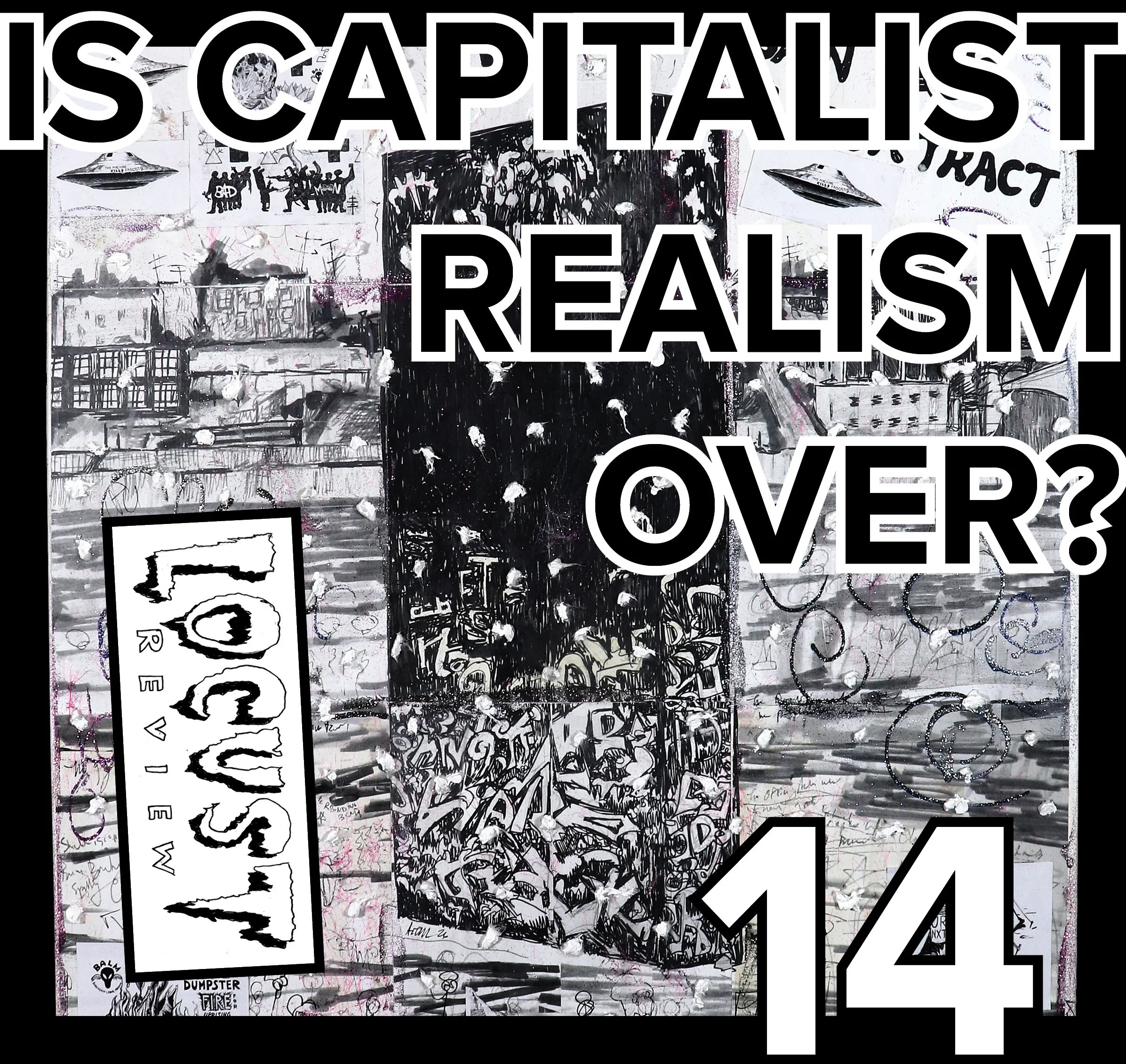
This article by April Miller will appear in Locust Review 14, “Is Capitalist Realism Over?”
WDM begins with a vision of “a future without capitalism” — even making reference to Fisher’s possibly apocryphal citation of Frederic Jameson that it is easier to imagine the end of the world than the end of capitalism. But the document’s preamble describes a slew of policies that would have been broadly compatible with the 20th-century Keynesian and State-Socialist paradigms: public ownership of major industries, an increase in free time, social security, free education, and so on. These things, like each and every demand in WDM, are eminently supportable and speak to the immediate needs and concerns of millions of people. If all the points in WDM were implemented in toto, it would represent an immense rupture with the political establishment and the power of the ruling class. But it wouldn’t be socialism.
Socialism lingers in the margins of WDM. The program even states that “just because [socialism] isn’t easy to imagine now, doesn’t mean we shouldn’t try to make it happen,” a noble recognition of political limits within the movement today. Each gesture WDM makes to “real democracy,” to “a classless society” where we “govern ourselves,” invokes a commitment to fight for something different. But all efforts towards clear definitions beyond 20th century legacy tropes exist purely within the realm of the negative: “a world without war and poverty,” or “a world where no one suffers for their race, gender, or religion, and everyone is free, equal, and cared for.”
At a previous time in the history of the socialist left, the task of sketching the beginnings of a new society was taken quite seriously. From pioneering works of science-fiction to the formulaic diagrams of Daniel DeLeon’s Socialist Labor Party, attention was given to designing not just the possibility but the reality of a postcapitalist world.
The history of 20th century socialism has cast an understandable shadow over this task. The twin determinist-fatalisms of Social Democracy and Stalinism, and consequently the crisis and collapse of these two trends and the mass parties they led, have relegated discourse over the shape of the future to the halls of economic abstraction — to a grand numbers game a dedicated cadre of critics and political economists conduct in perpetuity. The wider movement, meanwhile, either cheerleads all perceived sites of resistance to the main imperialist power, or limits the political horizon to immediate economic and democratic demands, with socialism relegated to a gesture of intent.
How to surmount this problem? How can the left reassert a transformative political horizon? While we cannot draw up a direct blueprint of a socialist society, as the DeLeonists had attempted, we know our basic starting point: social ownership of the economy, productive functions determined by use-value rather than exchange-value (by way of planning), and the radical extension of democracy into all fields of life. To carry out such a reorganization of society requires the end of capitalist class rule.
Mike Macnair, author of “Revolutionary Strategy,” posits that a fundamental strategic task for socialists is to articulate and build an alternative center of authority to the capitalist state. Whether you agree with Macnair and his adherents that such an alternative can be found in the form of a “democratic republic,” with the more popular (revolutionary) view that workers’ councils will play that role, or something else, one thing is certain: if the working class is to exercise collective control over society and the economy, it must be prepared politically to do so. This is the key to moving past both reformist and purely negative views of a socialist future.
A revolutionary recentering of self-organization and democracy in mass political practice can make concrete DSA’s programmatic commitment to socialism. That thousands of DSA members are already experiencing the beautiful mess of collective decision-making in their chapters, in their unions, and elsewhere, is a phenomenal thing. Many prominent DSA members such as Claire Valdez have already expressed the perspective of a radical expansion of democracy. But democratic practice and democratic thinking cannot stop when one exits a chapter meeting. Instead, there must be a conscious embrace of the experimental, “do-it-yourself” (DIY) character of much of DSA’s work.
The mass workers’ parties of the 20th century were scaffolded by an alternative social sphere capable of developing the social bonds and critical-creative faculties of workers who were to take on the task of administering society. A century later, DSA has the opportunity and obligation to rebuild something of this kind. Walter Benjamin left us with many things, among them the crucial point that it is not enough to “bring culture to the masses,” underlining the necessity to transform the social function of culture, and its relationship to the masses, to “turn spectators into collaborators.”
Humanity is in a dangerous moment. In the United States, we are seeing a decline in literacy. Approximately 45 million people have a reading level below the 5th-grade average, 21% of the population. The problem is getting worse, and it’s a strategic hurdle for socialists in a period of intense far-right disinformation. Paired with the near-omnipotence of media content by way of digital spaces, the ground is more fertile than ever for the fascist “aestheticization of politics.”
Socialists must respond by fusing our fight for better living standards and defense of democratic rights with a mass practice of popular education and the forging of a new working-class civil society. The mass support socialists have won for the “affordability agenda” (however undermined by mainstream Democrats) shows immense potential and that we have a responsibility to seize on. The reformist imaginary has its limits, but to identify a limit is the first step, not the last step, towards surpassing it. It is on this basis that we can begin to advance a political vision of a socialist future on a positive, unambiguous basis: a world where every cook can govern.
About the author
April Miller is a purveyor of ephemera, chronic oppositionist, and ultra-radical oat-sower. She is a member of North Brooklyn DSA and a masters student in Labor Studies at the City University of New York. April is on the editorial board of Reform & Revolution magazine and the former editor-in-chief of the Cooper Point Journal.