
The City at the End of Capitalism
I am mulling whether to do another run at Cyberpunk 2077. Help me… or don’t. There’s no real stakes here, except that I am not over it. It is an absolutely mesmerizing RPG [1]. I probably enjoy it so much because I didn’t play it in or around its launch in late-2020. I started after the Phantom Liberty expansion and several rounds of quality patches were added, vastly improving the game and its reputation.
I know you rigorously follow all the digressions in the footnotes, so you will have already read how I play a game like this for the story and do it on the easier modes. The story of Cyberpunk 2077 is sprawling, sometimes messy [2], frequently changing tone [3] and genre [4], often moving but also funny [5]. The NPCs are brilliantly characterized, even when some of them are infuriating or even offputting, as people often are IRL (“in real life”).
The most outstanding character, however, is the setting: Night City, a free city at the southern tip of Northern California, independent of the New United States of America. It is fictional [6] and exists within an alternative timeline, branching off from the one we know, sometime in the 1980s. It is overtly dystopian but, despite the nearly 90 years of differing history, most of its dysfunctions stem from dramatically accelerated trends we know from our existence.
It mostly clearly emerges as a character in its own right after the introductory chapter, after the flashback interlude where we meet Johnny Silverhand [7], during act two, when the player character, V, is adrift in Night City, without even having personal transport [8]. They are looking for work and looking for an answer to their predicament. Our V passes pedestrians, dodges oncoming cars, occasional gunfire and even a hit squad put out on them by the Maelstrom gang. Usually they end up resorting to public transport [9]. The question we will look at though is why? If you lived in a place like Night City, given any chance, you would leave as quickly as possible. Why go back? What is it that draws us to dystopia?
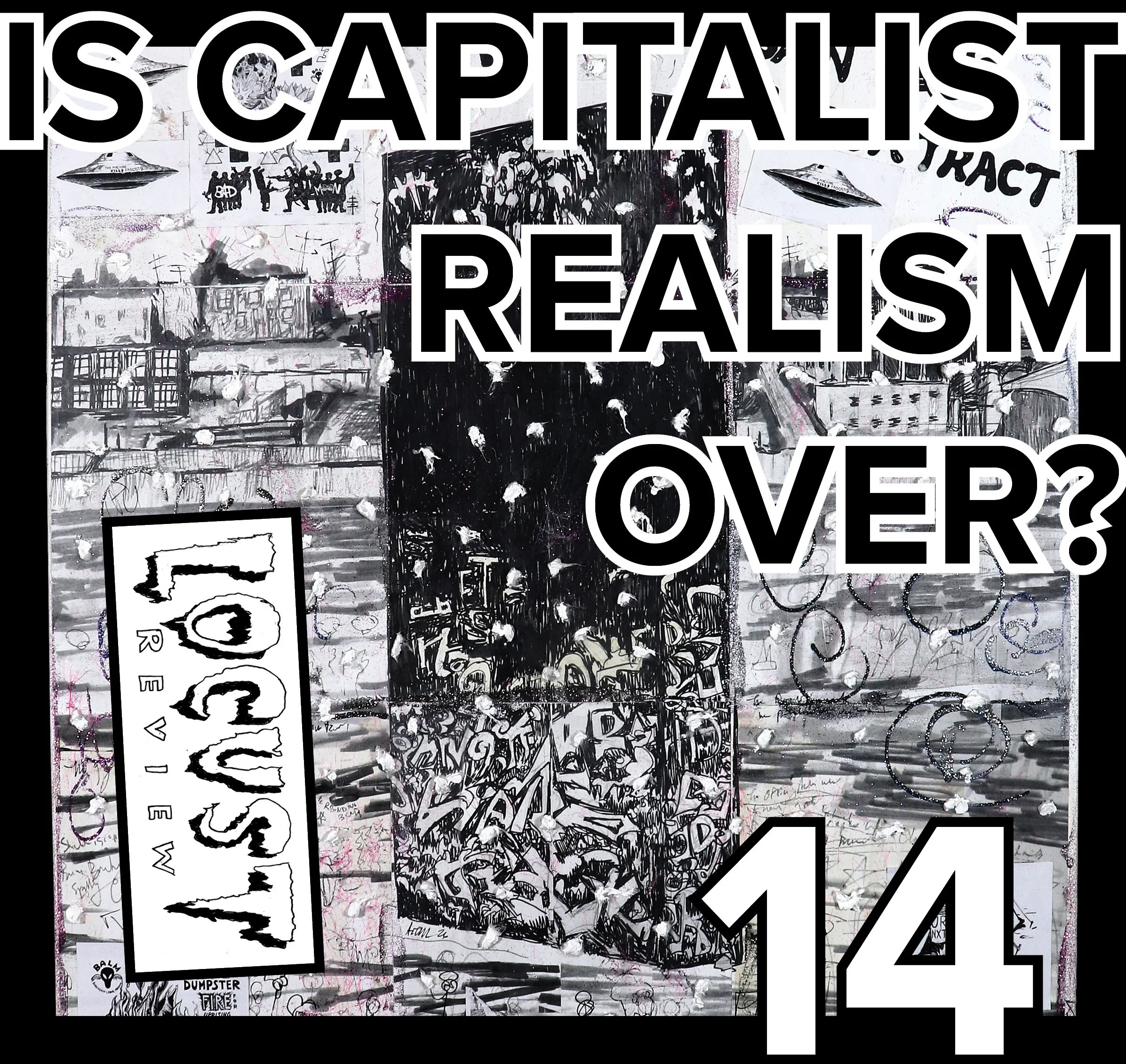
This essay by Adam Marks will appear in Locust Review 14, “Is Capitalist Realism Over?”
Or, Where is Dystopia?
I might be wrong but we are talking about a location in modern, popular culture. I don’t think dystopia was a place in people’s minds back in the Middle Ages, let alone at the twinkling dawn of history or in the long neolithic night [10]. We know its counterpart, utopia, a fictional society with highly desirable qualities, having been introduced to the modern definition by Thomas More in 1516 [11].
As well as wrong, I may well be eurocentric, but the renaissance and its disavowed twin, the reformation, dispelled the idea that civilisation sprang from some immutable source, whether natural or supernatural. Together they affirmed we made our societies ourselves and could quite clearly remake them. Since then, as a culture/cultures, we have held up both utopia and dystopia as symbols of alterity, to express this, often keeping them at not such a great distance from each other. The Communist Manifesto, for example, is utopian or dystopian depending on how you understand the dialectic of things such as abolition of private property [12].
In a world ruled by the maxim ‘There is No Alternative [13]’, the first attraction of dystopia is it shows there quite obviously is.
Dystopia at the End of Capitalist Realism [14]
We encounter Night City as its powerful contradictions are about to be dramatically inverted. It holds together, at least in 2077, quite absurdly, in the face of mounting obstacles to its social reproduction.
People in formal employment face greulling hours. Night Corp boasts of being the most employee-friendly firm, with a standard 80-hour week and five days of paid annual leave per year. In Night City, your employer is also likely your landlord and healthcare provider. Some firms, like Arasaka also practice formal indenture, lasting for decades [15].
Night City is one of the few places, fictional or IRL where paramedics are also paramilitaries. This is because of Night City’s astonishingly violent culture, comically lamp-shaded by the introductory monologue, which recaps the previous day’s mayhem, where confirmed murders rounded out to a “solid and sturdy thirty”[16].
On the screensaver, a statistic regularly flashes by, in 2076, the birthrate in NC declined by 7%. If that trend continues, Night City will be in line for zero births shortly after 2100 [17]. Flora and fauna have mostly been exterminated in Night City [18]. A fairly critical (not to mention brilliantly written and acted) scene between Takemura [19] and V, starts with “I would admire the view, if there was anything to admire” but quickly leads into Takemura’s surprise at spotting a cat, the first animal in Night City he had seen that wasn’t a cockroach. Such is his astonishment, he wonders if it might be a bakenko [20]. To the west of Night City, Coronado Bay is similarly lifeless, not just because of pollution, but also because of rogue, AI-guided mines placed during the Fourth Corporate War, which attack any vessel going out too far out [21].
I could go on, talking about the absurd pantomime of NC’s ‘democracy’ or its barren culture of stupendously crass advertisements [22]. Night City is clearly in a doom loop with no hope in sight. As Takemura points out in his row with V, who, other than corporations, has the means to keep order on the mess [23]? This, however, brings us to the second charm of dystopia, revealed in this tale.
The Restoration of Agency
Cyberpunk 2077 is many things. In its goofier moments it is, like the Witcher series [24], a power fantasy. Like Geralt of Rivia, V pays a price for their phenomenal endowments. Unlike Geralt, however, V is not an outcast, V is specifically nobody [25].
V is an accidental protagonist. Events, dystopian events, throw them into the narrative. Whatever their start in life, V and their Choom, an affable hoodlum called Jackie Welles are recruited to carry out an exceptionally ambitious heist that goes spectacularly wrong [26]. V first escapes, is then doomed, then redeemed, then doomed by their redemption. In trying to emancipate themselves, V is able to build and rebuild their body and mind because they are imbued with a biochip that, while it is killing them, enables them to withstand greater and greater levels of cybernetic enhancement.
This contrasts with the original tabletop games, where players can enhance themselves but at the cost of losing their humanity (a core game stat) and risking permanent cyberpsychosis [27]. It also contrasts with the Netflix animation, Cyberpunk Edgerunners. Set a year before the events of 2077, it features a similarly reluctant protagonist, a boy called David Martinez, who, through this particular story, also imbues himself with similar enhancements [28]. He believes he is special, immune to the effects of cyberware. The obvious tragedy is he is not.
I may have an insufferable, bombastic streak but in the way I play V however, they turn from a grasping (overreaching) mercenary, into a dramatic agent of change. This particular V is like the coming of Merry and Pippin into Fangorn Forest [29]. There are multiple opportunities to take this course of action [30]. V can ally with Panam Palmer and reunite the Aldecaldos [31]. V can steal a truck full of medical equipment so El Capitan can start a pro-bono clinic in Santo Domingo. V can support Judy’s scheme to violently evict the Tyger Claw pimps from Clouds [32]. This V can even fight off an entire delta force, sent by the President of the NUSA, to take back her cybernetic slave/human bomb [33].
V’s rise, fall, rise and… uncertain fate means there is a glimmer of hope within Night City [34]. This is in part they are thrown back onto their own resources and partly because:
Cybernetics are the Fast Track to Identity Formation
Cyberpunk 2077 is something like a dream. The story’s slippery logic is most apparent in the Johnny Silverhand flashbacks. You only need to give them a moment’s thought to realise they don’t make a lick of sense [35]. After being imbued with biochip, V’s waking moments hardly obey sense either. Very few of the quests given to them are timebound, despite the very clear limitation set in-story [36]. The game, as such, is not a task list to get through but a set of decisions to make and an identity to form [37].
It’s not an accident every lifepath V can start on, we meet them looking into a mirror. Their image and agency is whole at that point [38]. At the climax of the opening act, V is looking again into a mirror. You have the choice [39] to break the mirror or not. V’s image is no longer whole and their agency is, of course, about to be similarly shattered.
Except for occasional returns to a mirror, we do not see V for the rest of the game, until the ultimate ending, when V is finally free not just of Johnny but the second, unacknowledged passenger in their life, and the camera-view withdraws. To journey through this dystopia we make and remake ourselves through V and their cybernetic transformations. Though there is a hurdle to get over.
Cybernetics and Trauma [40]
We touched briefly on the Cyberpunk spin-off anime. In narrative it is a classical tragedy, the hero is both raised up and destroyed by the one and the same event/decision in their lives. In visuals, though, it is an understated horror. An example:
David Martinez's inciting incident is seeing his mother [41] gunned to death on an NC highway. After her passing, David discovers she was trading cyberware under the counter to criminals. She used the proceeds of this trade to fund his attendance at an elite Arasaka-run school. He takes a purloined sandesvistan [42] to a backstreet clinician, known simply as ‘Doc’[43] and persuades Doc to graft it onto him. Doc agrees [44], rises from his chair with a truly lurid smile and selects the right pair of cyberhands for the job, revealing (to the viewer) his natural arms as mere stumps.
Hopefully not to infodump too much, the best in-game example is Songbird from Phantom Liberty. After hitting a tantalising dead end with the encounter with the Voodoo Boys [45] V is contacted by a mysterious person calling themselves ‘Songbird’. Songbird seems to know a lot about their predicament [46]. They tell V they know how to find a cure for them. They must, however, help Songbird in return… V agrees [47] and one of the most compelling, extended action sequences begins.
We first ‘see’ Songbird at the gates of Dogtown, a Vatican-sized city-within-a-city, claimed by an NUSA officer turned warlord called Kurt Hansen. Songbird is a woman in her early thirties, slim with shoulder-length hair, wearing a tough-looking grey and black leather outfit. She is clearly an exceptional netrunner, able to remotely project herself into V’s psyche using the Relic, even temporarily silencing Johnny. This is how we know her until, several dramatic escapades later, we meet her in person. This time we see her, at first, from behind, on the mezzanine of the Black Sapphire48. We realise Songbird is so enhanced she is more machine than human. The projection we have known so far is just that, Songbird before she was pressganged into the Federal Intelligence Agency, when she was untraumatised and whole [49].
The world of Night City is a nightmare. People are physically and psychically wounded by capitalism in excelsis. The etymology of trauma comes directly from the ancient Greek for ‘wound’ but it also gives us the German word ‘traum’, meaning dream. Dreaming is the body’s answer to trauma.
Early in the game [50] V meets their second questgiver, a cliched but charismatic femme fatale called Evelyn Parker. She wants to put together an audacious heist, stealing a valuable piece of tech from a very important client [51]. Evelyn introduces us to Judy Alvarez, the best Brain Dance Editor in Night City [52]. Both V and the player are given a tutorial in brain dance technology. It allows us to experience other people’s lives as (essentially) a potent dream. To begin, you are told to look into the alternately flashing lights. It is an almost one-to-one recreation of EMDR therapy53 the cutting edge of trauma treatment, imitating the REM state in waking patients.
If a braindance is dreaming and dreaming tackles trauma, does this story show a way out of the nightmare? Night City encourages dependence and addiction to cybernetic enhancement. There are few characters you can meet who are fully ‘ganic [54]. Though there are poor and even destitute people with cybernetic enhancements, cyberware is usually a sign of social status. Part of Goro Takemura’s fall is that his top of the range cyberware, provided by Arasaka, is immediately disabled. Cyberware is a golden chain binding people to the Very Late Capitalism in Night City. Citizens struggle to live either with or without it.
Like social media, AI or nuclear power, it’s tough to uninvent this technology. Instead we should find a way to integrate it into a higher social form.
Two Souls Within You
In the course of their adventures V meets two very mysterious, apparently powerful characters. There is Mr Blue Eyes, who is a lurking presence in some main story chapters, very prominent in the Peralez story and, should V choose the ultimate path of glory and successfully attack Arasaka Tower alone, Mr Blue Eyes will approach V, after their separation from Johnny, for One Last Job. Mr Blue Eyes is at absolute best an ambivalent figure.
The Zen Master, who is quite possibly the digitised revenant of Rache Bartmoss [55], seems to be benign. He appears only to lost folk in need of guidance. He first meets V in the aptly named Reconciliation Park [56].
Night City is full of bhikkhu. They don’t seem to be concentrated in any kind of temple, though they are sometimes found praying next to the odd, multiarmed statues dotted around the city. In 2077 buddhist monks abjure cyberware as a point of faith. This is a specific point in the quest, Losing My Religion, which begins when V finds a despairing monk who has been desecrated by members of Maelstrom.
The Zen Master [57] is different. We meet him in the park [58]. He offers our V a ‘meditative braindance’ as a way of healing them. We can pay the Zen Master whatever we see fit. If we do remunerate him we use the customary method, cybertransfer [59]. His eyes glow blue when the credit is received. The Zen Master is not who he seems.
Nonetheless, we meet the Zen Master four times. He gives us four meditations [60] based on the classical elements. Before the final meditation, called Imagine, we are allowed to ask him one question. Each question option (and answer) pertains to V’s predicament. The most insightful interaction is:
V: What is happening to me?
Zen Master: You are dying. You have two souls within you. One wants to fight, the other is afraid.
V: Which one is mine?
Zen Master: Both [61].
The Bartmoss Collective, which pesters V early on in the game with anticapitalist text spam, assures the good people of Night City the escape from capitalism is through ‘uninterrupted meditation [62]. In my interpretation of these encounters [63], the Zen Master, who is Rache Bartmoss from the Cyberbeyond, is trying to reconcile V, the commonplace zero struggling to survive, to the events that united them with Johnny Silverhand, the great dreamer, the unique number one, together as the reluctant binary code that can free the people of Night City.
Extending this metaphor, the misery that is upon us IRL cannot be undone. We are the angel of history, looking backwards, seeing only a trail of carnage. Capitalism has done awful things to us but those awful things have prepared us to carry out capitalism’s overthrow. In the end, V (and Johnny) let go of their past [64], including their old ideas of what they would have become, to effect their last, most radical transformation. V and Jonny go their separate ways in Mikoshi, accepting each other and their destinies:
“Goodbye, V and… never stop fighting.”
About the author
Adam Marks is an award-losing author, shitposter, Bolshevik and adopted Welsh Republican, living and working in Caerdydd, Cymru.
Endnotes
1. Meaning a Role Playing Game: Cyberpunk was originally a Table Top Role-Playing Game (TTRPG) series, created by a game designer called Mike Pondsmith: https://cyberpunk.fandom.com/wiki/Mike_Pondsmith. The ‘game’ in these scenarios, in my opinion, is the collective telling of a story. This is the Good Reason why I play games like these on fairly easy modes. I don’t need to have exceptional hand-eye dexterity and the right fine-motor skills to enjoy a story. The Real Reason is, perhaps, that I don’t have exceptional hand-eye dexterity or fine-motor skills to begin with.
2. A fascinating, semi-vital character called Kerry Eurodyne is not introduced until, more or less, the Third Act of the game, after Johnny takes V to the Pistis Sofia and after they together attempt to reconnect with Rogue Amendiares. The Kerry chapters work as comic relief and character study but divert from the overall tale which, bear in mind, is governed by the ticking clock inside V’s skull.
3. Gigs and Side Jobs are jewels in the game’s crown. When you accept work from Regina Jones in Watson, in between finding a way to incapacitate, rather than kill cyberpsychos (a tricky thing), you can be dragged into numerous true-crime tales. As well as stealing cars, you can take jobs for Muamar Reyes in Santo Domingo that increasingly make your V a small-time Robin Hood, culminating in stealing a truck full of medicine to help the sick and dying children of the district. You can also have a katana fight in a high-end clothing outlet, recover a cyberdeck from a dead man in a fridge and regularly talk to the friendliest AI ever to inhabit a vending machine.
4. Depending (sometimes) on your choices, Cyberpunk changes from crime, to gangster tale, eldritch horror to existential meditation, scavenger hunt to spy thriller.
5. V and Johnny are a natural comic duo.
6. Well, duh.
7. One of the most endearing characters I know who, mostly, just delivers exposition.
8. Night City is also hostile to pedestrians.
9. The horror!
10. I will accept arguments about, maybe, the first chapter of the Communist Manifesto: https://www.marxists.org/archive/marx/works/1848/communist-manifesto/ch01.htm, or the biblical connotations drawn from literal locations like Gehenna: https://en.wikipedia.org/wiki/Gehenna.
11. https://en.wikipedia.org/wiki/Utopia_(book)
12. “You are horrified at our intending to do away with private property. But in your existing society, private property is already done away with for nine-tenths of the population; its existence for the few is solely due to its non-existence in the hands of those nine-tenths.”
13. https://en.wikipedia.org/wiki/Capitalist_Realism
14. We’re going to bypass all far-right dystopia for now. I had a plan for a section about covid conspiracies, Q Anon, two-tier policing, the stab-in-the-back theory etc, but that would be too much of a topical leap. I am also going to leave what, for me, are mostly left-liberal critiques of the story unanswered. Some of them are full-on hot-take-industry nonsense, other, more good-faith critiques stem from the fact the Cyberpunk universe is a provocation, and provocations can’t really be provocations without getting some hostile reactions.
15. https://cyberpunk.fandom.com/wiki/Big_5_Employers_in_Night_City_%E2%80%93_2077
16. “Ten outta Heywood”: https://youtu.be/gt943-HQzGc?si=HTJ-fVMxn90vPegP
17. For a bunch more eye-catching facts, so to speak, try: https://gamerant.com/cyberpunk-2077-things-never-knew-night-city/
18. https://cyberpunk.fandom.com/wiki/Wildlife
19. A ronin of the Arasaka corporation, thrown into more or less the same predicament as V by the fallout of the Konpeki Plaza heist. Unlike V, Takamura is motivated by the wish to be restored to grace with the corporation.
20. https://yokai.com/bakeneko/?srsltid=AfmBOooZqrYvFB1yzYiRlIUoJOC3edA_-5XJUZPDskJ72BTc5XKYpO6e
21. https://cyberpunk.fandom.com/wiki/Del_Coronado_Bay#2070s
22. Though its radio stations are pretty good. My favourites (in-game) are Pacific Dreams, Body Heat and Royal Blue Radio. Morro Rock is also worth a listen, not just for the music but the incredible stories and wild rumours passed on by its resident DJ, Maximum Mike. Back to the point though, live music in Night City is dominated by truly ancient acts like Kerry Eurodyne, Cartesian Duellists and the treasured memory of Samurai.
23. A clearly Bad Faith argument, which V more or less gets at. Who, other than corporations, is to blame for Night City’s violent decay? It’s worth noting, as I may well do a little further down, there is no remotely potent rival to corporate hegemony except, perhaps, the Aldecaldos camped on the city’s outskirts?
24. Also made by CD Projekt Red: https://www.cdprojektred.com/en
25. To begin with…
26. There is substantial online dialogue about how the Konpeki Plaza heist was always doomed and maybe even a set up: https://youtu.be/kro6s7vkJe4?si=uTIblPr7AwgwSp7c
27. A dissociative disorder caused by augmentation: https://cyberpunk.fandom.com/wiki/Cyberpsychosis
28. Leading to some underplayed if truly gruesome body horror. Even before David succumbs to madness, look at what’s left of him by the time he climbs into the cyberskeleton.
29. A small stone falling that starts an avalanche.
30. You can play V in a way that does not reconcile with Johnny Silverhand. You are left with few options and the consequences of this… hmm.
31. The Aldecaldo clan is the closest thing Night City has to a collective agency, definitely egalitarian, somewhat democratic. Until (maybe) River Ward follows through on his implied end-of-game promise to create a small urban army, the Aldecaldos are the only organisation willing and able to contend with the will of Night City’s corporate rulers. Interestingly, all other organisations, both gangs and corporations are riven with deadly factional conflict. Panam and Saul can and do resolve their differences in peace.
32. Have you ever thrown a sadistic pimp off a skyscraper roof? It’s quite a head trip.
33. The right course of action in Phantom Liberty though, again, there’s a heck of a price to pay. You will face down another superbly written (and acted) character called Solomon Reed. Functionally President Myers’ own Takemura, he is likewise a very sympathetic, almost-antagonist who, nonetheless… in my humble opinion, you must oppose.
34. “Queen Lillith” can no longer “conceal the Tenth Circle from the ancestors' eyes.”
35. Until we acknowledge the true, psychological and practical function of dreaming.
36. Some are. The game mechanics are a little tricky in this regard. Similarly, it is slightly frustrating, because there is no 3rd person gameplay, there are cutscenes that look like gameplay and gameplay that looks like cut scenes. Never let your guard down.
37. The player is the true outside agent in V’s existence. The players are (sort of) acknowledged, in a sense, in canon, by the FF06B5/Magenta Mystery, a remarkable Alternate Reality Game that was played between the game developers and gamers themselves as the Cyberpunk was repaired/rebuilt across several years: https://www.youtube.com/watch?v=6gJJ-c0c8CU
38. V either wipes the mirror, resets their broken nose or vomits.
39. I say ‘choice’ but, canonically speaking, you have to choose this.
40. A lot of the better faith critique of cyberpunk is based on its depictions of trauma. The cyberpunk universe depicts a world where sexism in particular, has not been overcome. Even with good intentions, it is difficult to portray this kind of subject matter and not stray into bad taste.
41. Who is an Arasaka employee.
42. A device that, in universe, is grafted onto the subject’s spine and vastly improves their reflexes. When activated, in effect it slows time for the wearer.
43. From whom David had previously been buying illegal XBDs.
44. Out of seeming curiosity; “Fuck it then, I’ll bite.”
45. This is a digression however, the treatment of race in Cyberpunk is interesting. The racism that we know and loathe from our society seems to be mostly absent in the Cyberpunk timeline. The Sixth Street gang for example, though they may be right wing and are definitely gung-ho patriots of the NUSA, they are very definitely racially integrated. In the original tabletop game the Voodoo Boys (a netrunning gang) were depicted as culturally appropriative white guys. In 2077 they are instead actual refugees from Haiti (which has been flooded off the map). They ironically adopt the name given to them by NC street culture. The only systemically oppressed people in this timeline seem to be the Nomads, internal refugees who are drawn equally from Native Americans and dispossessed farmers
46. The NUSA knows a lot about V. There is a computer on the crashed Spaceforce One, with a file detailing what happened at Konpeki Plaza. If you upload the file, it becomes the first all-is-not-what-it-seems moment.
47. There is the option to not help Songbird and President Myers. If you want to you can watch Spaceforce One fall to the doom of everyone onboard, but why would you do that?
48. A casino that is simultaneously a fortress and playground for Hansen and his soldiers.
49. Later on, if we side with Reed at a crucial moment, in between being chased by a terrifying, AI-driven robot that cannot be fought, only escaped from, we are shown scenes from Songbird’s life, when she was known as Song So-Mi, we see her being blackmailed by Solomon Reed, trapped by the Phantom Liberty he offers to all FIA recruits.
50. I usually reach this point after the encounter with the Maelstrom gang in the All-Foods factory. You reach the point where, in my opinion, you realise V always should be played as a woman. Having been made to sit by Dum-Dum, the gang leader Royce bursts into the room and attempts to bully V into paying twice. He makes the fatal mistake of laughing at her. He turns his back, V rises from her chair and in one splendidly fluent movement sticks a gun under his chin. “I’ve had enough.” Bang. No one ever underestimates V again.
51. Evelyn is opaque and evasive about both her motives and the significance of the tech. Maybe I’m a sucker but, for me, it’s testament to the writing how we willingly overlook what should be stunningly bright red-flags.
52. Judy is my absolute favourite character. While she has her own moral greyness, Judy is truly endearing. Panam may be mesmerising as Boudica on a Desert Bike, Judy is the beating heart of this story.
53. https://www.mind.org.uk/information-support/drugs-and-treatments/talking-therapy-and-counselling/emdr/
54. One of them is Claire Russell, a bartender and transgender woman. She talks about her old life with her deceased husband. Before he died, Claire half-promised her husband she would get ‘chipped’ for the first time, but did not truly want to go through with it, saying, in the present, how she loved machines but did not want to become one.
55. For more on the People’s Maniac, read: https://cyberpunk.fandom.com/wiki/Rache_Bartmoss
56. A part of downtown Night City that may once have been beautiful but in 2077 is a rubbish strewn midden.
57. As he is referred to by others. He does not answer to any name.
58. His soft voice dramatically cuts through the hubbub.
59. Money in the world of Cyberpunk is interesting. You do occasionally see physical rolls of cash, though there aren’t any commercial banks in Night City to hold or distribute them. Mostly though, you buy and sell things through a distributed ledger in your cyberware. A genuine socialist democracy will keep account through social credit, where banking would be an open, public enterprise. NUSA and Free States citizens clearly treat money as social credit but, given that cyberware is key to corporate domination, firms like Militech and Arasaka are clearly the bodies issuing credit, not the democratically organised people.
60. Based on the four western classical elements, earth, water, wind and fire; not, interestingly, the wu xing model of the universe. He eschews the fifth element, metal, a feature of the wu xing model. He is not what he seems.
61. Note: This time, V squeezes an extra question in and gets an extra answer… this is the most important question.
62. The first time I saw this message I read it as ‘mediation’ but did a double-take. It is meditation.
63. An important caveat, we are not doing the kind of analysis where we ask an artist or artists to faithfully reflect our worldview, we’re not asking work of art to do politics for us. We are simply expressing something we have found in it, a piece of ourselves.
64. Which by this point are one and the same.