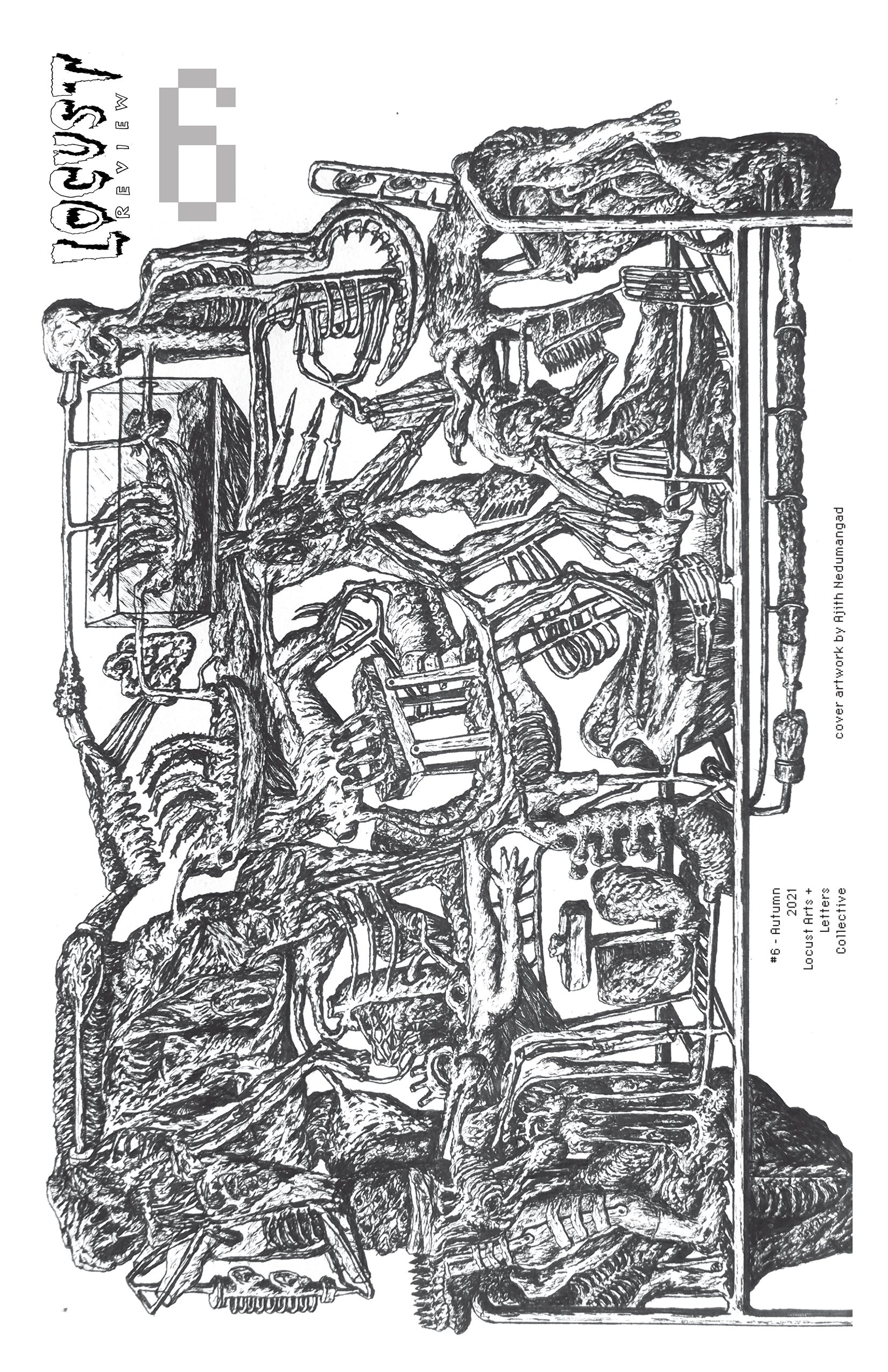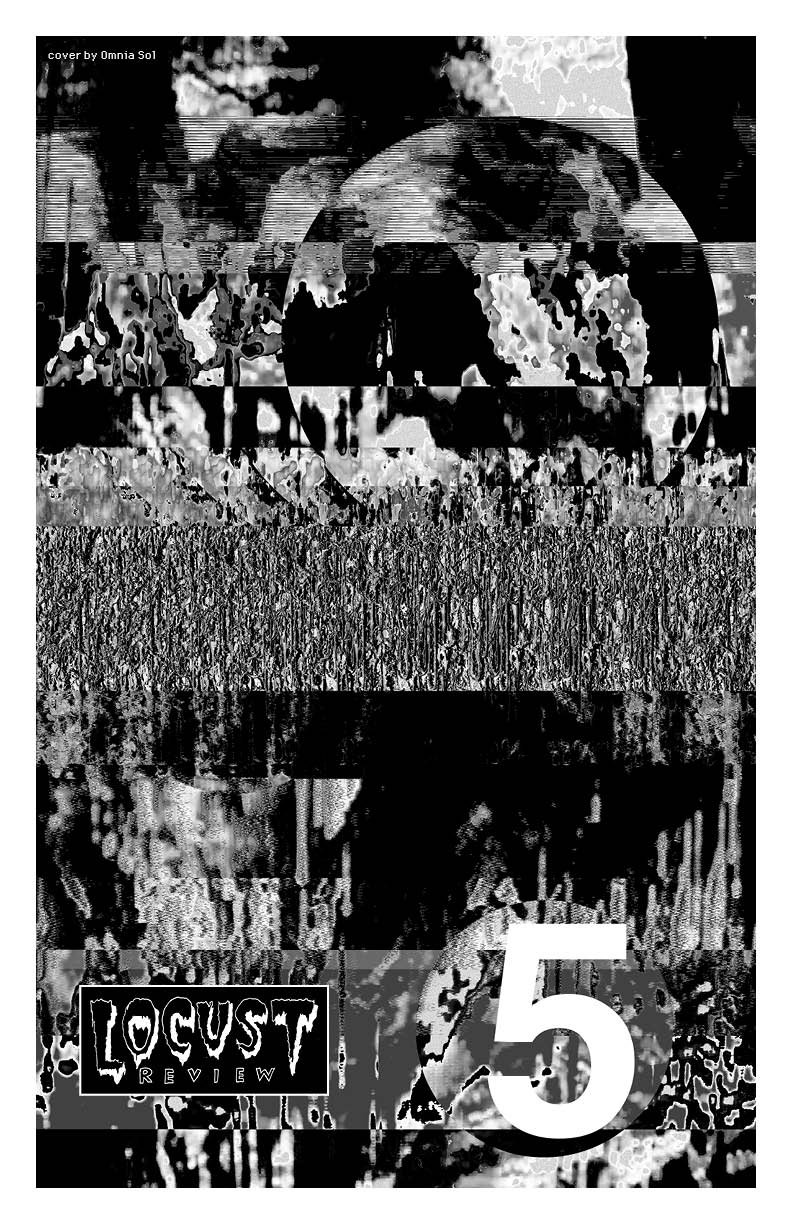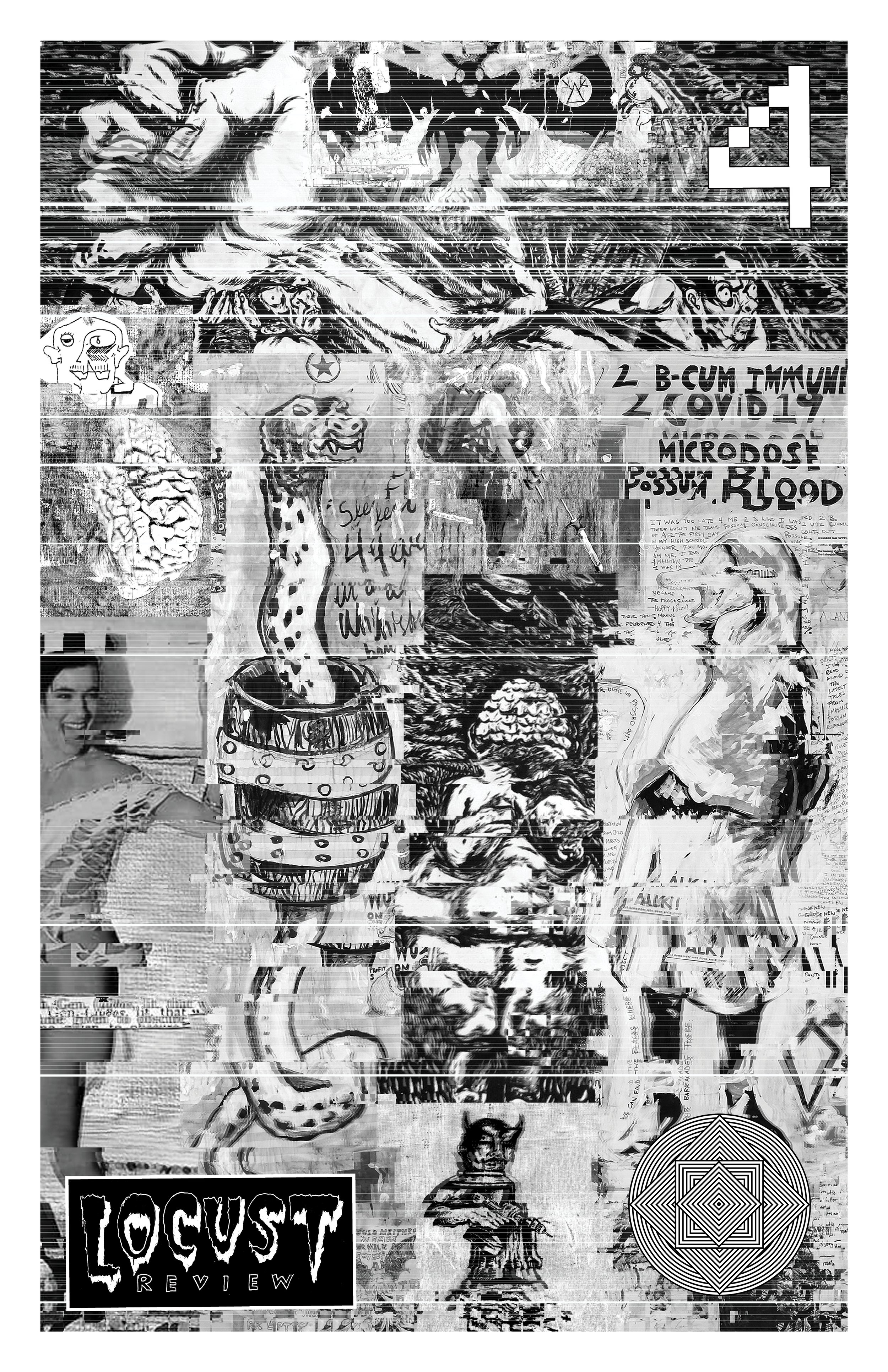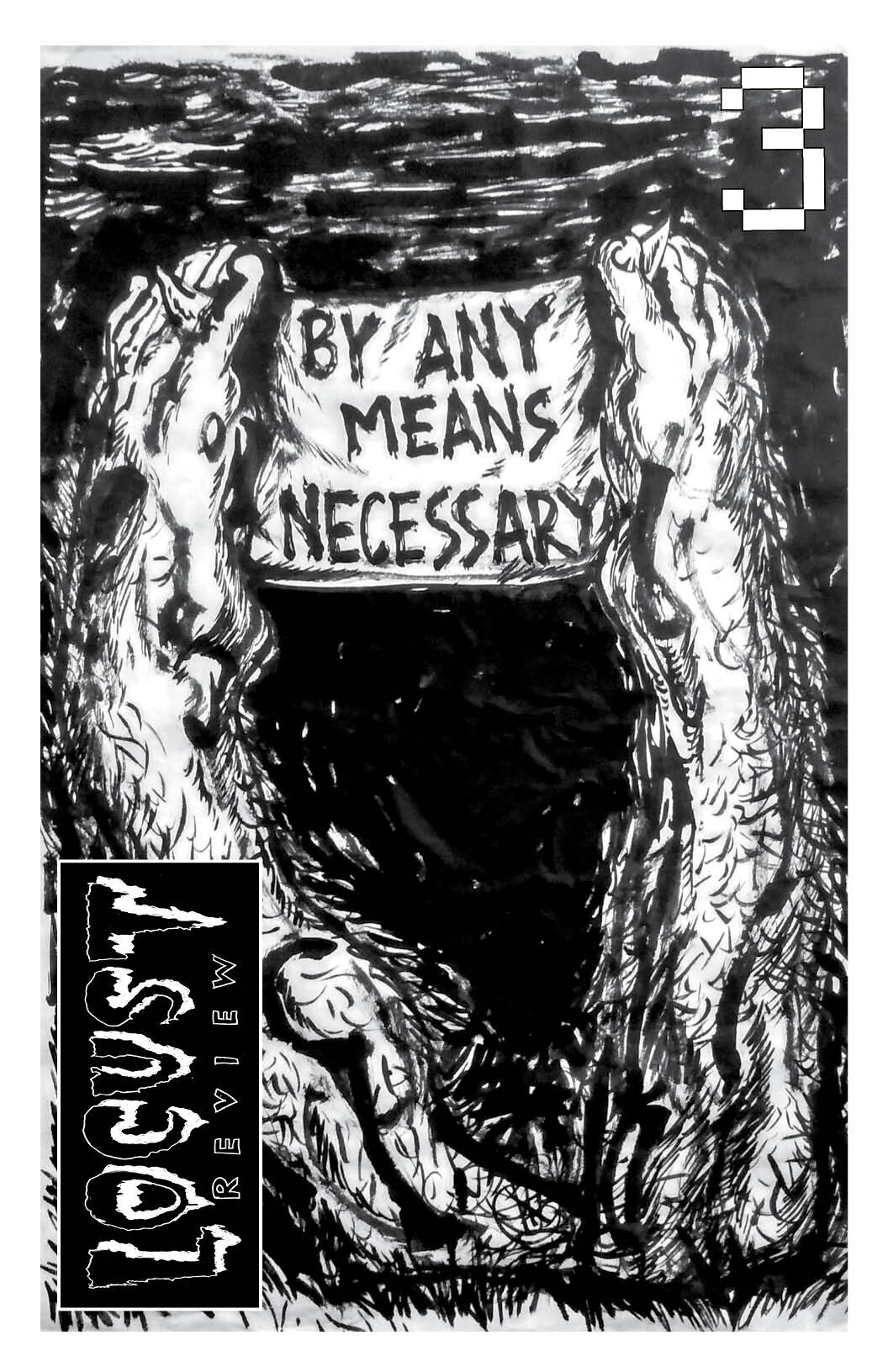
We are finalizing Locust Review 14, “Is Capitalist Realism Over?” Locust Review has always been influenced by Mark Fisher’s discussion of capitalist realism. But what if capitalist realism — tied to the political center — is over? As AI slop is weaponized into fascist aesthetics, as the ghosts of Stalin and Kautsky are resurrected on the left, as absurdities mount, has the mainstream prohibition on radical alternatives morphed into something else? Locust Review 14 will feature:
As AI slop is weaponized into fascist aesthetics, as the ghosts of Stalin and Kautsky are resurrected on the left, as absurdities mount, has the mainstream prohibition on radical alternatives morphed into something else? To what degree have elements of capitalist realism — market Stalinism, business ontology, depressive hedonia, reflexive impotence — attenuated, allowing the return of “grand narratives,” however weakened? To what extent do these dynamics continue, including within the left itself? And what does it all mean for the working-class, the Left, and art?
Math and bigotry seem to be the main coping mechanisms of the US capitalist class. Math provides the utopia — through technology and AI — as well as fixes election results, fixes labor, fixes society. At the same time, bigotry is being used as a cudgel, in part, to obscure the shifting algorithms of capital. Altogether this is a response to climate disaster and imperial decline, creating concentric racist circles of automated fortress.

As the US empire declines, avenues for middle-class advancement, historically tied to racism and imperialism, have declined. Running out of its traditional gambling venues, the American middle-class -- and parts of the ruling-class -- bet on Trumpism, racism, and fascism.

American fascism has a plastic shopping mall nostalgia. It is the fascism, not of a young empire thwarted, but an empire in decline. It is, at one level, a photograph of an abandoned Pizza Hut with the caption “This is what they took from us.”

As part of a reorganization at Locust, we are seeking art, poetry and fiction, but also non-fiction, essays and reviews for the upcoming issue. Fiction submissions should be less than 3,500 words. Poetry submissions should be less than four pages. Non-fiction submissions should be less than 5,000 words for essays and less than 2,500 words for reviews. Images should be submitted in jpg format at 300 dpi, and at least eight inches in one dimension, and be accompanied by the title, date, and materials used in creating the work.

The multiverse trope in contemporary culture is overdetermined. It is ideological. It flows with the fragmented totality of an attenuating neoliberalism. It is also a result of the economy of digital media. On streaming services, the multiverse tropes of Star Trek, Star Wars, Marvel, and other intellectual property franchises reflect the expansion of an attention economy. Disney’s acquisition of Lucasfilm and Star Wars for more than four billion dollars requires the maximization of content production to realize future profits. A steady output of content must be produced to capture attention. In this way, the multiverse trope is also phenomenological. Digital media, along with the chaos of gig economics and neoliberal precarity, create a sense of “everything everywhere all at once.”

How do you dismantle a conspiracy theory? Through simple logic? A counter delirium? How do you disrupt — or gesture to disrupt — bland technophilia? Do you point out how the dystopian dreams of the tech billionaires will fail? Or, that they will work all too well? For the well-heeled, does the uncertain future overwhelm the comforts of the present? For the rest of us, does precarity overwhelm efforts to salvage the future?

The formation of the proletariat by capital’s historic crimes — and the ongoing recomposition of the class by imperialism, racism, heterosexism, and immiseration — is not unlike the creation of Frankenstein’s monster. The working-class, as a whole, is a disordered and chaotic body. Labor was (and is) formed through the theft of forests, farms, continents, and people. It was (and is) formed in the creation and displacement of entire industries, gender norms and the shifts in social reproduction, the invention of “races” and “nations.” The targets of capital’s crimes were (and continually are) fused together and torn apart in their relation to capital. Labor does not become a class “for itself” by pretending otherwise. It must study the journals of the “men who made it.” But the class becomes conscious when each disordered element of the class defends every other disordered element.

There are, culturally and in actuality, their “monsters” and our “monsters.” Our rulers describe whole sections of the working-class and subaltern in terms borrowed from various folk and other horrors. They demonize people by race and caste. They stoke fears of crime, exaggerated and irrational, even as they drive the entire world toward war and climate disaster. As they steal the wealth created by our labor. As they loot entire nations.

The following editorial was published in Locust Review #9 and written in late fall (2022): There is a prevailing sense of being under siege. It is felt in our bones. It turns our stomachs inside-out. It chokes our arteries with anxiety.

Please send submissions — artwork, poetry, fiction, creative nonfiction, short essays, and so on — to locust.review@gmail.com by October 31st.

Dear comrades-descendants, the labourers of the 20th century are writing to you. Tell your children and grandchildren how we struggled for your right to immortality. We lived in heroic times when great discoveries were made, when the world was shaken by revolutions and wars burned the planet. […] You have probably already eliminated all harmful bacteria and viruses and live without ageing or sickness. But it was us who helped you in this, when we discovered the mysteries of cancer and overcame the barrier of tissue incompatibility.

Early in US history, graveyards were chaotic tumbles in the middle of cities. In the late 19th century, however, there was a suburbanization of death. Large new cemeteries were built in the farmlands and woods outside town. The ramshackle graves in the cities were sometimes a health hazard but also a site of ideological discomfort for the bourgeoisie. In Chicago, the silty earth near Lake Michigan would sometimes belch up a buried corpse. Wealthy cosmopolitans increasingly envisioned grassy fields with trees housing family mausoleums like estate mansions. Such stately accommodations were out of the reach for workers. For the poor there was a potter’s field.

We can still dream… for now. Throughout all of the darkness, we have managed to hope for something better. And behind that hope, there is always that word. Less a word than an idea, a longing, whose open description has come to be scoffed at in adult conversation. Utopia.

The discounted gift subscription rate will be available through January 15, 2022. In addition to the standard subscription packages, all gift subscriptions will include an additional copy of Locust #6 and Imago #1.

WHAT IF we become cyborgs right before the world ends, and because we are cyborgs we can no longer fear the apocalypse? Does the glowing sky on fire become, in our minds, an Instagram filter?

The Locust Arts & Letters Collective will be presenting a panel at Historical Materialism Online 2021, the replacement for HM’s conference that normally takes place in London in early November.

“Are you employed sir?”
“Employed?”
“You don’t go out looking for a job dressed like that? On a weekday?”
“Is this a… what day is this?”
-- exchange between Jeffrey Lebowski and the Dude

When more and more disasters are reached — in the form of personal catastrophe, a continent on fire, a city underwater, a state without water and electricity, a plague uncontrolled, a planet on the verge of ecological catastrophe — capitalist realism can only shrug (and hone new forms of disaster capitalism).

So send us what you have – your art, your poetry, your fiction, your odd ephemera – and remember that we only ask it be weird, strange, experimental, and that it cling to the dreams of liberation and the hopes of radical transformation.

How strange does sunlight seem to us now? Or seeing someone we haven’t seen in a year? Perhaps… even shaking hands with them? What is the odd-but-familiar sensation we call touch? And what does it mean on this dying rock? What does it mean for our hope and despair to be simultaneously so attenuated?

“I wanted to greet you, welcome you, embrace you, but ‘Normal’ kept getting in the way. I wish you, the Old King, the New King, and the Old King’s soldiers, good luck.”

Submissions are now open. As always, we want your words and images, your prose and poetry, your “this doesn’t quite fit in a normal world, in more than one way.” It needs a place. We have always sought to give it a place. We reckon, as the world spasms and unravels in so many unpredictable directions, it will continue to need a place.

Join us on Thursday, November 12 (18:30 GMT, 1:30pm EST, 12:30pm CST, 10:30am PST) for a Locust Review panel discussion at this year’s (virtual) Historical Materialism conference. Our panel, focusing on “Irrealism as Socialist Cultural Strategy” will feature Locust editorial collective members Alexander Billet on “The Case for Critical Irrealism,” Holly Lewis on “How Collective Dreams Can End the Sleep of Reason,” Adam Turl on “Their Weird and Ours: Socialist Irrealism vs. Fascist Occultism,” and Anupam Roy on “Representational Impossibility: A Propagandist’s Urgencies and Crisis.” More information follows below.

Attention humans. We at Locust Review are pleased to announce SWARMCAST, a monthly podcast on the weird, the political, and where they intersect in fiction, art, poetry and creativity. Hosted by LR editors Tish Markley, Adam Turl and Alexander Billet, SWARMCAST will feature discussions of the radical weird, history and current events, interviews with artists, writers, and musicians, readings of poetry and fiction from contributors to LR, and even the occasional comedy performance.

We found the corpse of Capitalist Realism. Rona-riddled, the initials “ACAB” carved in its forehead. It was discovered in the burnt shell of a Minneapolis police station. On discovery it opened its eyes and stood up and told us to go back to work. We refused. It reached for us, moaning a voracious hunger of unholy sadism, unquenchable violence, an unknowable cosmic horror, stinking of gout and fresh teargas.

“BE REALISTIC” we are told. The weather is rejecting us, fascism has resurrected itself, pogroms rage, new pandemics knock on our doors, and yet, “be realistic.”
“Be realistic.” The favorite refrain of those who, in their blindness to history, allow history to be changed in ways they cannot understand. “Be realistic.” The slogan of those who love their power and privilege while denying they have any of it. “Be realistic.” The bootlicker’s mantra, chanted when the independent thoughts they have repressed begin to surface.

Now here we are. A global pandemic. We are stuck at home, that voice asking “what about the rent?” or “what happens if you lose your job?” or can’t get unemployment getting louder and louder. Or we are saddled with that ignominious label of “essential worker,” unprotected, likely underpaid, always exhausted, always at risk.

Locust Review #2 is finally in the mail. We’re sorry that we were so delayed mailing out the issue. Of course this four-week delay was largely due to the pandemic and its related social crises and catastrophes, struggles and horrors.
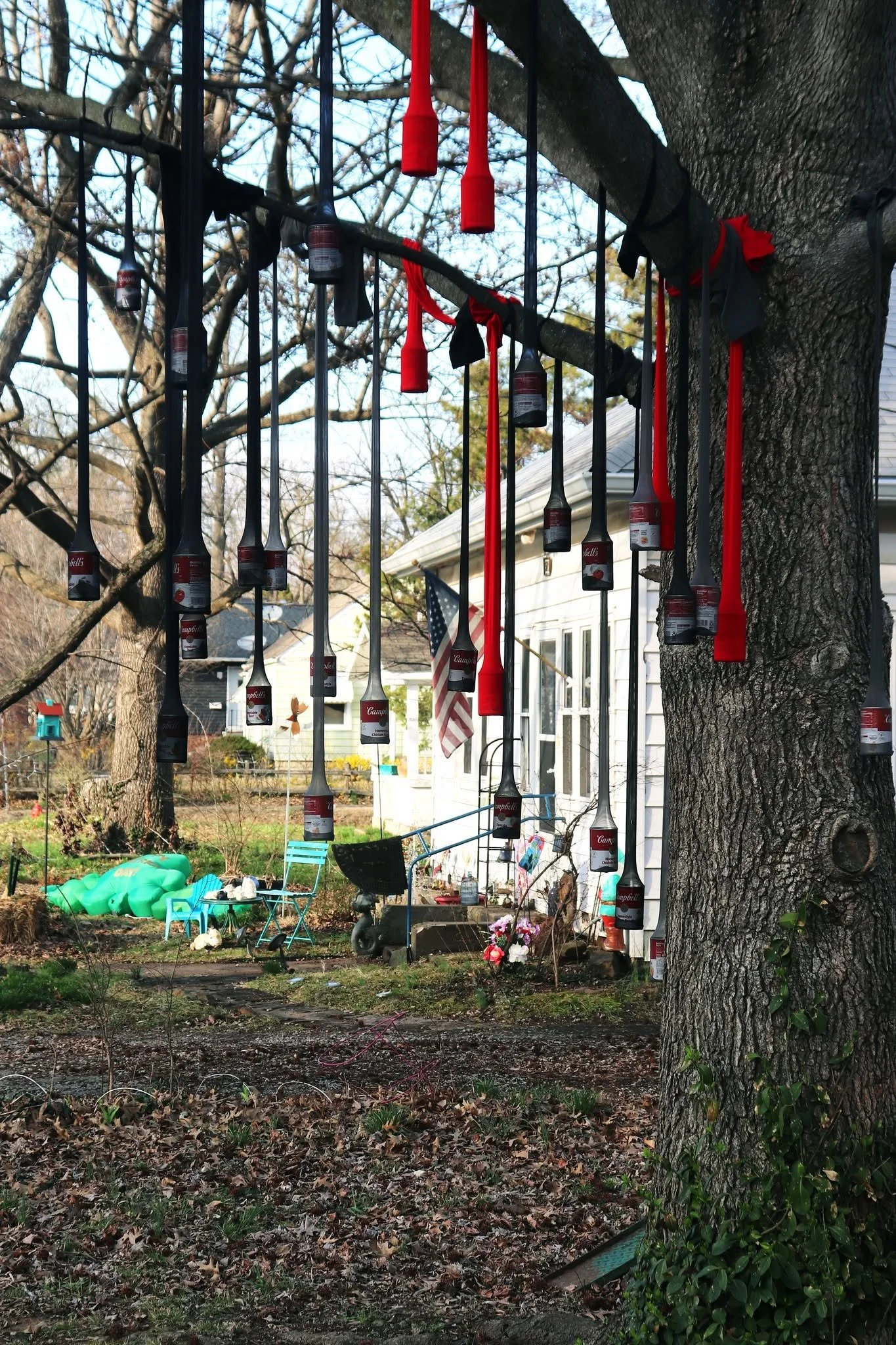
Tish Turl and Adam Turl, Soup for Your Family - tree, pantyhose, Campbell’s soup cans (2026)
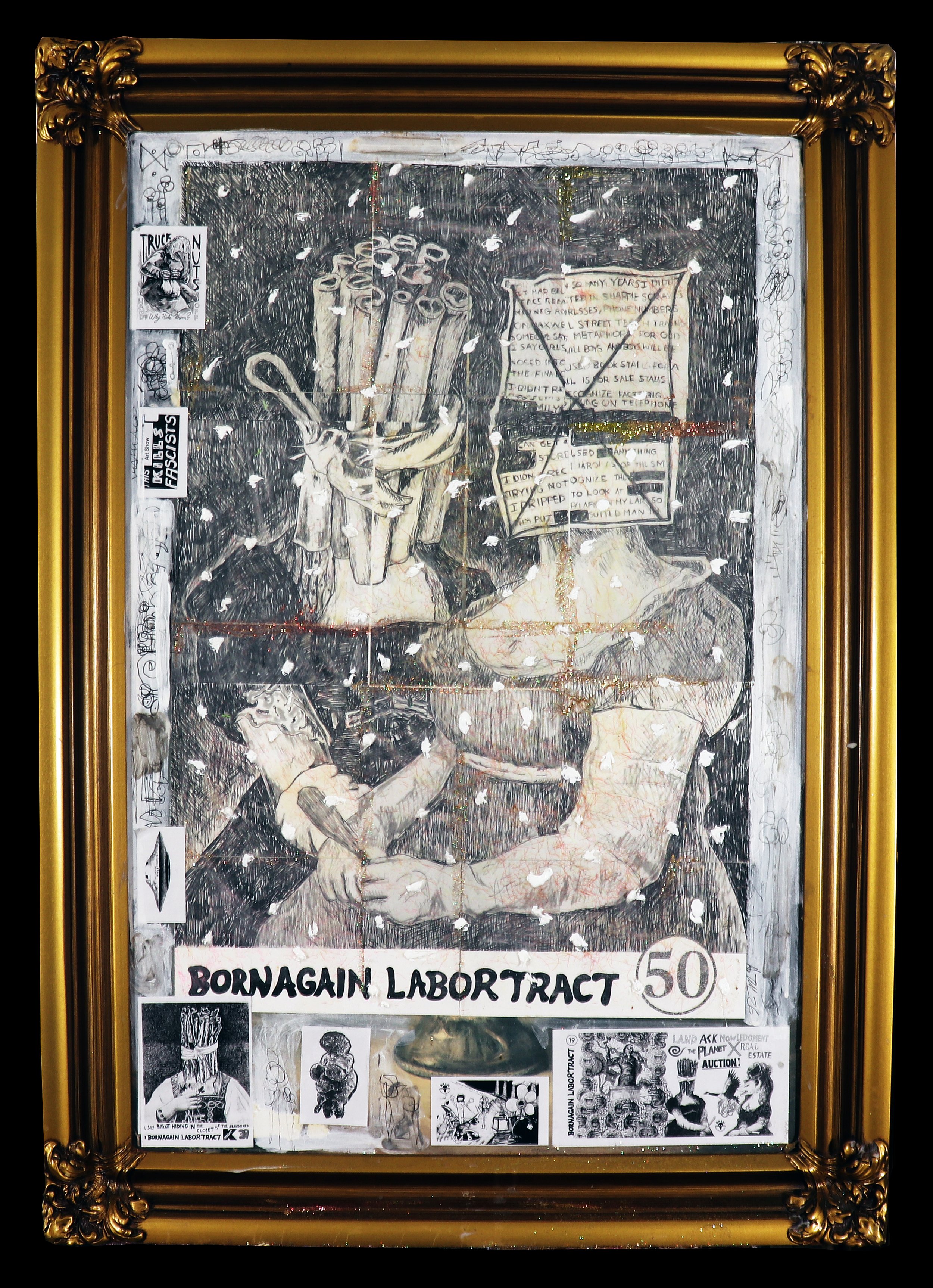
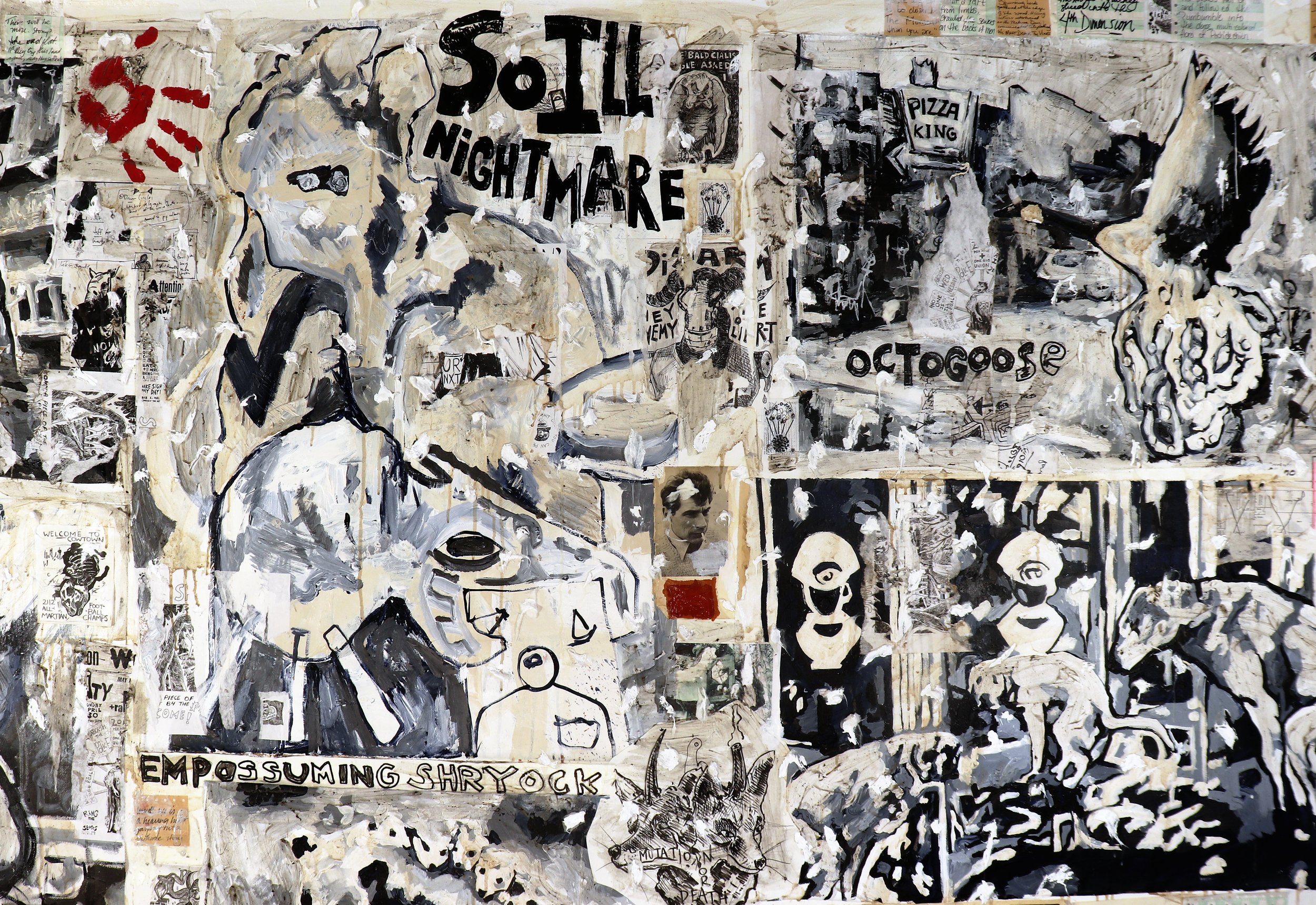
Tish Turl and Adam Turl: Born Again Labor Tract 50: Self-Portrait with Redacted Atrocity #1 - mixed-media collage and painting, digital prints, acrylic, marker, glitter, graphite, ink, coffee, stickers, cotton and ash on salvaged "thrift store painting," approx. 38 x 27 inches (2026)
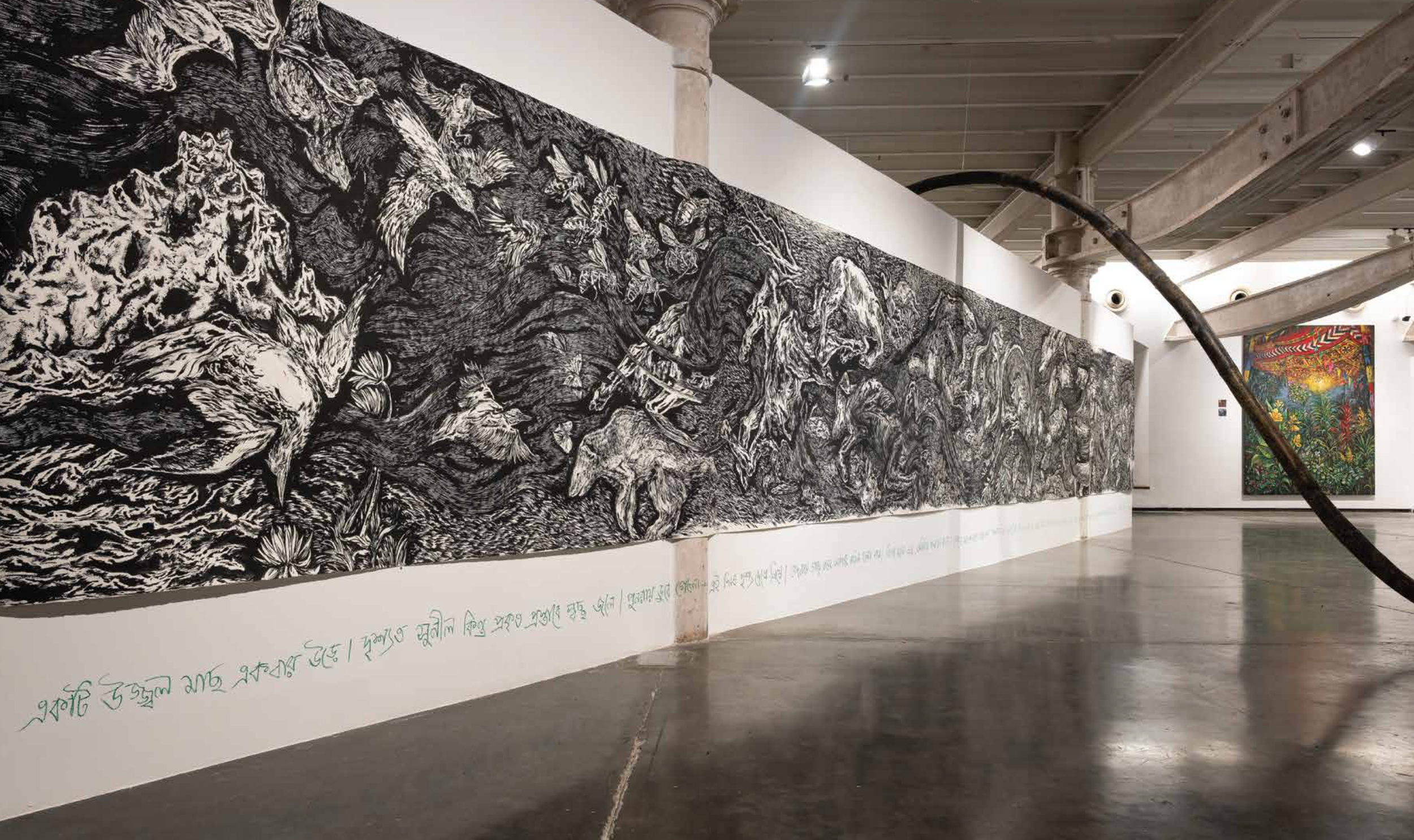
Anupam Roy, Seventh Broken Story: Sloshing Time, Jessore Road, ink on paper, as installed at Project 88 in Dehli for …ing: Sceneries without Sovereignty, Project 88 in Delhi, India.
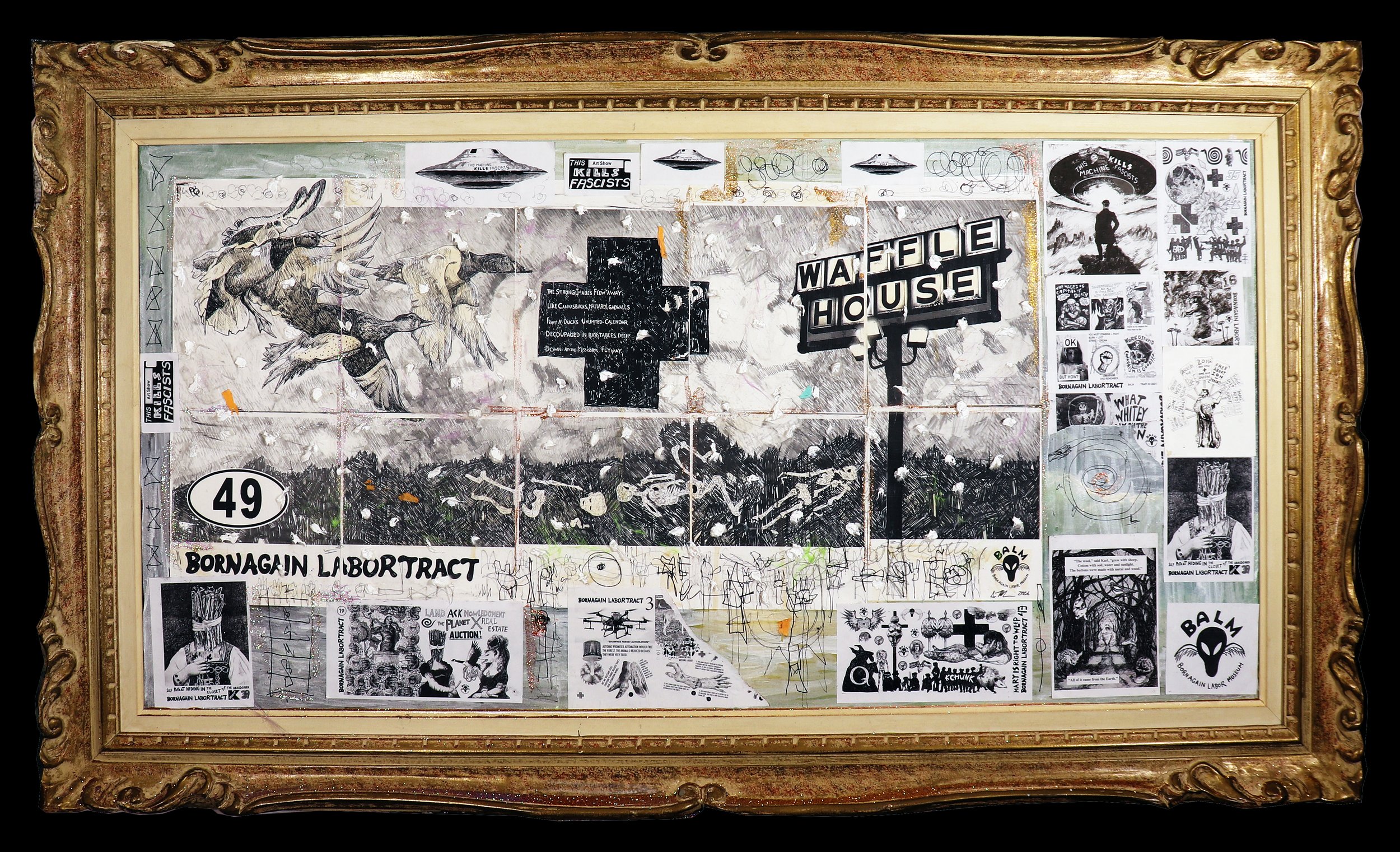
Tish Turl and Adam Turl, Born Again Labor Tract 49: The Strong Images Flew Away - mixed-media collage and painting, digital prints, marker, ink, wig hair, graphite, Post-It notes, coffee, glitter, stickers, cotton and ash on salvaged "thrift store painting" (2026)
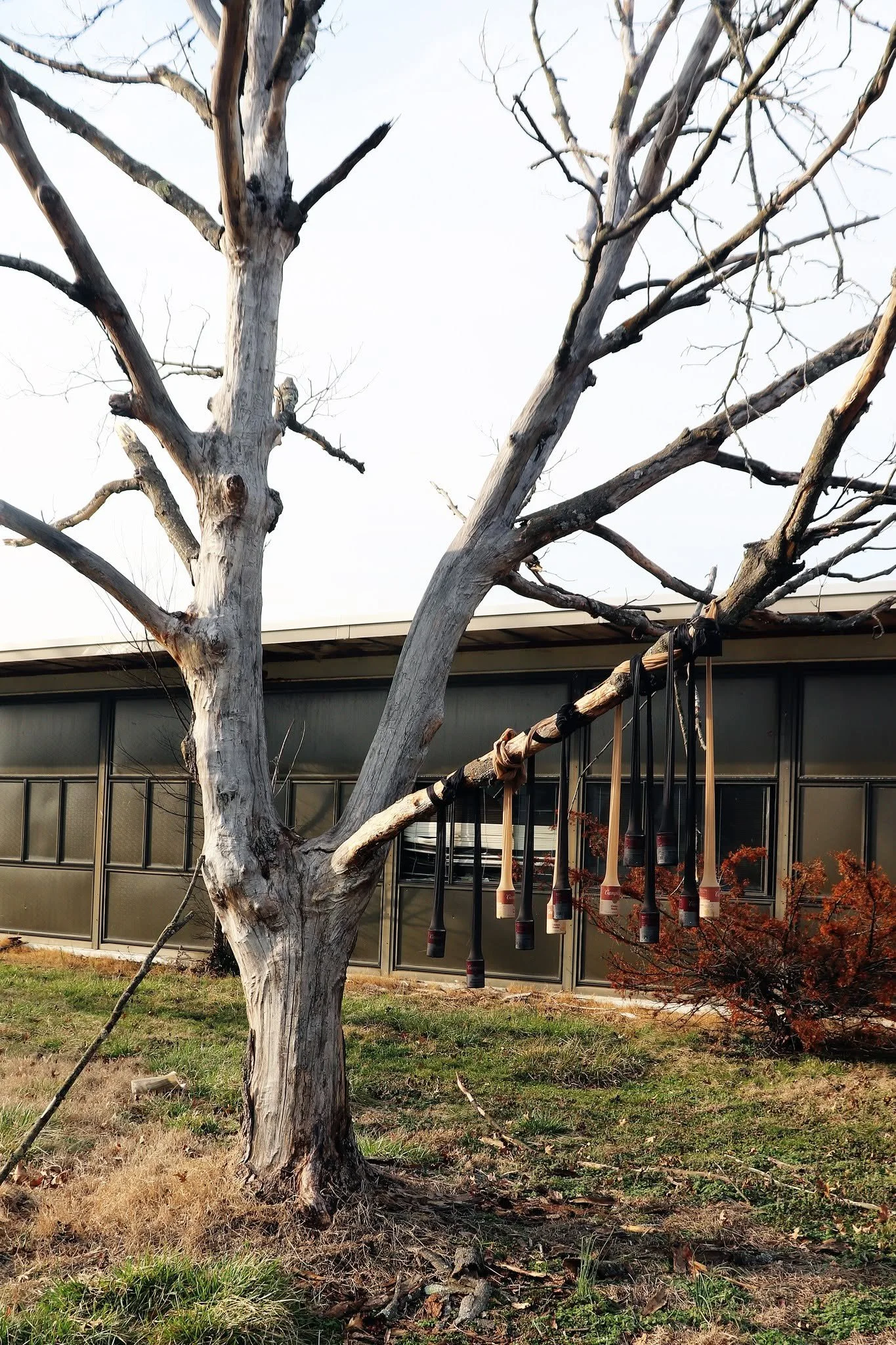
Tish Turl and Adam Turl, Soup for Your Family - Soup, pantyhose, tree, abandoned high school (2026)
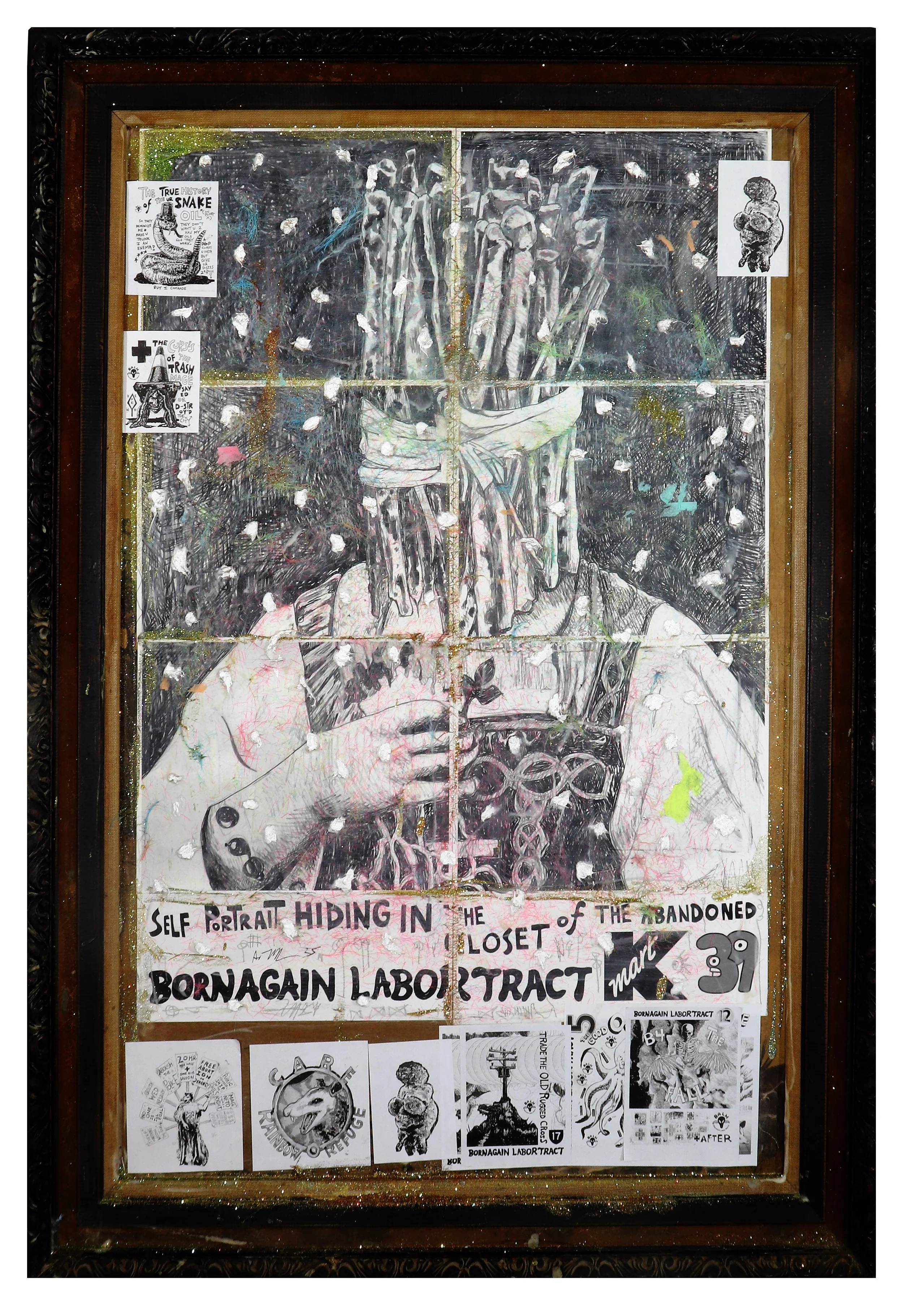
Tish Turl and Adam Turl, Born Again Labor Tract 39: Self-Portrait in the Closet of the Abandoned K-Mart - mixed-media collage and painting, digital prints, acrylic, stickers, wig hair, glitter, coffee, graphite, marker, cotton and ash on salvaged thrift-store "painting" (2025)
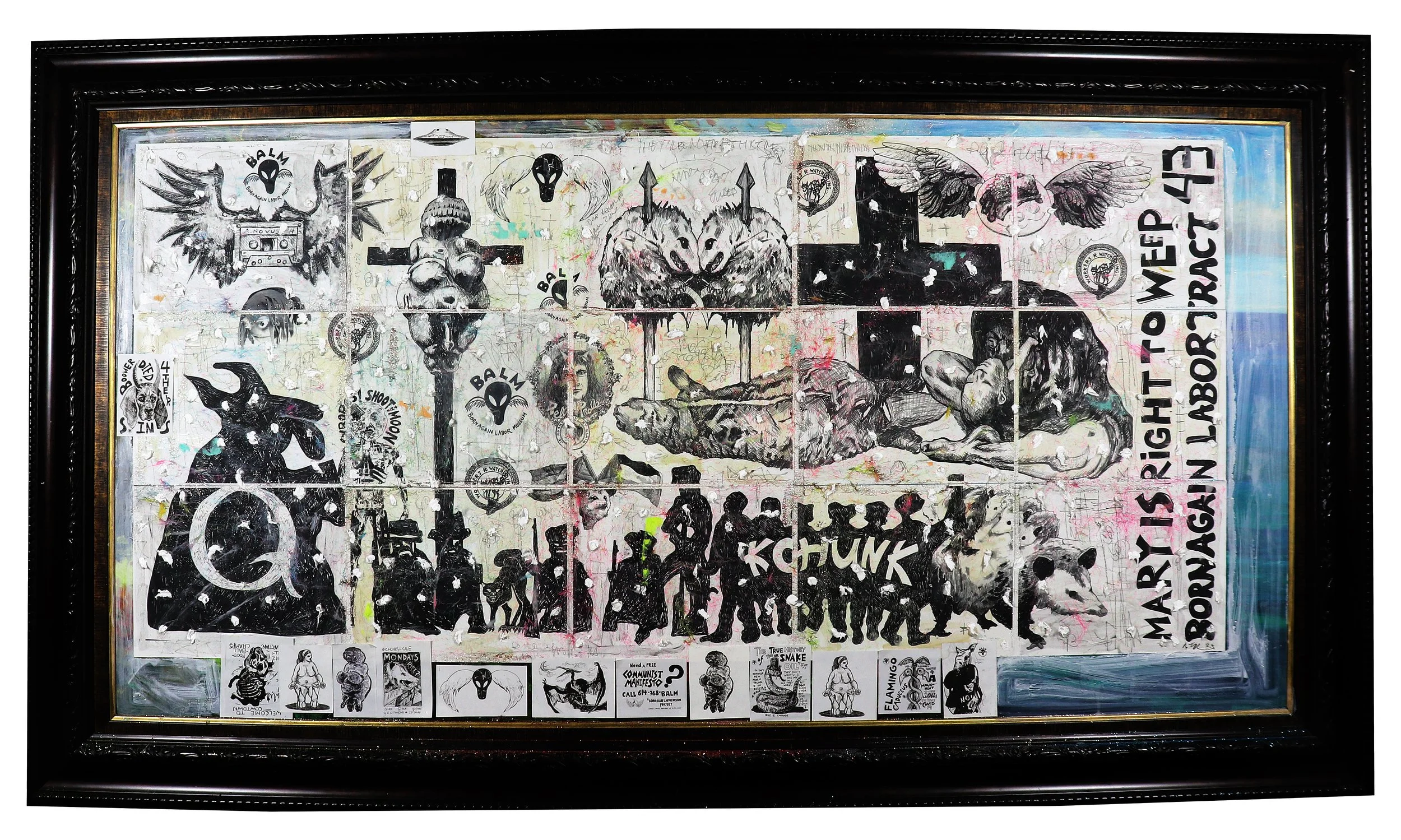
Born Again Labor Tract 43: Mary's Right to Weep - mixed media collage and painting, digital prints, acrylic, marker, ink, graphite, glitter, wig-hair, ash of burned American flags, stickers, coffee, cotton and ash on salvaged "thrift-store painting," approx 60 x 40 inches (2025)
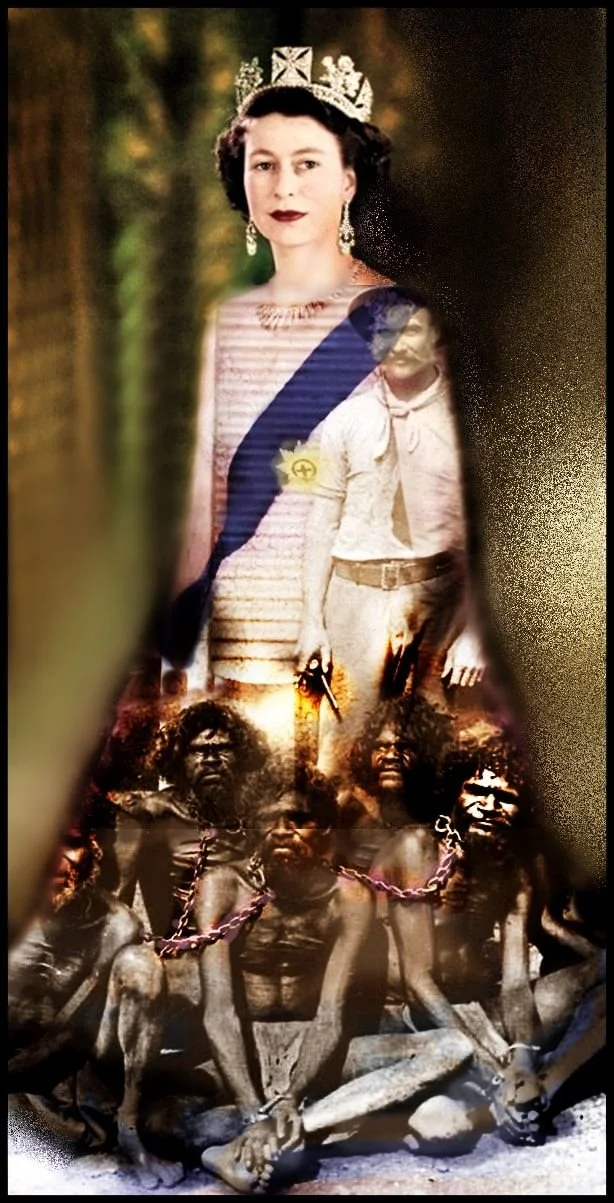
Laura Fair-Schulz, Anti-Imperial Flora and Fauna Dress, digital photo-collage (2025)
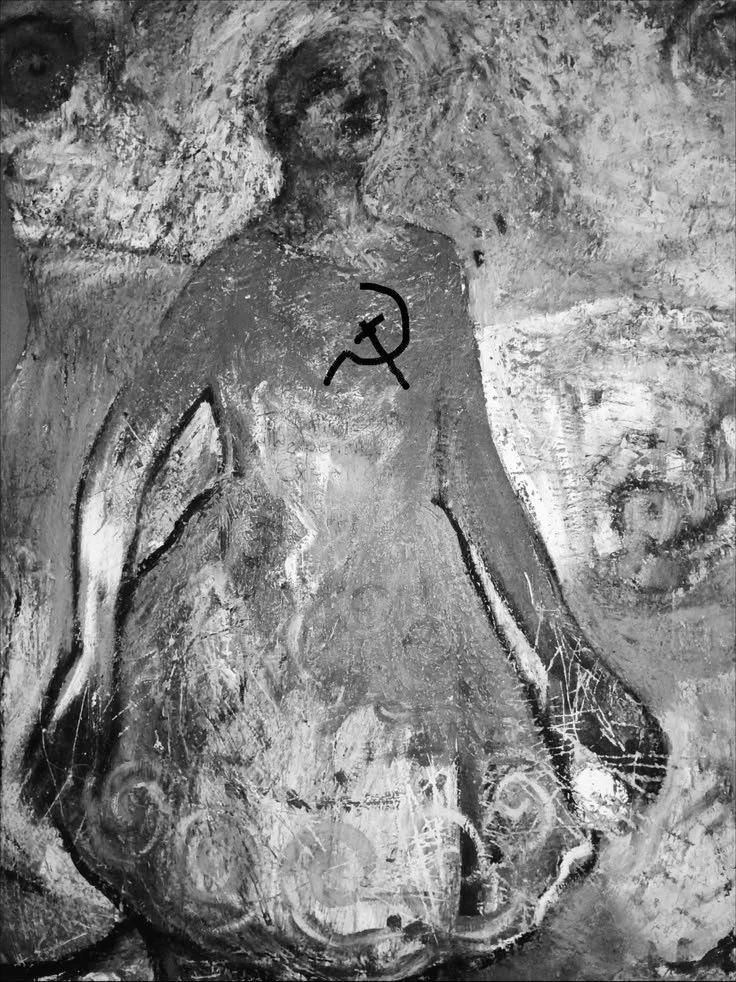
Laura Fair-Schulz, Job (Biblical Figure) - Gaslit Figure, painting and drawing (2025)
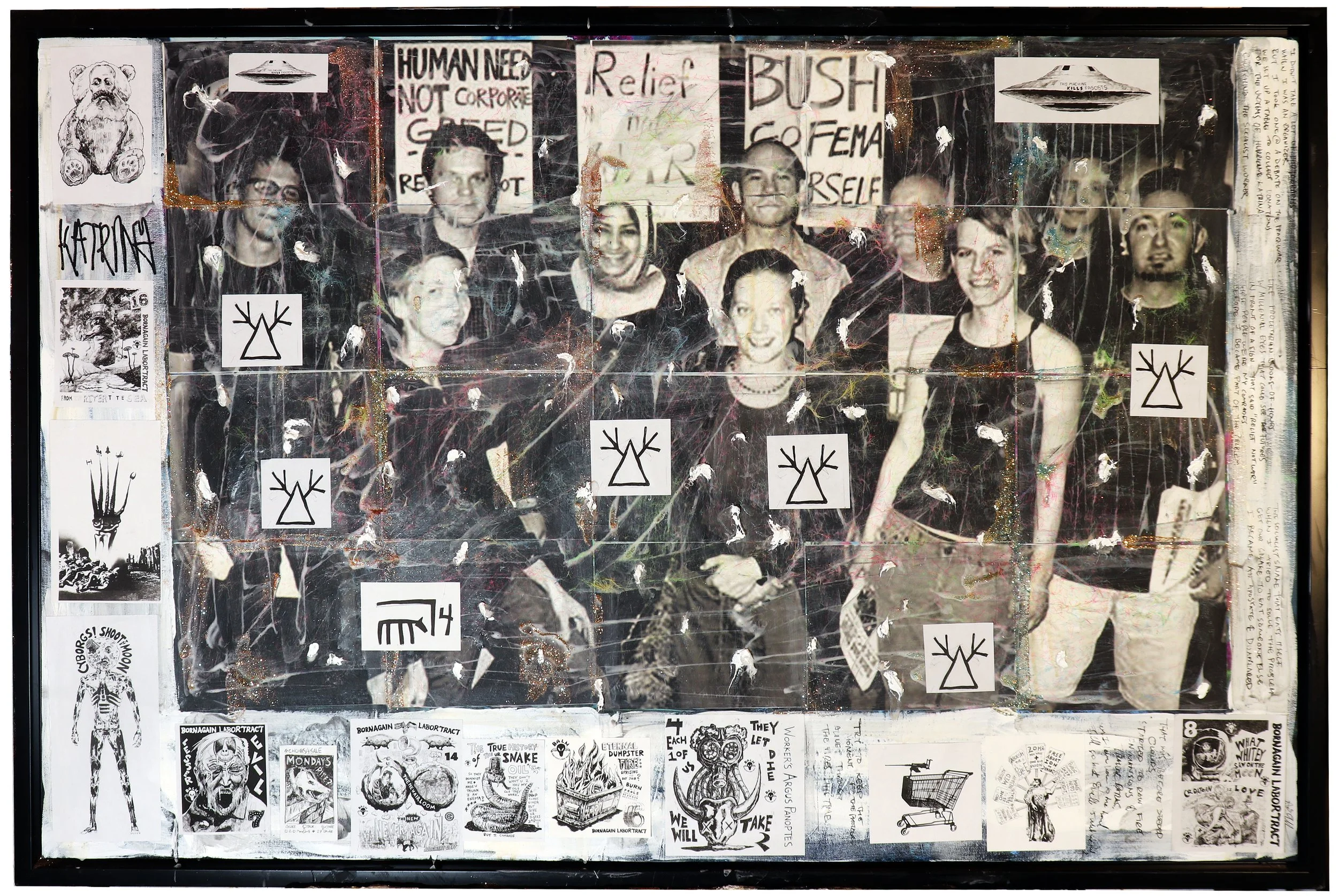
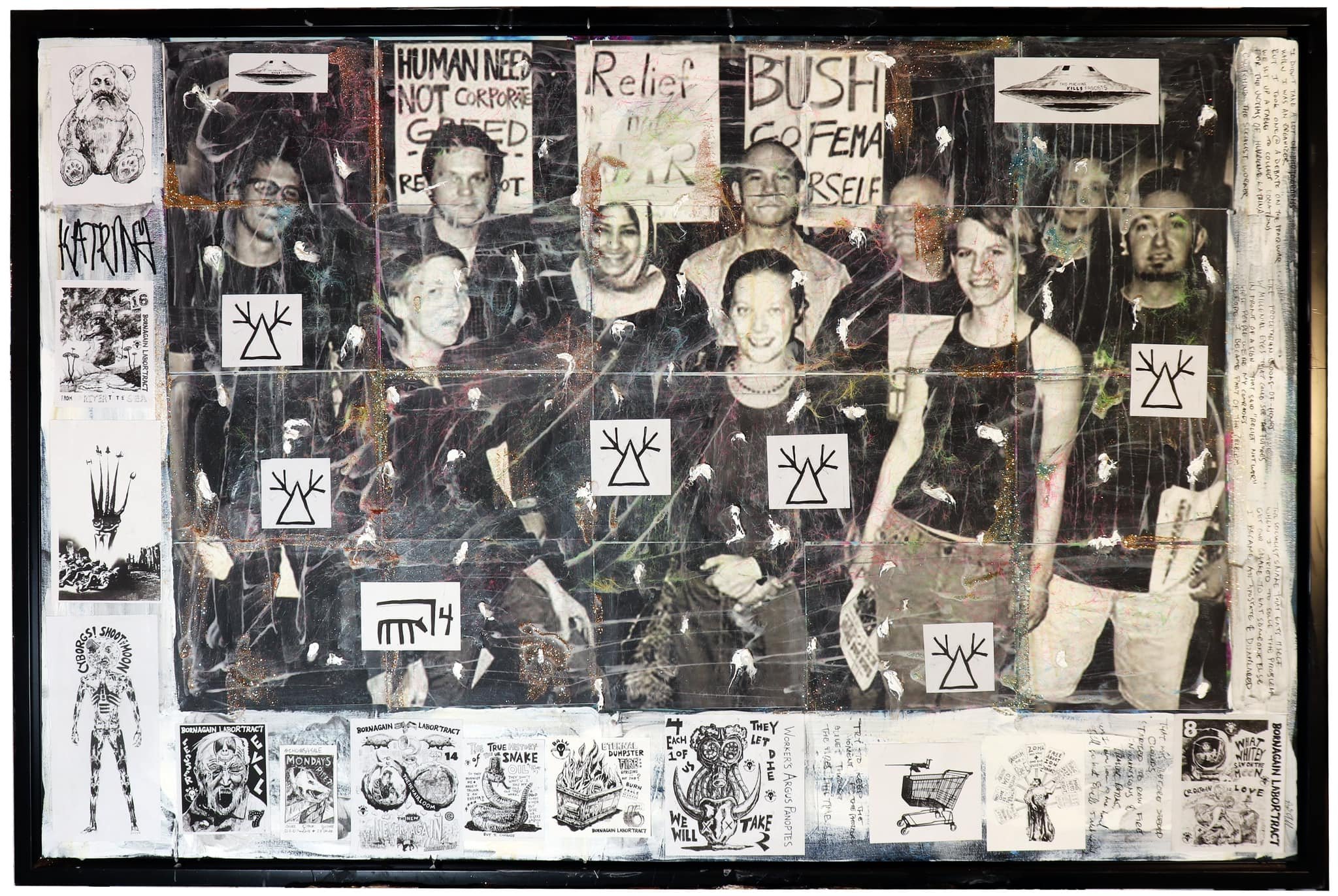
Tish Turl and Adam Turl, Katrina - mixed-media collage and painting, digital prints, drawings, acrylic, glitter, wig-hair, graphite, ink, marker, coffee, stickers, cotton and ash on thrift store painting (2025).
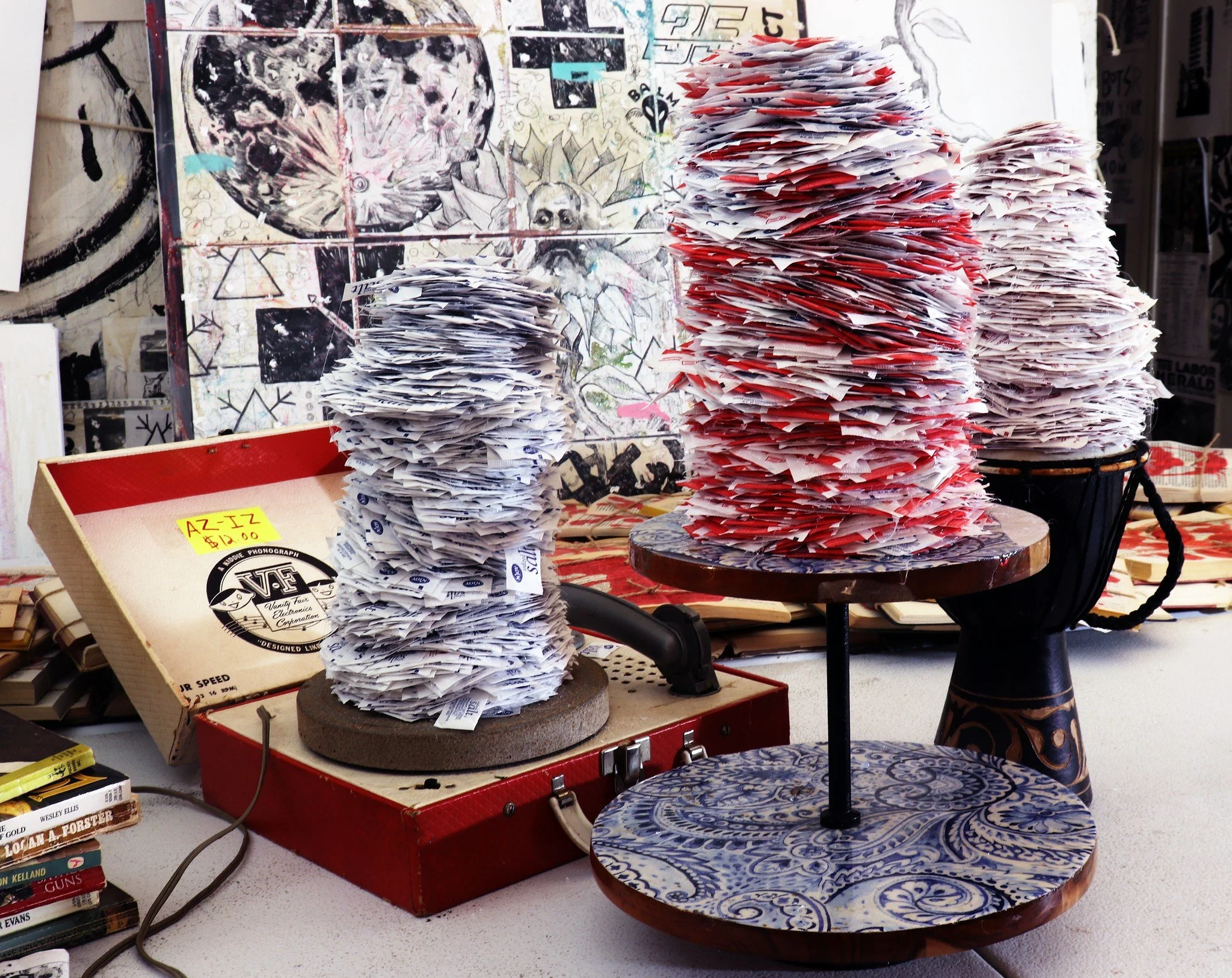
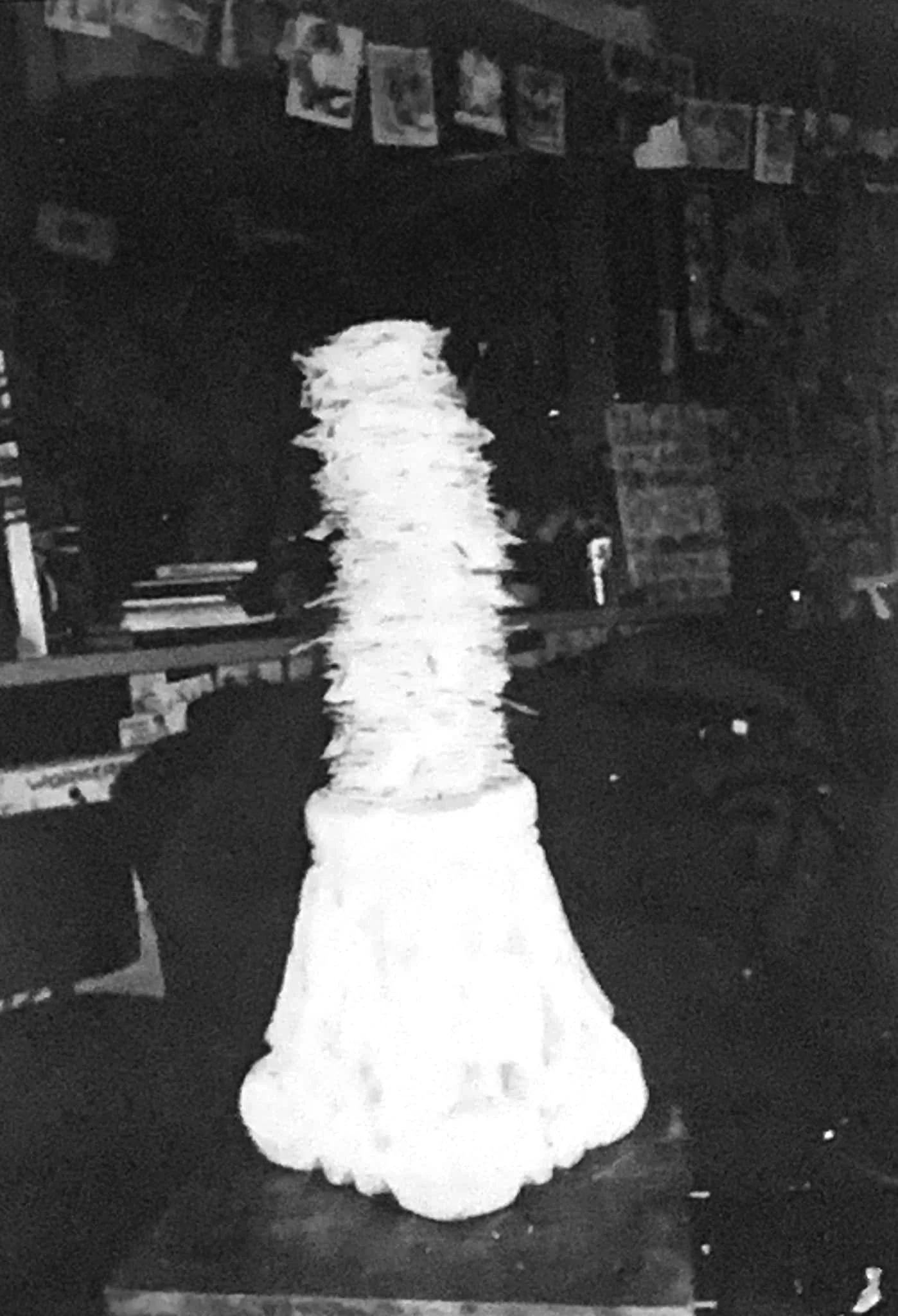
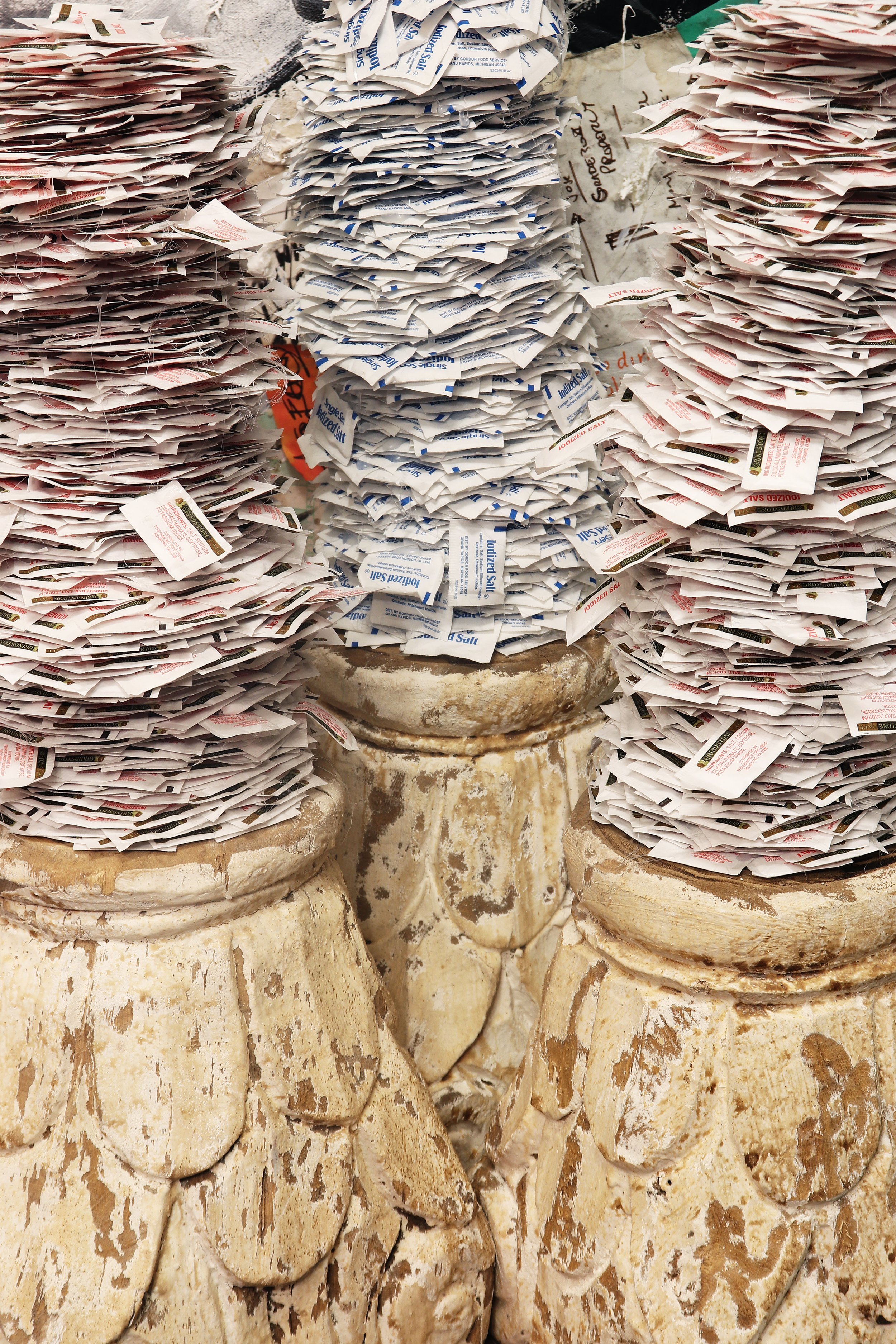
Tish Turl and Adam Turl, Flying Saucer Drive-In Parking Lot's Wife, Rock and Roll McDonald's Parking Lot's Wife, and Trader Vic's Parking Lot's Wife - salt packets, foam, glue, salvaged pedestals (2025)
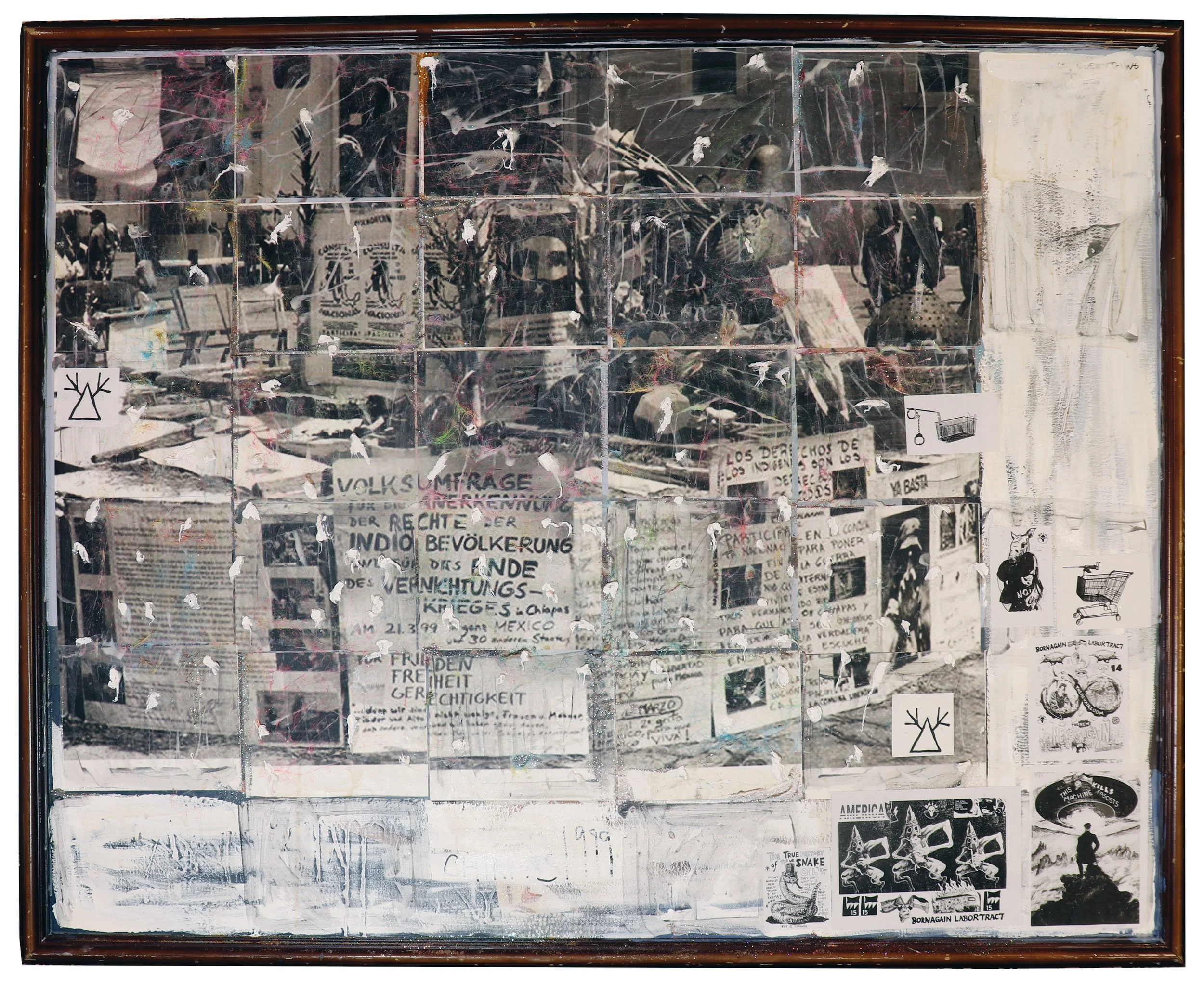
Tish Turl and Adam Turl, Chiapas 1999 - mixed-media collage and painting, digital prints, drawings, acrylic, glitter, wig-hair, graphite, ink, marker, coffee, stickers, cotton and ash on thrift store painting (2025).

Tish Turl and Adam Turl, Born Again Labor Tract 24: Biologie Wayne’s HRT Bootleggers - with quotes by Emory Douglas - mixed media collage and painting on thrift store “painting,” prints, acrylic, marker, graphite, wig hair, coffee, glitter, ink, cotton and ash (2025)
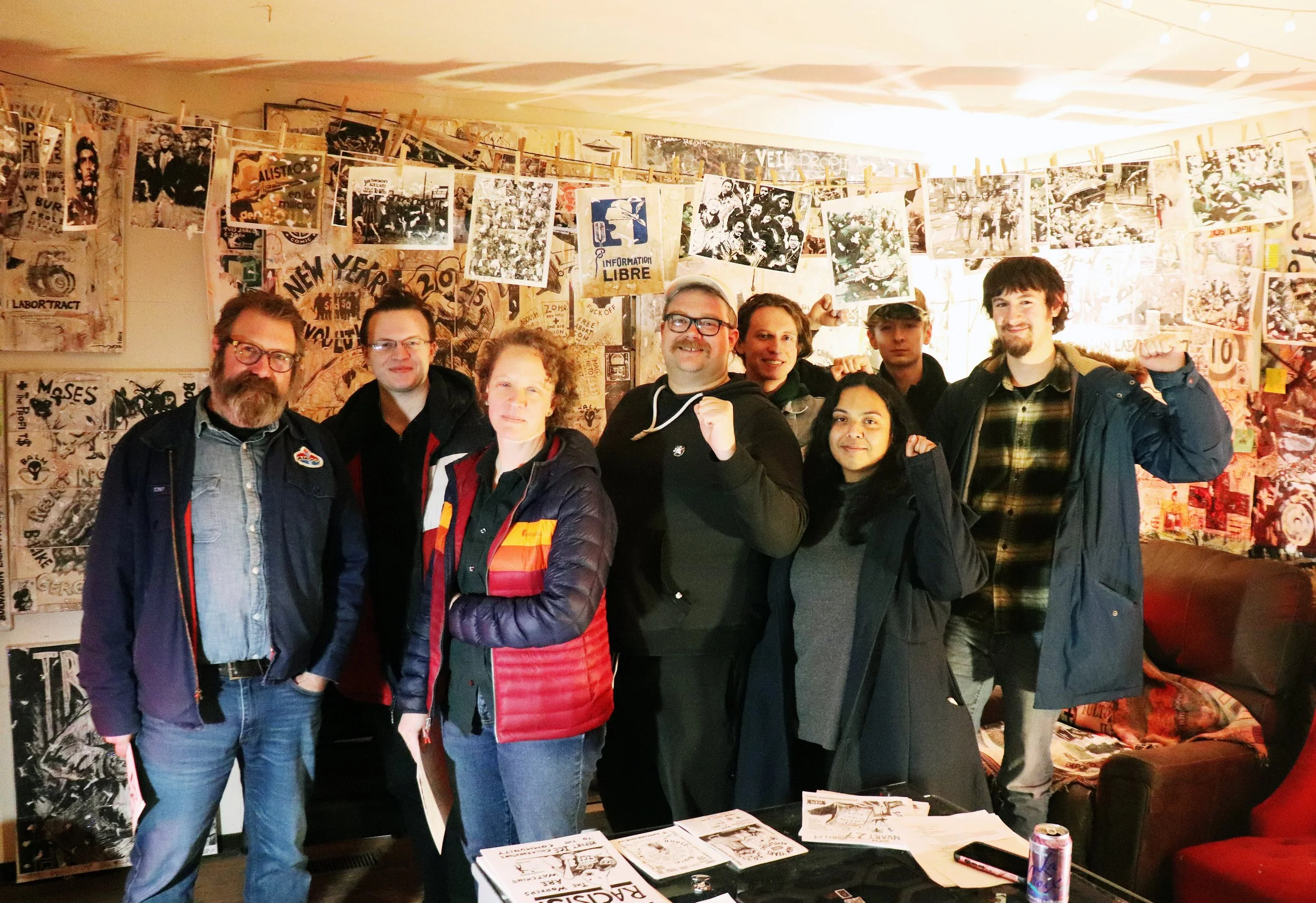
Southern Illinois Democratic Socialists of America (SIDSA) Labor Working Group meeting at BALM in 2025.
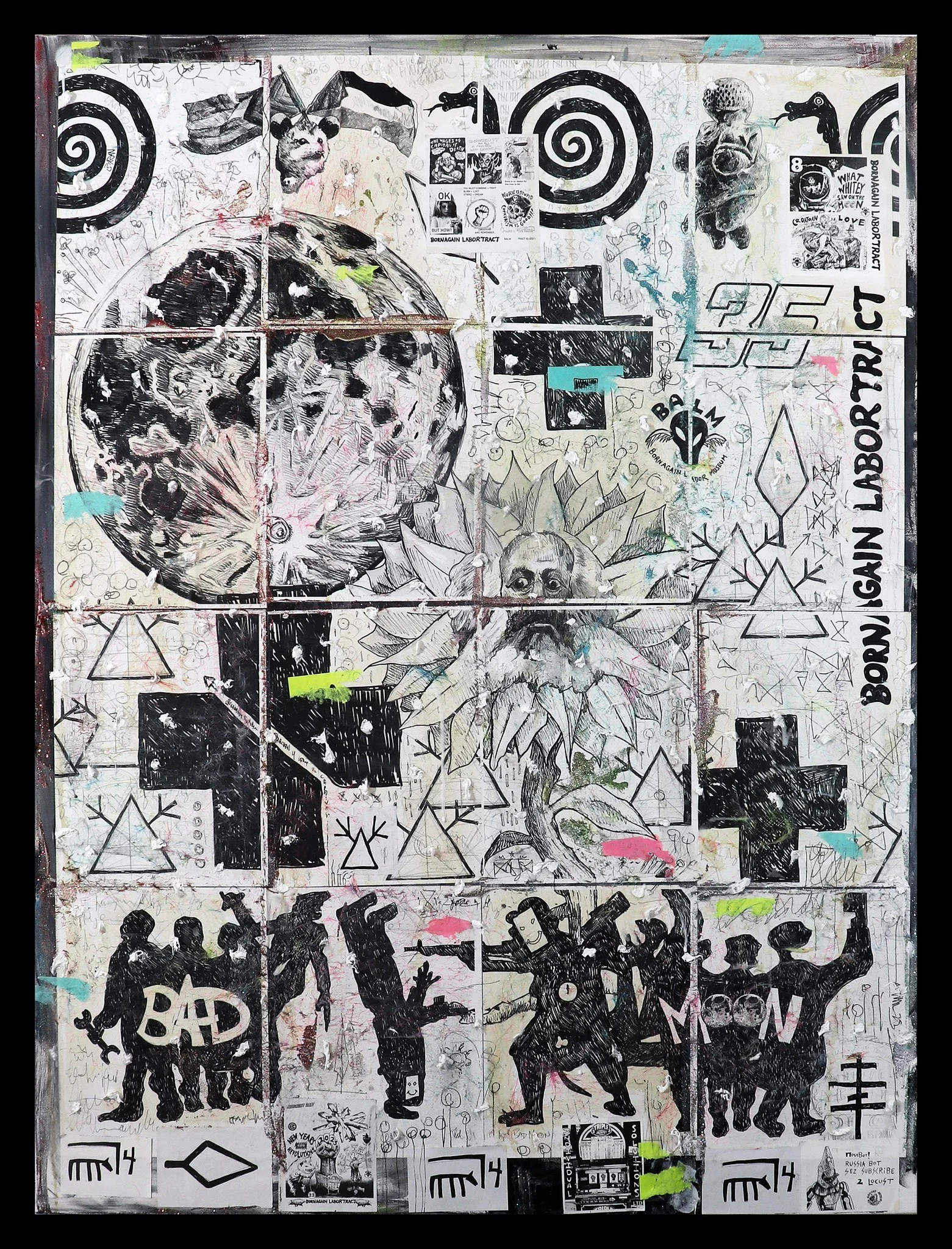
Tish Turl and Adam Turl, Born Again Labor Tract 35: Circular Firing Squad under a Bad Moon Rising - Mixed-media collage and painting, digital prints, acrylic, coffee, wig-hair, glitter, stickers, marker, graphite, cotton and ash on canvas (2025)
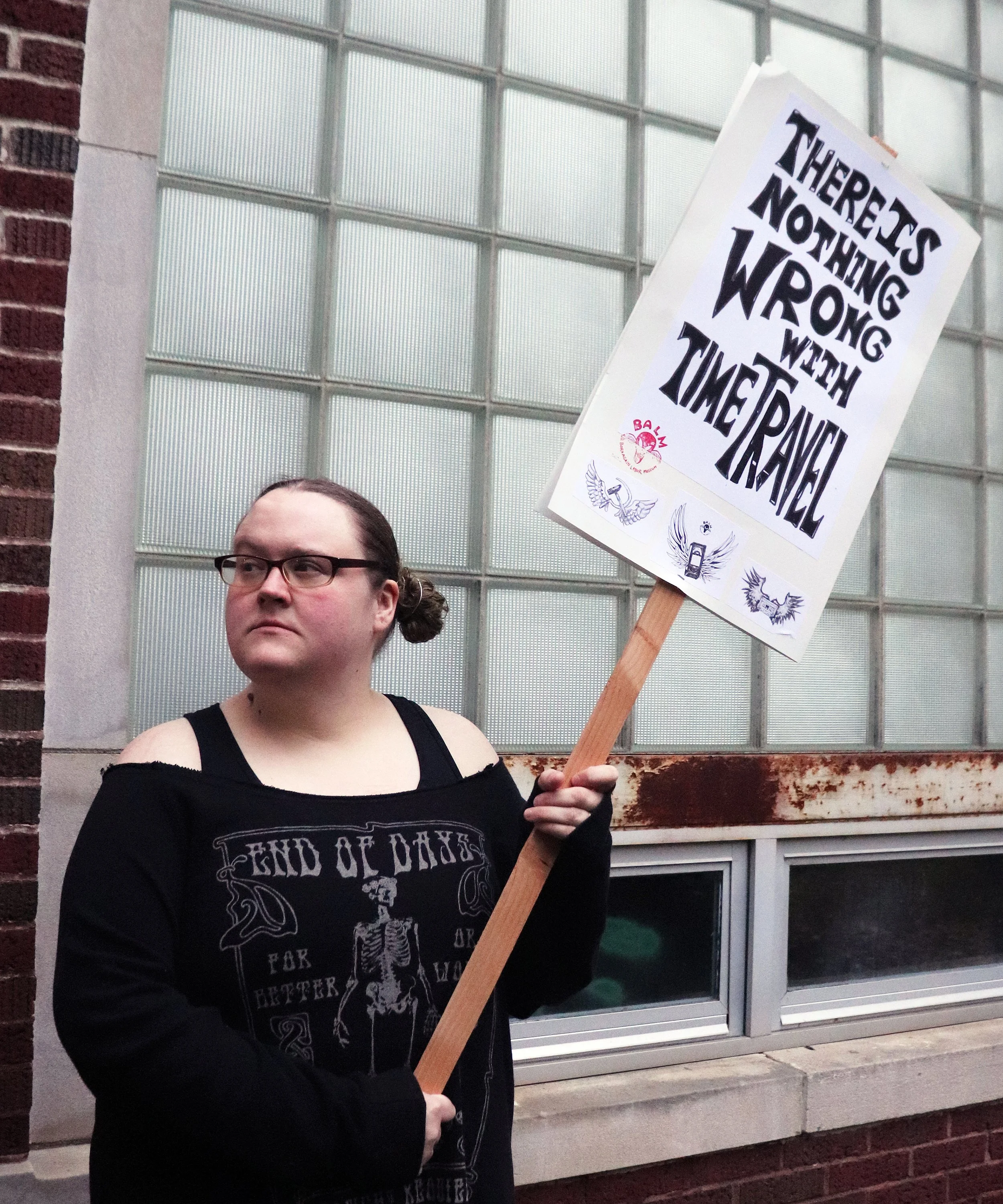
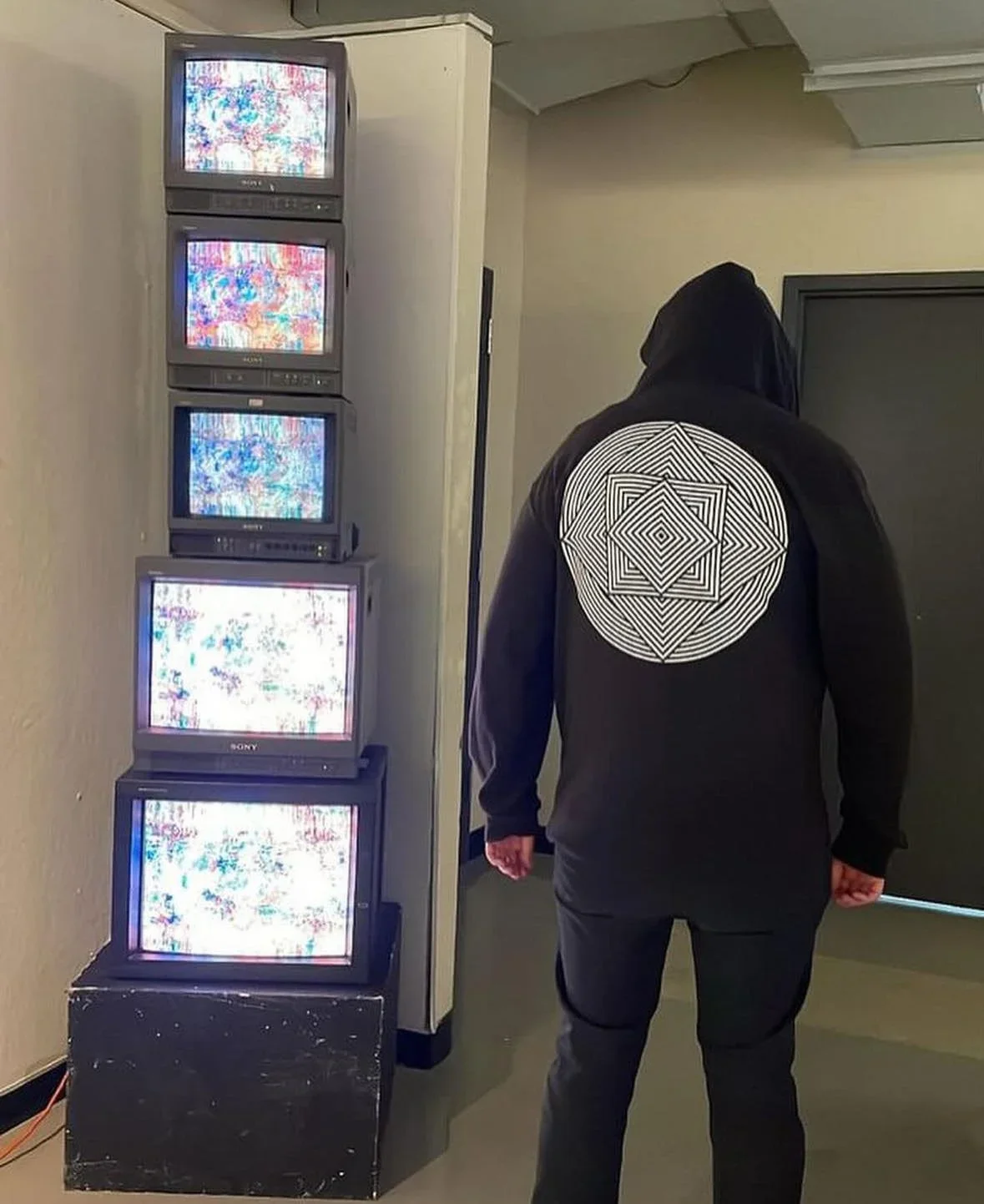
Tish Turl and Adam Turl, Common Task Agit-Prop Library - Irealist protest signs (2021-ongoing)

Tish Turl and Adam Turl, Born Again Labor Tract 8: Demanifest Destiny - Acrylic, digital prints, collage, mixed-media, glitter, coffee, wig hair, graphite, ink, stickers, cotton and ash on canvas (2024)
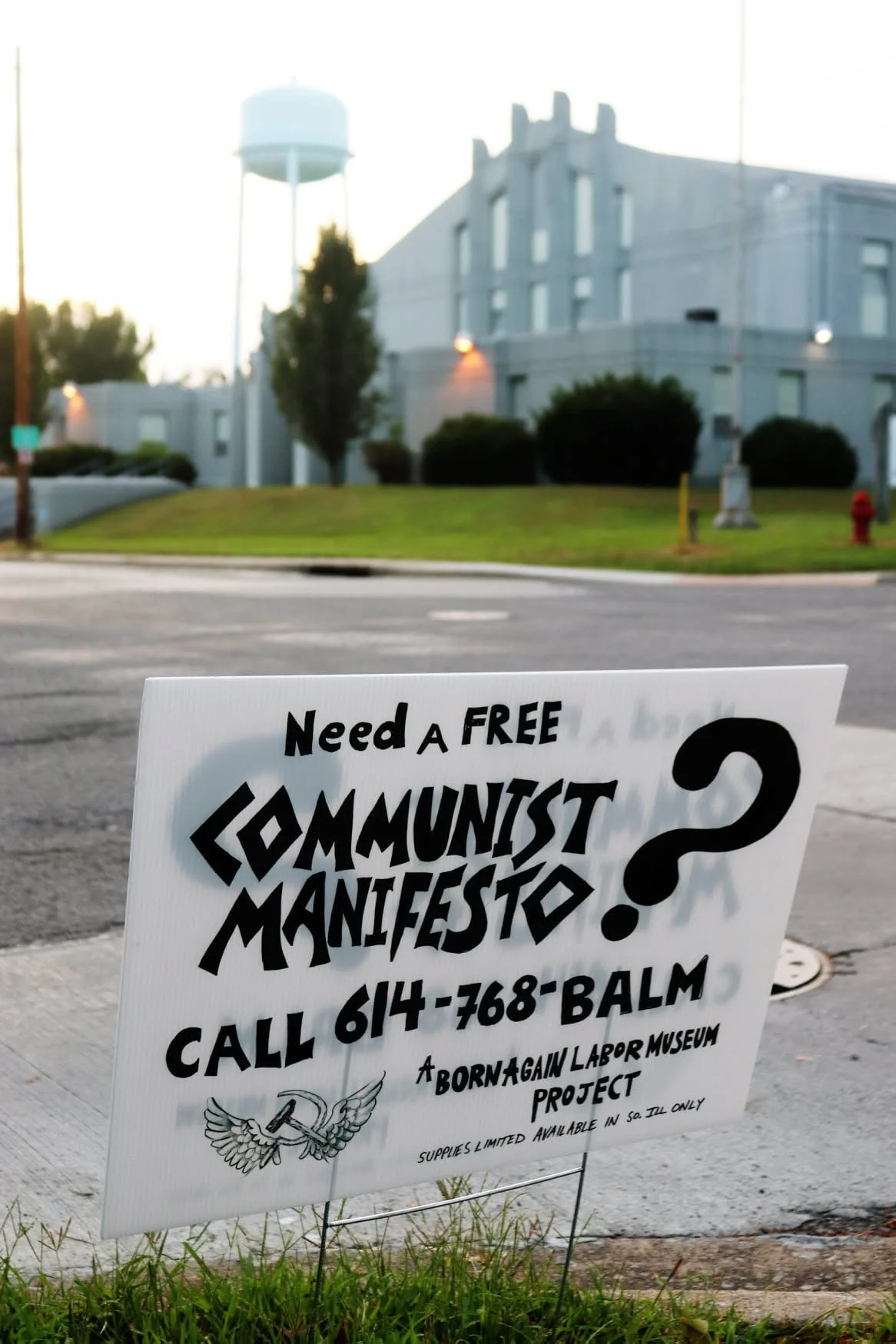
Tish Turl and Adam Turl, Communist Manifesto Distribution Project (2021-), distributing free Communist Manifestoes in southern Illinois.
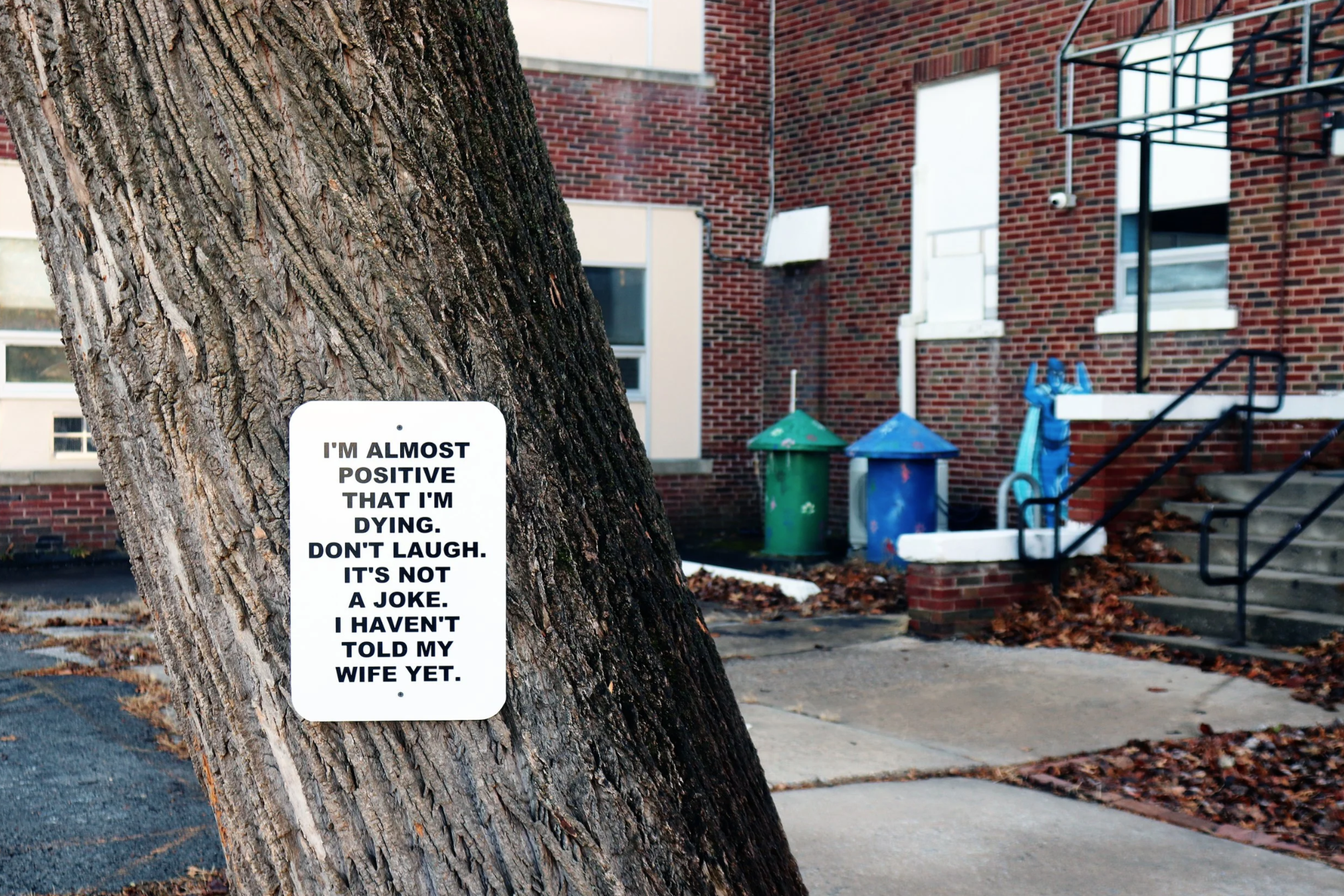
Tish Turl and Adam Turl, Big Muddy Monster Atlas Project, after a poem by Mike Linaweaver, irrealist historical markers (2021-ongoing).
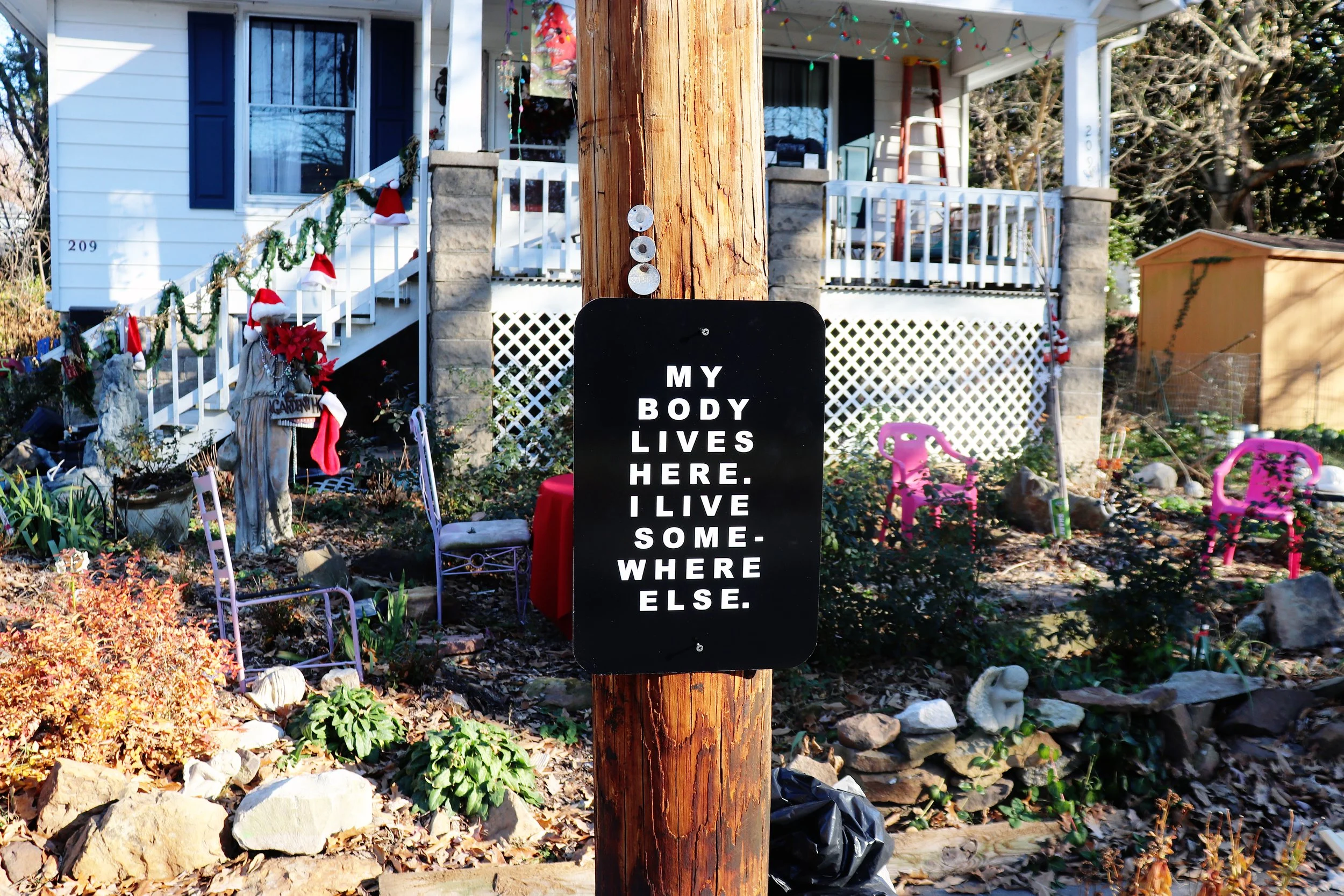
Tish Turl and Adam Turl, Big Muddy Monster Atlas Project - vinyl and aluminum irrealist historical marker/sign placed around southern Illinois (2024).
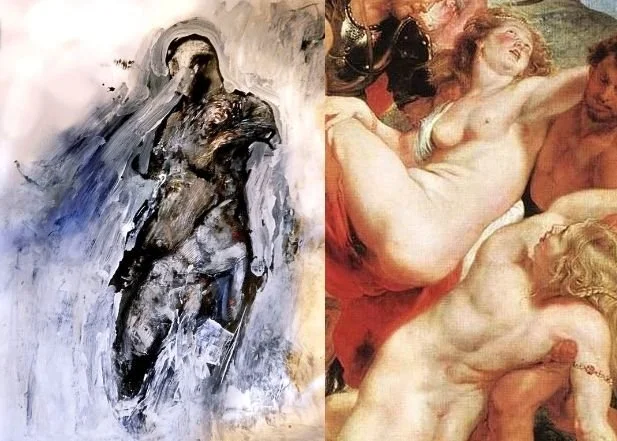
Laura Fair-Schulz, Walking (after Peter Paul Ruebens (Daughters of Leuccippus), drawing and painting, digital image (2024)
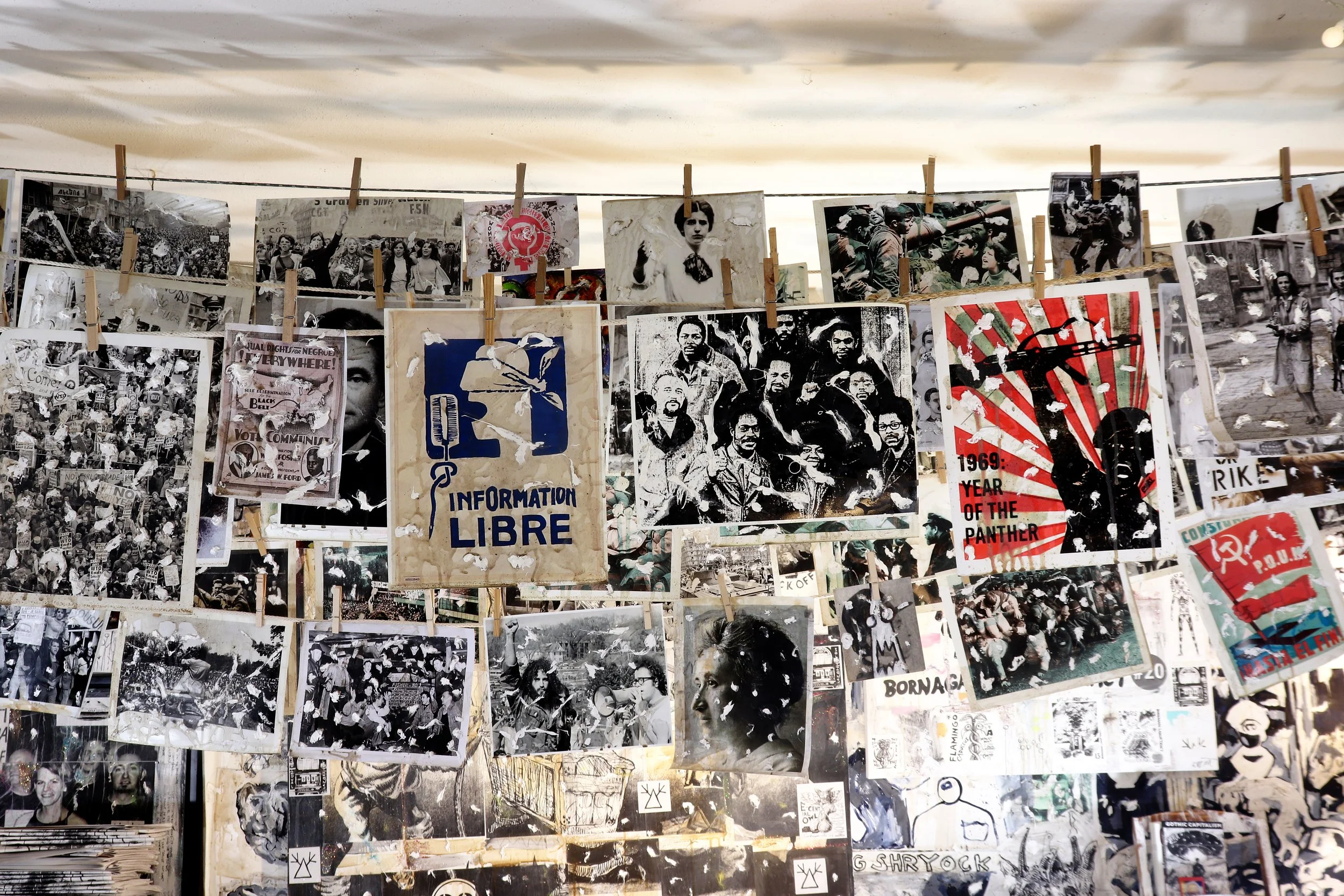
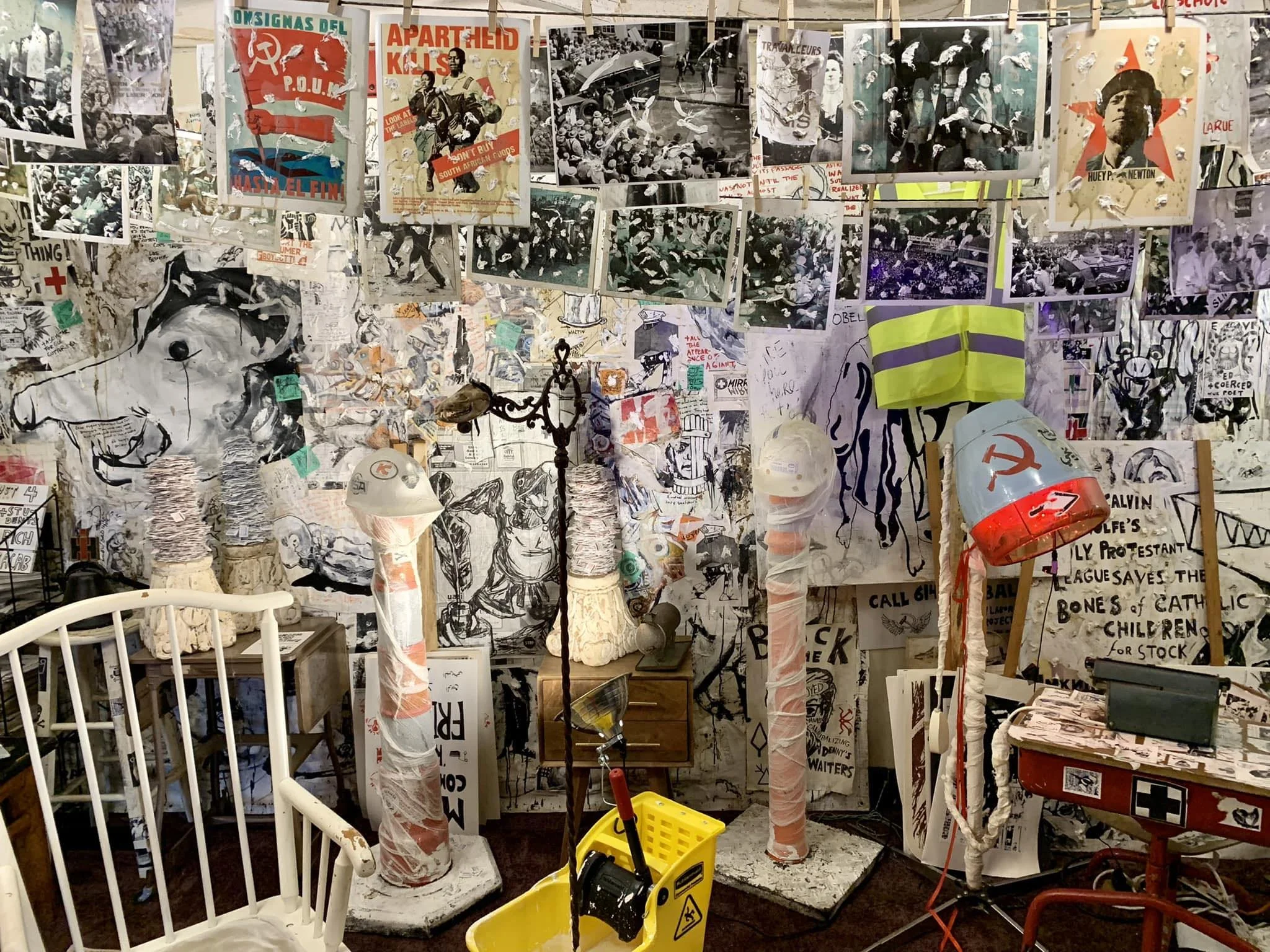
Tish Turl and Adam Turl, Social Resurrection Task Prints - digital photographic prints, coffee, acrylic, cotton and ash, clotheslines, clothespins (2021-2026)

Anupam Roy, Land Guards, acrylic and distemper on tarpaulin (2023)

Laura Fair-Schulz, First as Tragedy, Second as Farce, Thrice as Apocalypse, digital photo-collage (2025)
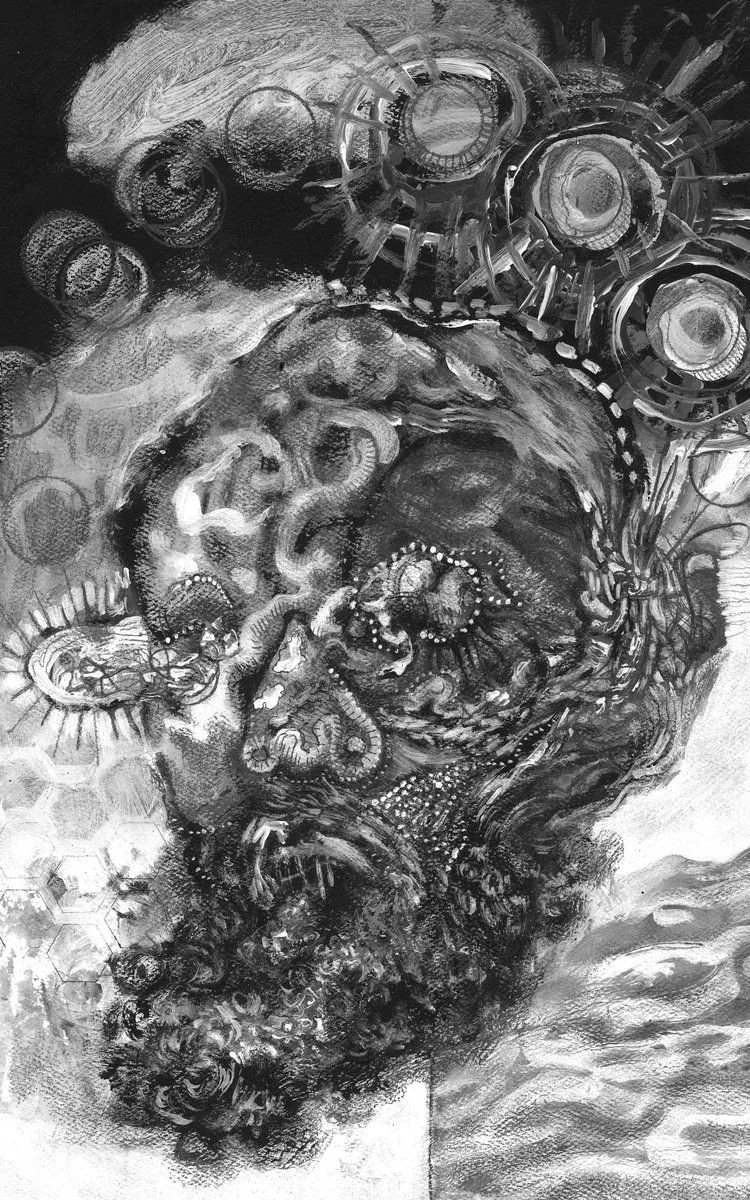
Laura Fair-Schulz, Sisyphus, drawing and painting (2023)
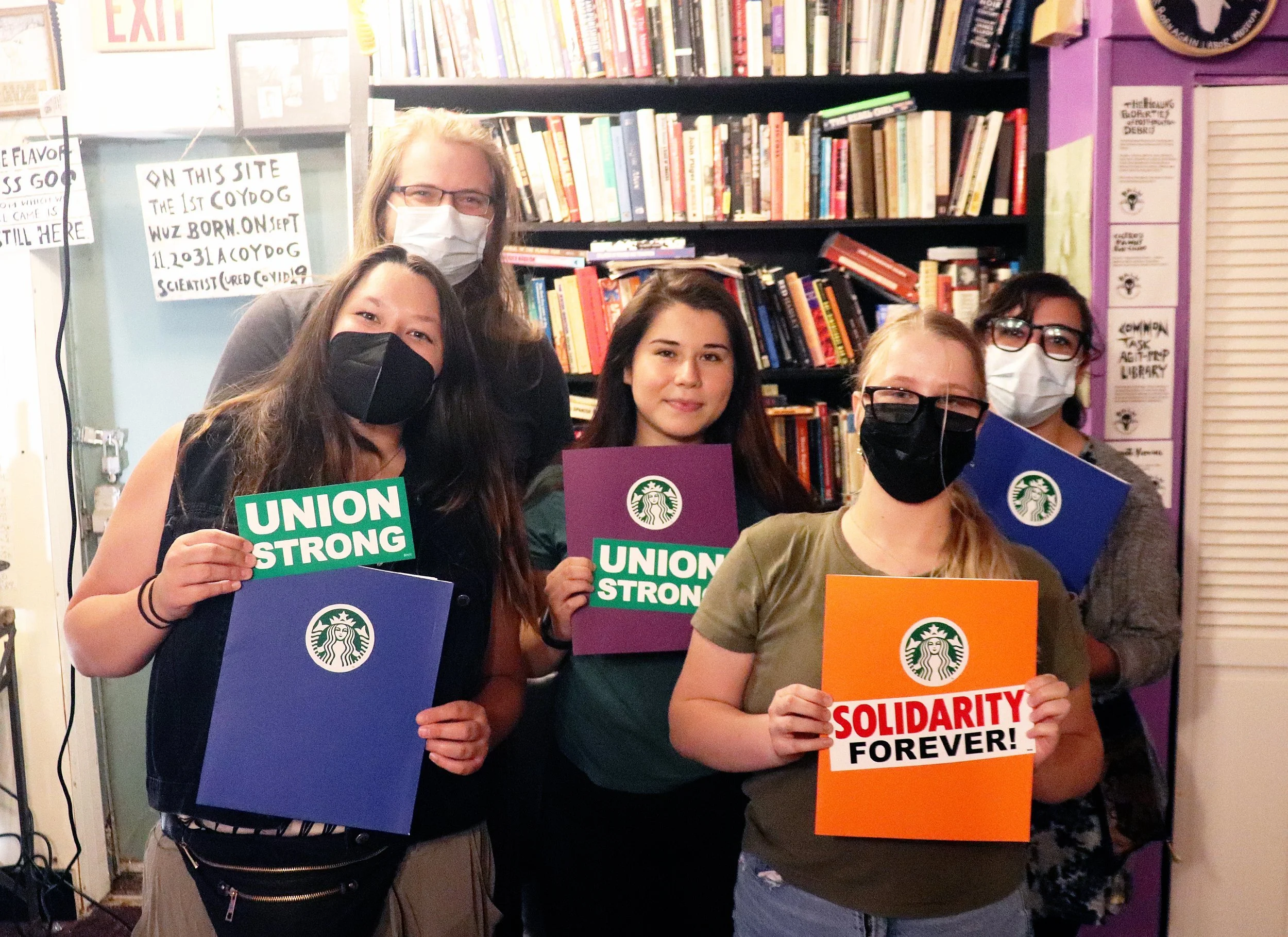
Starbucks workers holding a union meeting at BALM (2022).
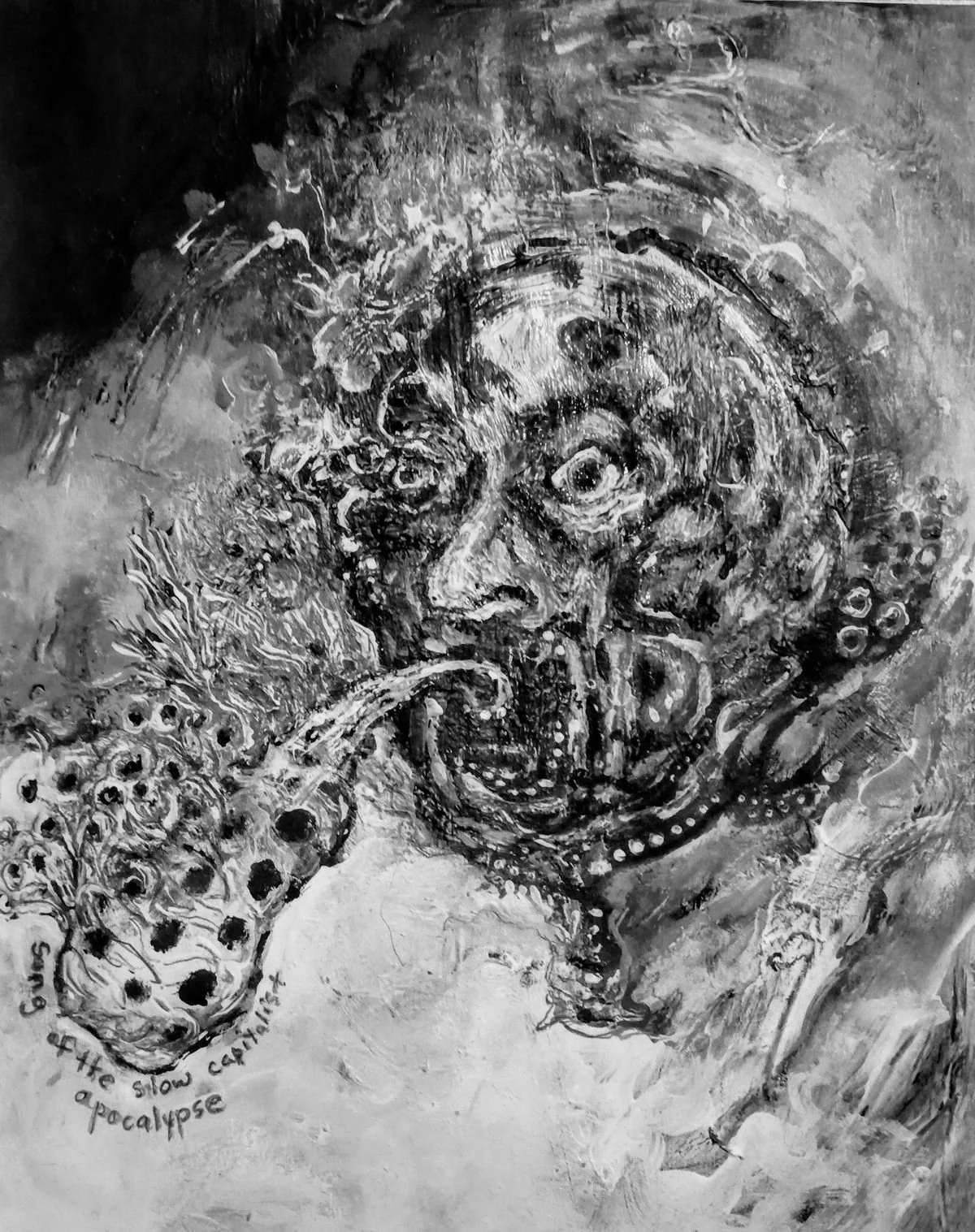
Laura Fair-Schulz, Song of the Slow Capitalist Apocalypse, drawing and painting (2022)
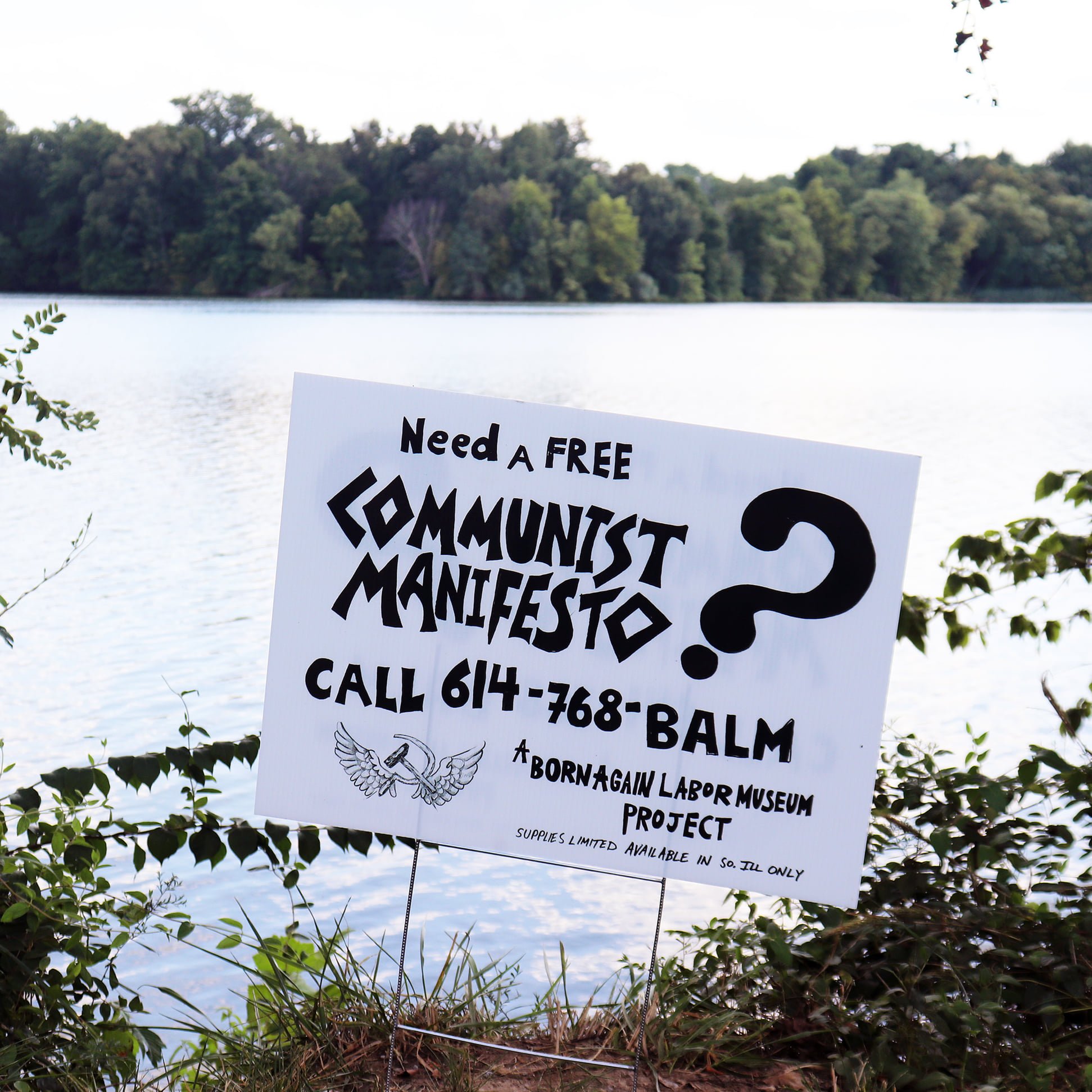
Tish Turl and Adam Turl, Communist Manifesto Distribution Project (2021-2026)
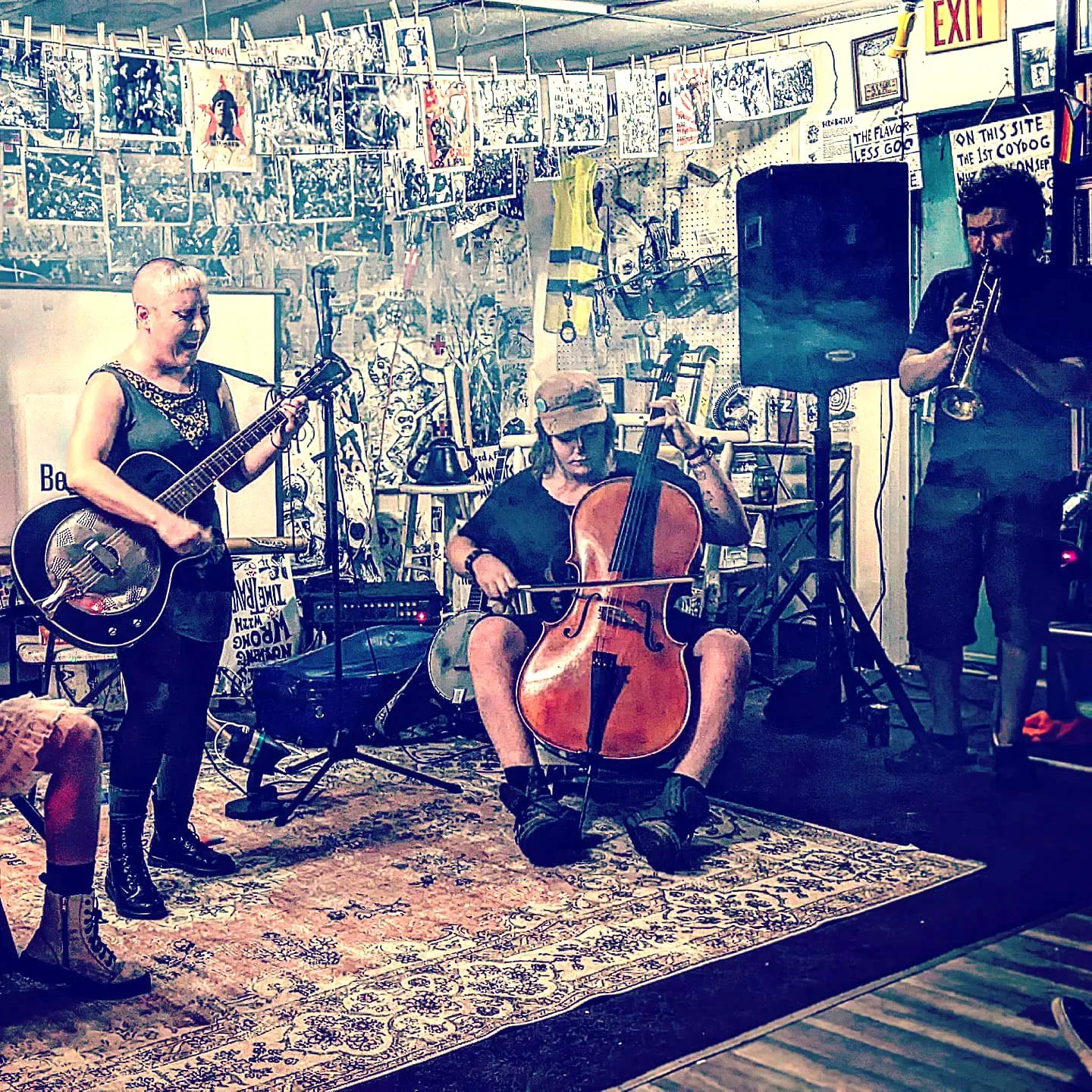
For Tonight Only performing at the Born Again Labor Museum at a fundraiser for Stop Cop City / Save the Atlanta Forest in 2022. Photograph by Children of the Rat Temple.
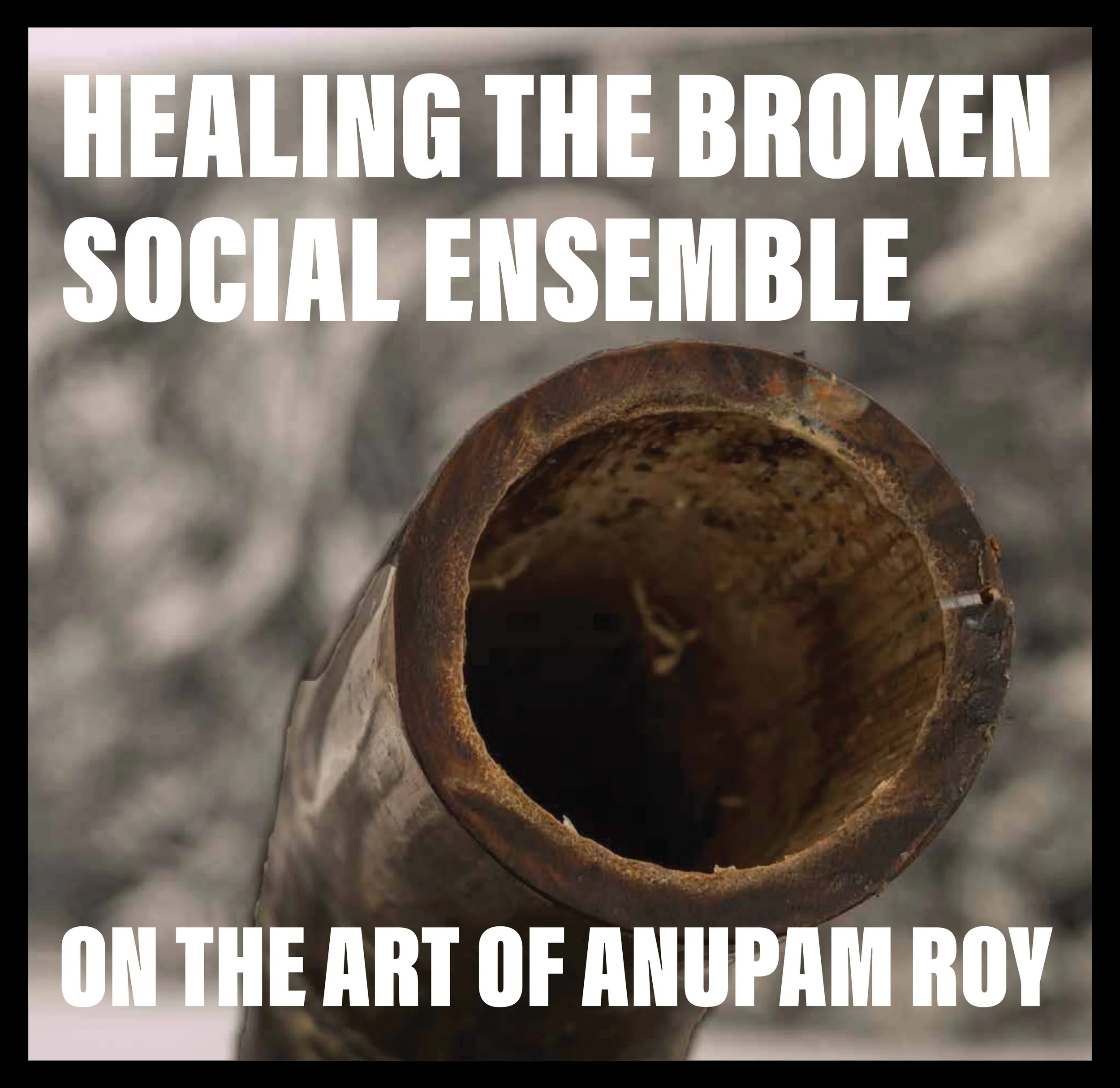
I fell in love with Anupam’s work because it isn’t “what it is,” it's something more. Anupam’s work is like slip healing fragments of broken clay.
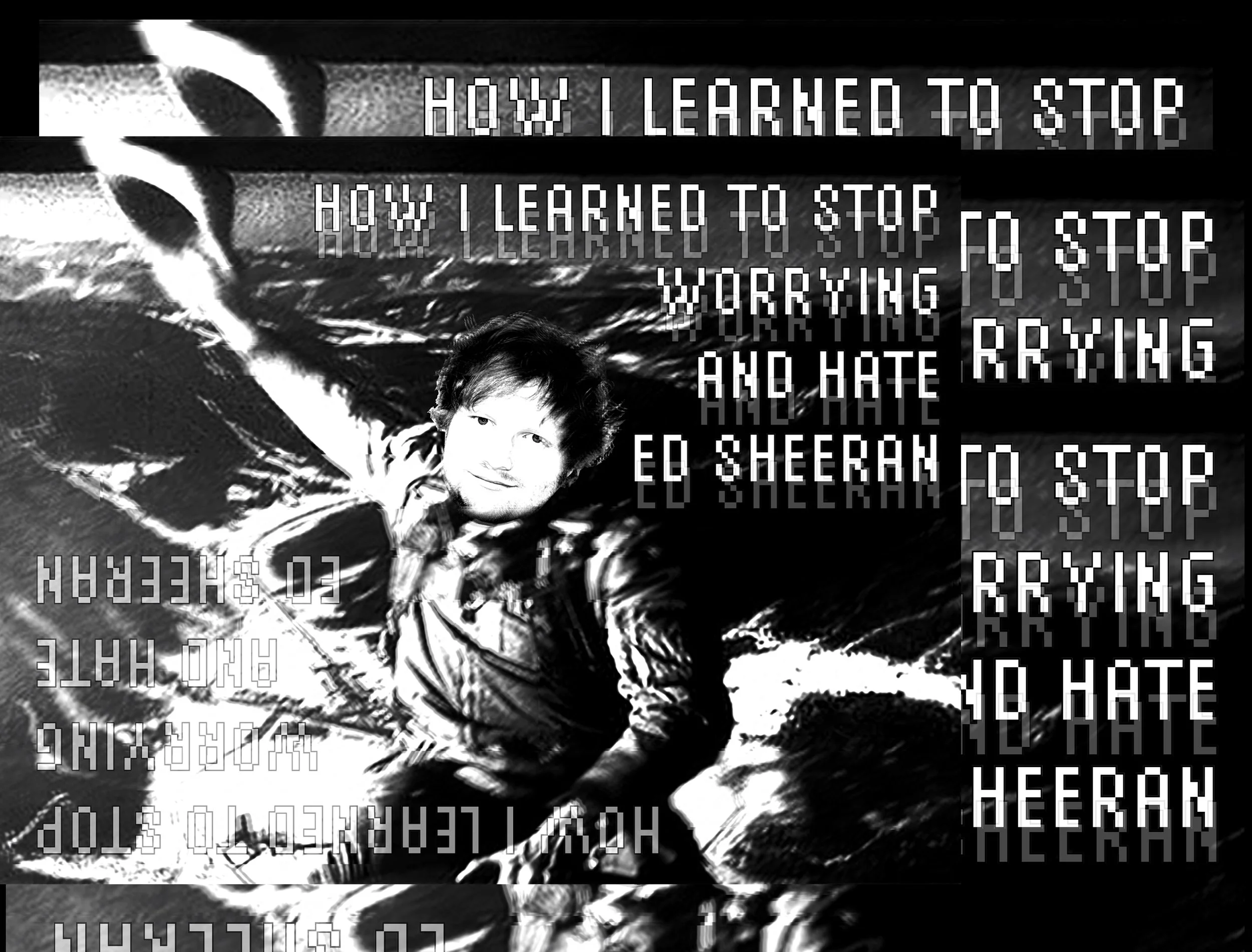
Because Ed Sheeran doesn’t exist. Not really. He may have at one point, but the avatar that cried onstage in Philadelphia and wants you to cry for him isn’t, in the end, a human with their own wants and needs, separate from the system he’s spent so much effort ingratiating himself to. Make enough decisions that fail to mark where you stand in relation to history, and you eventually vanish completely. Incapable of love, of fairness, of courage or even a modicum of individuality. Just another piece of flotsam aimlessly drifting through the tepid flow of capital.
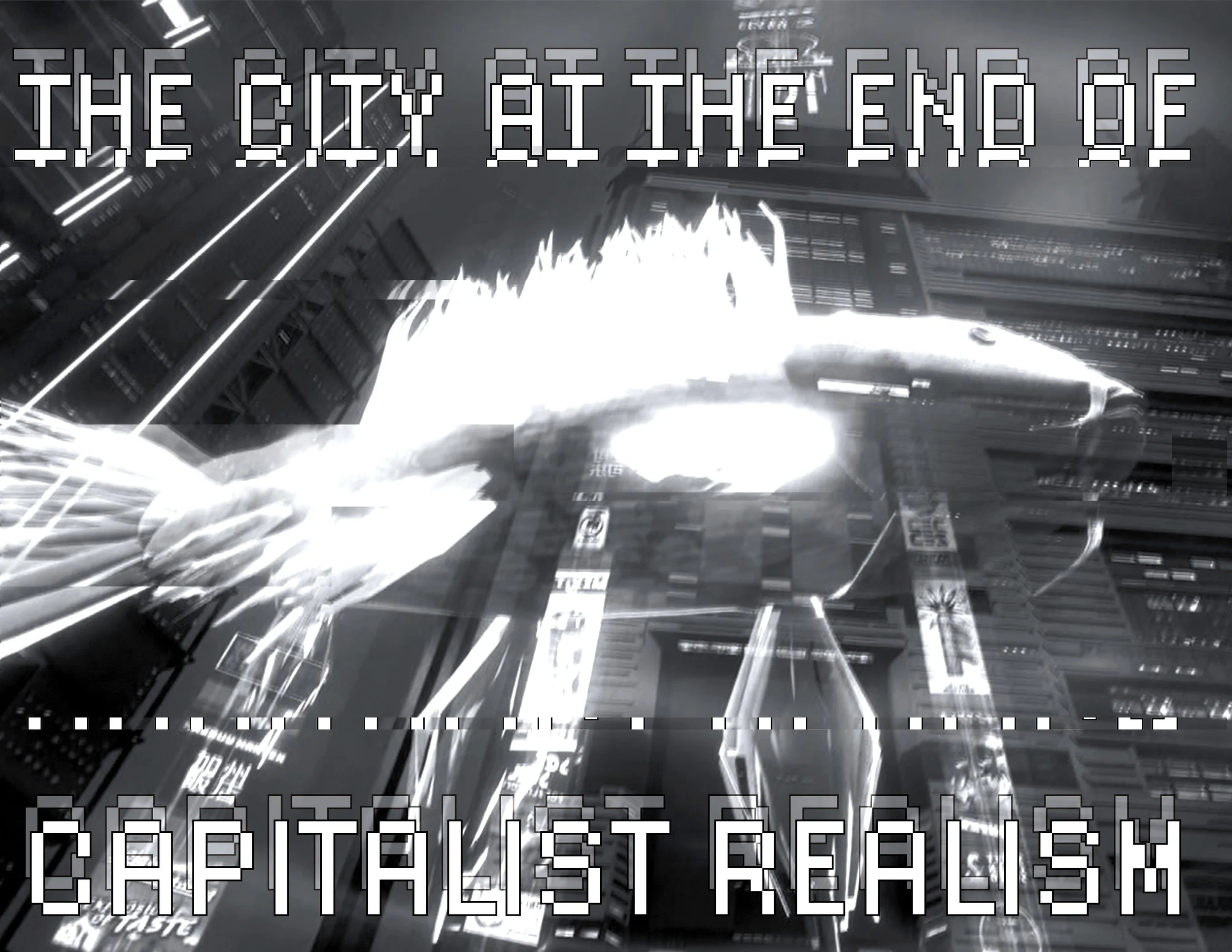
We have held up both utopia and dystopia as symbols of alterity, to express this, often keeping them at not such a great distance from each other. The Communist Manifesto, for example, is utopian or dystopian depending on how you understand the dialectic of things such as abolition of private property. In a world ruled by the maxim ‘There is No Alternative,’ the first attraction of dystopia is it shows there quite obviously is….
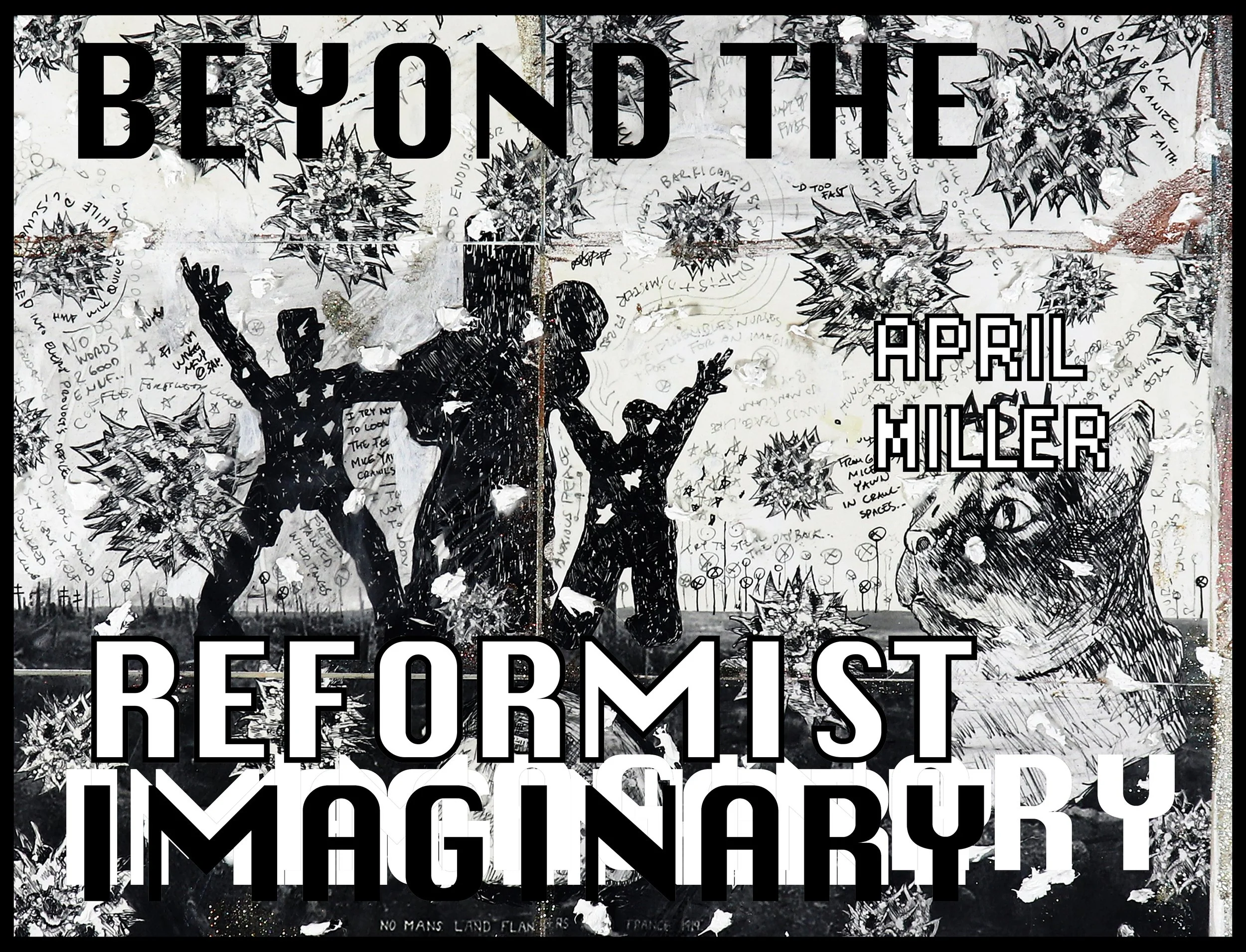
The twin determinist-fatalisms of Social Democracy and Stalinism, and consequently the crisis and collapse of these two trends and the mass parties they led, have relegated discourse over the shape of the future to the halls of economic abstraction — to a grand numbers game a dedicated cadre of critics and political economists conduct in perpetuity. The wider movement, meanwhile, either cheerleads all perceived sites of resistance to the main imperialist power, or limits the political horizon to immediate economic and democratic demands, with socialism relegated to a gesture of intent.
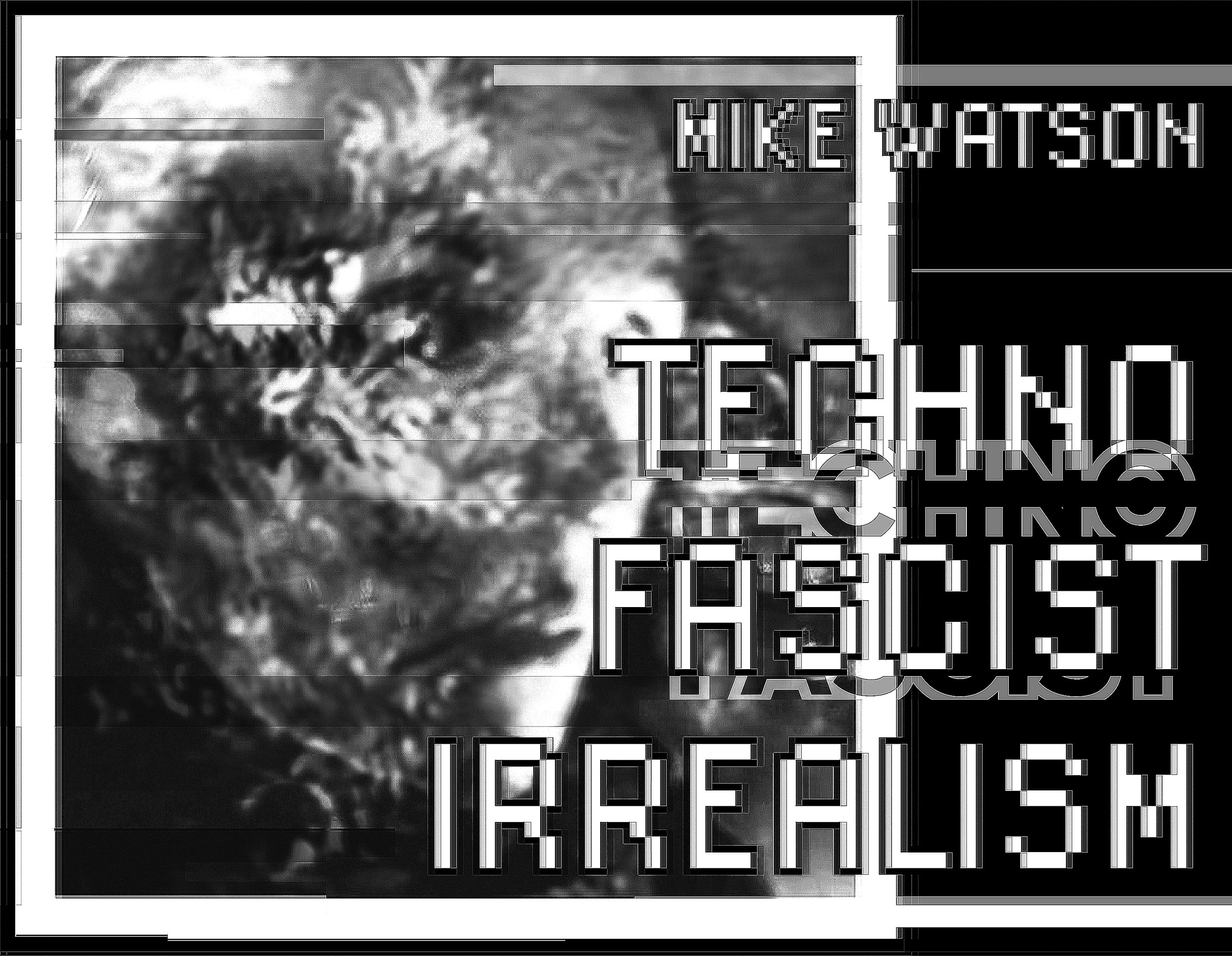
Our forebears said evil is banal, but still we were unprepared for the crushing weight of the everyday as it unfolds parallel to the shifting tectonic plates of history pursuing the darkest timeline. Politicians gather (like generals… in their masses) and pull levers that threaten to shift ethical poles and move continental thought patterns, leaving collateral damage in all four corners. A future army is set on the march. It might be made up of drones. It will be comprised of killers... Back home your son wants a particular dish, cooked in some specific way. The drains are blocked, in some anomalous way. The algorithms of war pump more data. The real estate magnate botches another sales pitch. It doesn’t matter — he’s not selling anyhow. He’s stealing. Meanwhile, you’ve got a lesson to teach, a bill to pay, a podcast to record, a meme to post, a pizza to cook… all as global techno fascism comes rolling in.
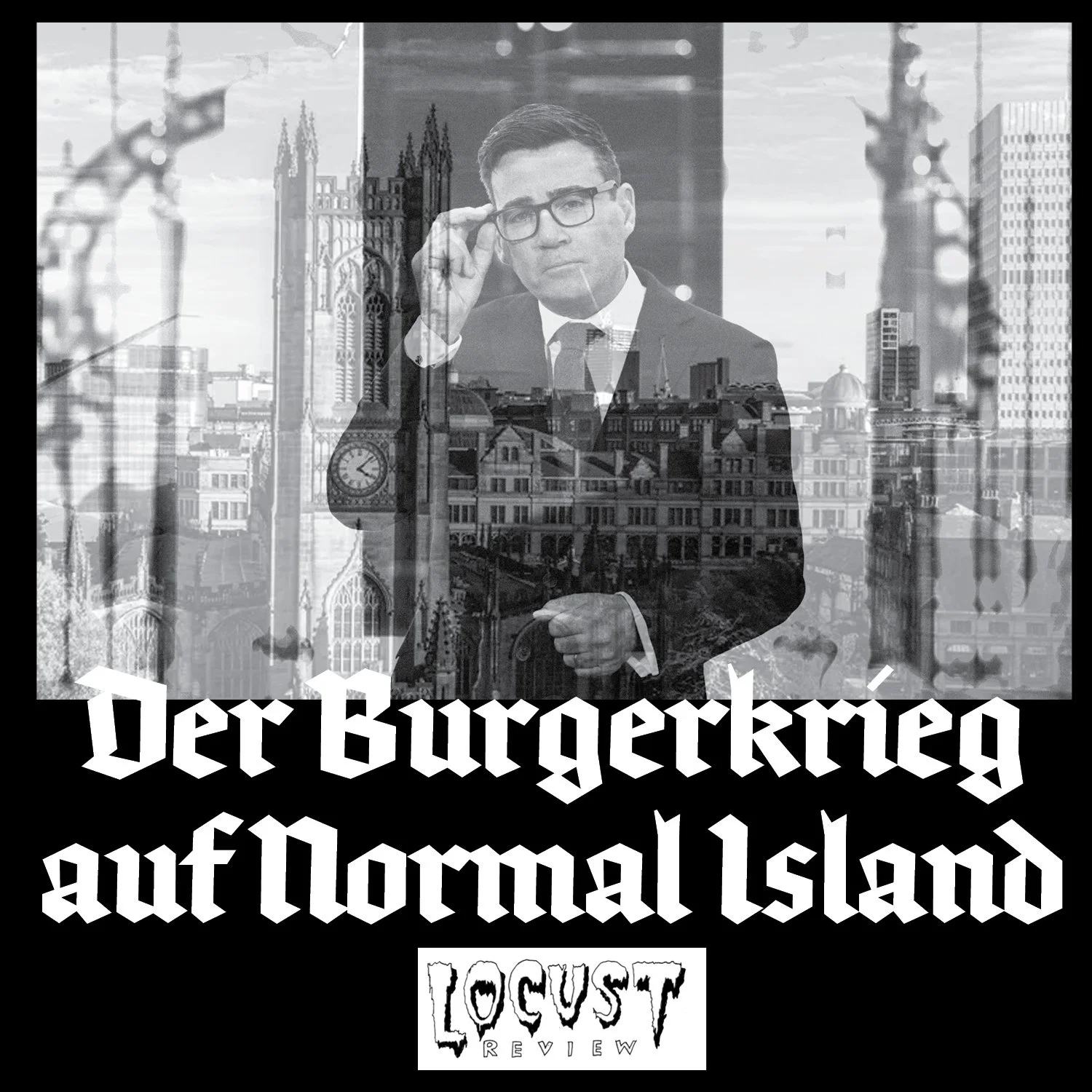
Whither the Burgerkrieg auf Normal Island? The UK economy is at near perfect standstill. The state is busy hammering the repression button, the only thing it knows works… and it’s not so sure it works.
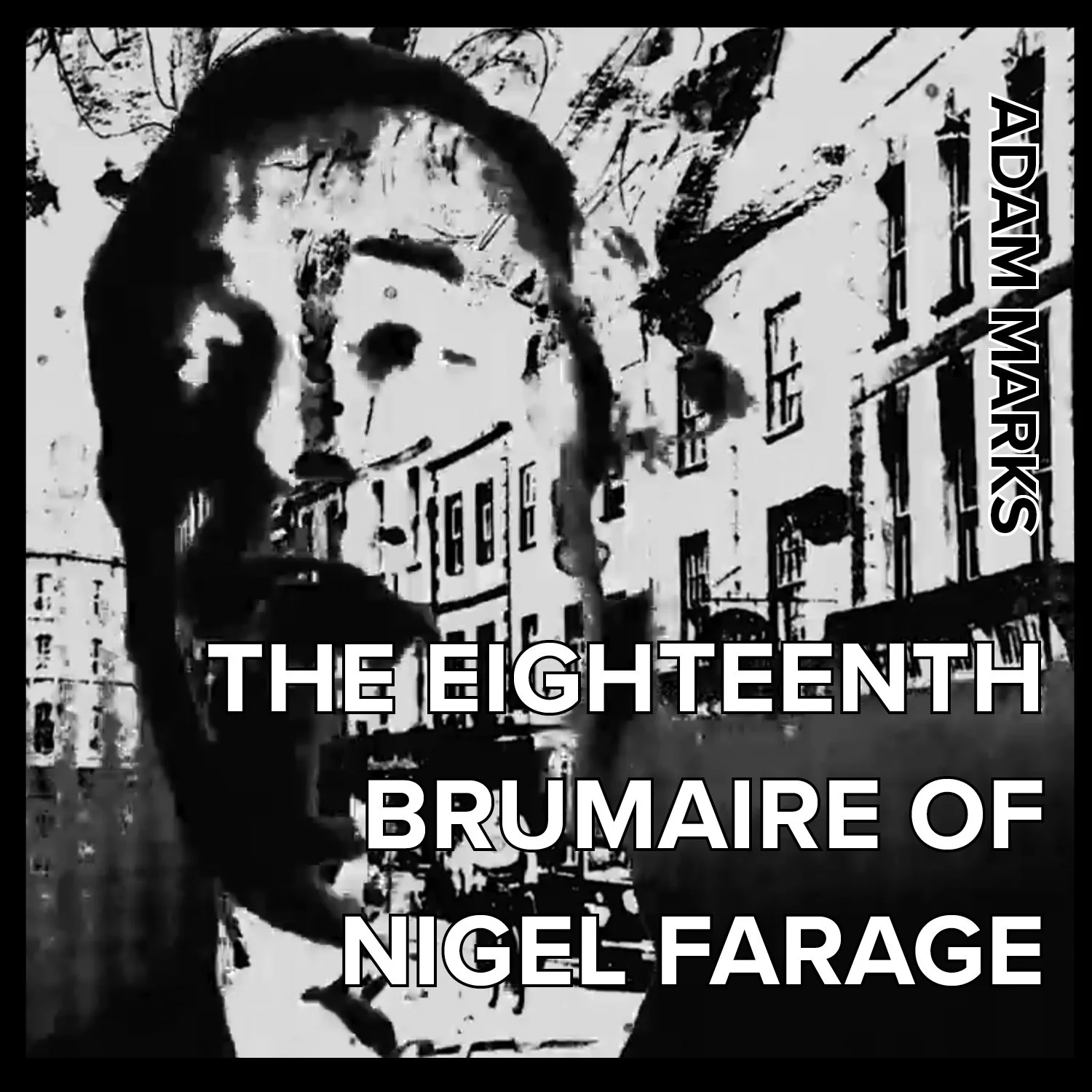
Mainstream right wing politicians have been experimenting with summoning their fascist golems. Suella Braverman who, in November 2023, was Home Secretary, after being frustrated at being unable to prohibit a peace march in London on the same weekend as Armistice Day, suggested that ceremonies at the Cenotaph on Whitehall were under threat from “hate marchers” displaying “thuggish intimidation and extremism.” The far right took this, fairly obvious, cue and descended on Whitehall, drunk and high. With no one to fight, they first fought the cops, then each other. Plus la change. Braverman largely blamed the police for this debacle. By December 2023, she was a back bench MP.
Digital technology appears as naturally artificial when it is actually shaped by political economy and intensive ideological encoding. It appears as a phantasmagorical being — a neutral cloud of invention floating above everyday life.1 In actuality it is a product of social life, including its privations, exploitations, and oppressions — and it reinforces or undermines those aspects of life, usually for financial and political reasons.
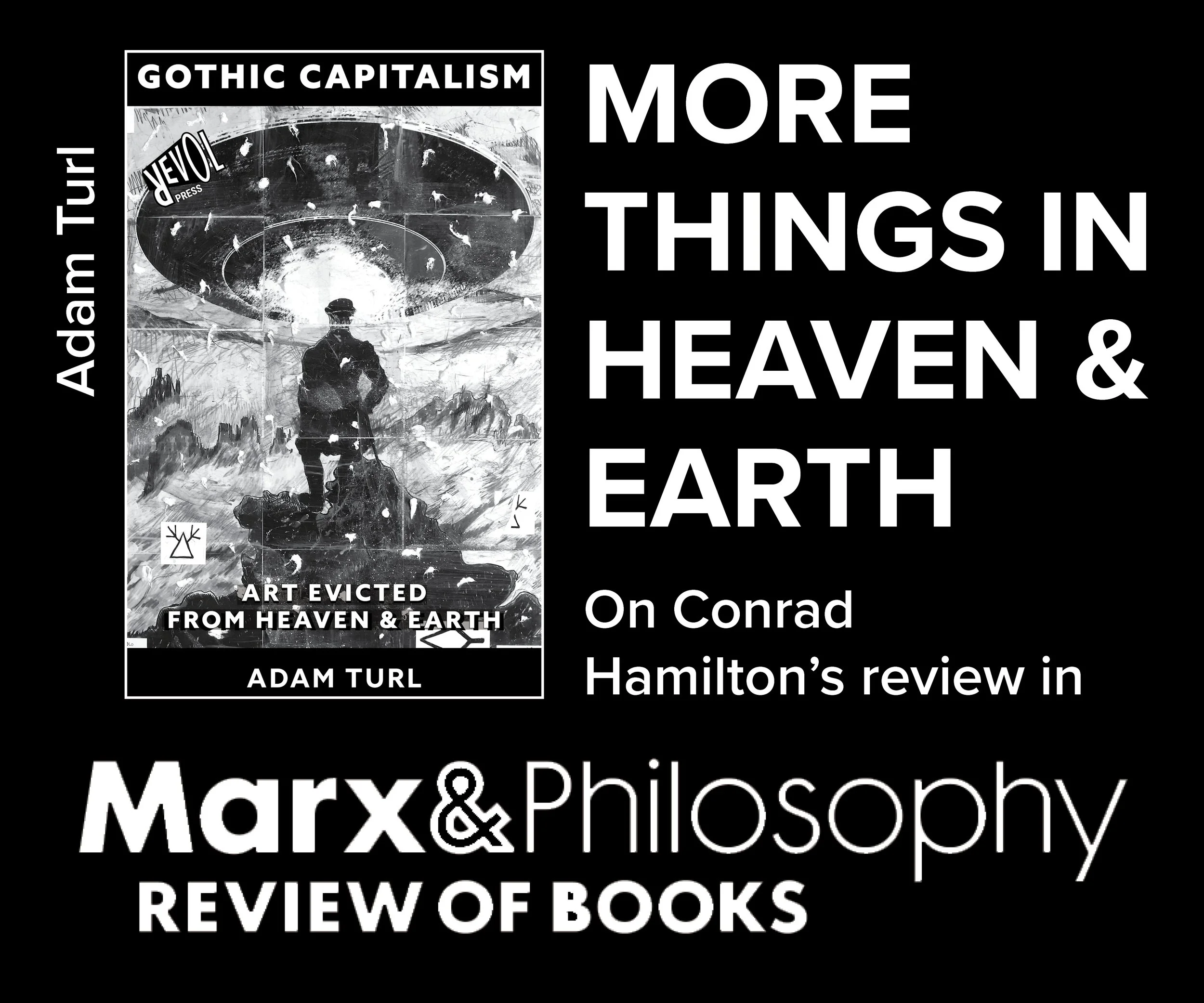
The socialist politics of art is, in part, centering both the rational and ineffable aspects of being on the actuality of a living revolutionary subject; the working-class both as it is, and as it could be. This includes the aspects of life that resist categorization, mapping, utility and rationality. Accepting this is not a concession to superstition. It is placing a working-class claim on all that it is to be human.

Few serious people would consider Greg Abbott, the current governor of Texas, to be excessively subtle or nuanced. But even by the crude standards of right-wing politics in the Lone Star State, Abbott turned some heads when he announced on October 19th, in a post on Elon Musk's "X," that college and university professors can and should be fired for mere "ideological differences" with him and his de facto fascist outlook. Right-wing politicians usually talk about such things in a slightly more guarded way, deploying euphemisms and dog whistles.

I contend that Manos, while complaining about the lack of politics in Turl’s work, has written a very apolitical review, predicated upon an intellectual campism rooted in what China Miéville calls “folk Marxism,” received beliefs, rather than dialectical reason. Manos’s view of the politics of art seems entirely functionalist.

The Housing Act 1980 was the big bang, the origin story for Normal Island. After World War Two Britain was desperately short of housing stock. State action, by both Tory as well as Labour governments, got homes built. Even in the 1970s work was ongoing, bomb sites were still being cleared. The 1980 Act, however, promised council tenants the right to buy their homes. In time a gigantic amount of equity was released. By 1986, financial markets were deregulated and this equity could be traded with greater ease and velocity.
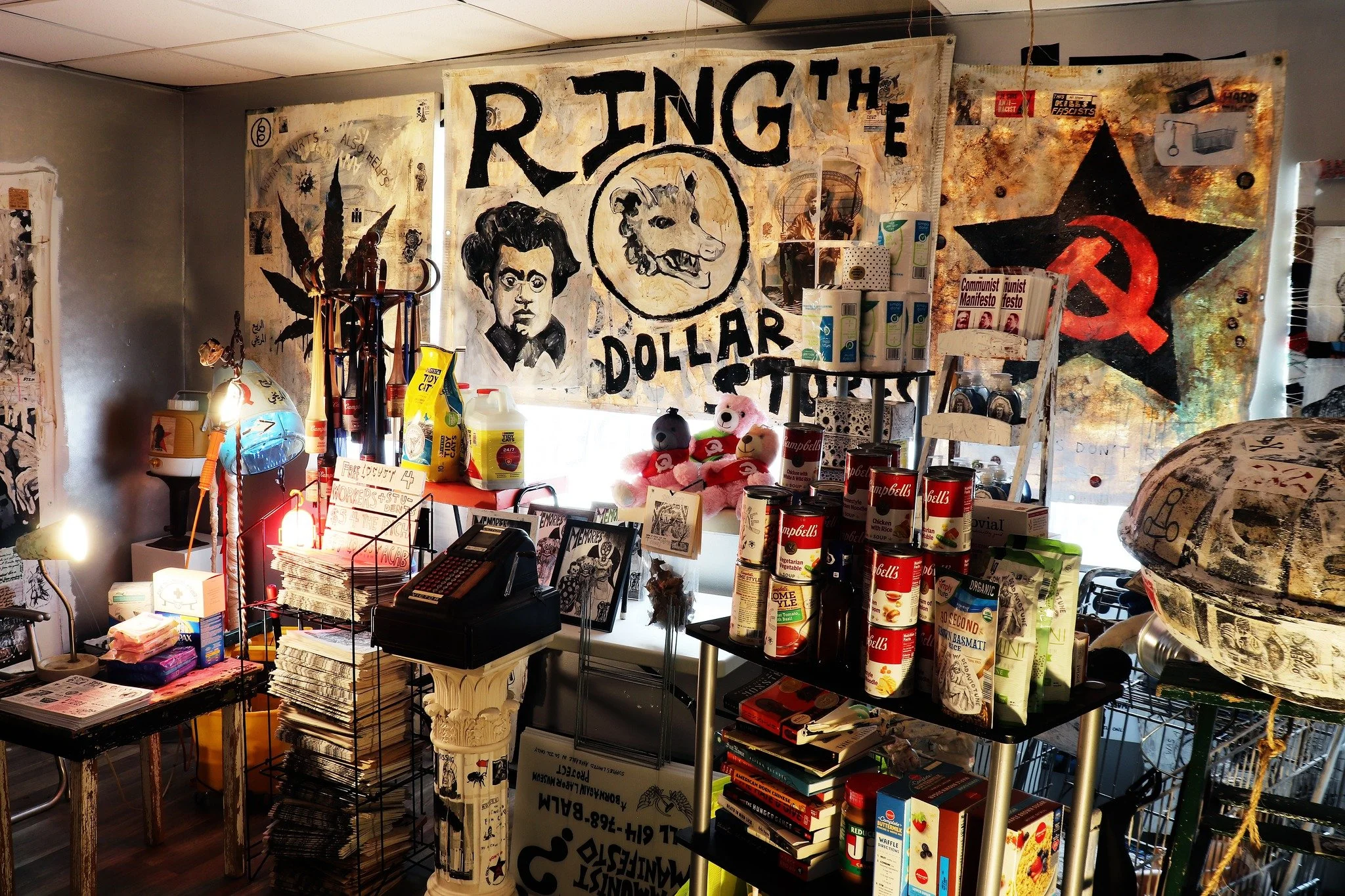
I think every place has a lot of lost souls, but also there's the impossibility of representation. We're from here. I'm from this town, Carbondale, Illinois, and we're familiar with the nature of the loss here in a way we might not be intimately familiar with in other places. But the sort of impetus was the realization the art space is a theatrical space.

The effect is important, not so much the actual individual piece of work. So if you have some good effect, of course you can have good effect or bad effect, but let’s hope that whatever you’re creating has some good effects. As long as that good effect fertilizes the soil that’s what I care about.

An art exhibit at the Austin-Irving Branch of the Chicago Public Library (on Chicago northwest side) was abruptly removed on September 18th by order of the city's Library Commissioner following political complaints by two unnamed individuals who are city employees and are on city payroll. Without contacting the Branch Manager or the show’s curator / organizer, the exhibit was censored and ordered to be taken down early. The show was installed on July 5, 2025, and was scheduled through September 27, 2025.

Anyone with enough sense can see how stupid the hue and cry over Kneecap is. But then, we live in a particularly myopic age, aggressively forgetful and wantonly incurious. One prone to performative pearl-clutching over simple talk of murder while real murder (indeed, genocide) takes place on a daily basis.

Orson Welles called Los Angeles “a bright, guilty place.” David Lynch, upon his arrival, noticed the brightness. “I love Los Angeles,” he wrote in Catching the Big Fish. “I know a lot of people go there and they see just a huge sprawl of sameness. But when you’re there for a while, you realize that each section has its own mood. The golden age of cinema is still alive there, in the smell of jasmine at night and the beautiful weather. And the light is inspiring and energizing. Even with smog, there’s something about that light that’s not harsh, but bright and smooth. It fills me with the feeling that all possibilities are available. I don’t know why. It’s different from the light in other places.”
If we assume a priori there is such a thing as an objectively “good poem” — but do not unpack what that means — do we not risk making normative evaluations of other poets’ work?

It’s been a year now. A year of declaring, forcefully, repeatedly, that the history of Israel and Palestine didn’t start on October 7th, that Palestinians deserve to live dignified and free, that rejecting Zionism is not antisemitic. That what is happening is indeed genocide.
A year of warning that this was bound to spin out into a wider regional conflict. As it now has. Lebanon. Yemen. Syria. Volleys of missiles between Israel and Iran, the possibility of all-out war creeping closer.

There are four great interwoven crimes that create capitalism — enclosure and the creation of the proletariat, industrializing chattel slavery, colonization/imperialism, and the subjugation of women and gender normativity. Not one of these is possible without racism. Not one of them is “over.” Not for working-class and poor people. Not one of them has stopped its ruthless destruction of life and being. But the mountain will come crashing down in a wave of a billion voices, accusing, exposing, confessing, rebelling. Hamilton’s book of brilliant poems is, in this sense, prophecy.

I want to create characters not that people aspire to be like but whom people see themselves in who end up doing things they already aspire to do but won’t, for whatever reason. Probably this penchant for fictional violence against wealth hoarders will get me into trouble eventually. Until then, however, I will continue to write about working class robots in sewers trying to shoot the evil meat above.

The internet promises democracy but delivers reactionary politics (and is designed to do so). It promises expression and valorization of the subject, but delivers, more often, dopamine denial and depression. Meanwhile the analog, at least in the arts, promises authenticity, but fails to deliver much more than rarefied bourgeois spaces, out of touch with the vast majority of the human race — as Amiri Baraka would say, “fingerprints of rich painters”... Or, empty art museum spectacles; Epcot Center immersion for the cosmopolitan bourgeois and petit-bourgeois.

The default cultural logic of neoliberalism and the political center is capitalist realism. In response the cultural logic of working-class emancipation (socialism) is critical irrealism. The ir – or no – of critical irealism is opposed to a particular kind of realism. Therefore, we should examine it more closely.

There is one form of the Romantic culture that does not advocate the return to the past, but a detour by the past, towards an emancipated future. This we call revolutionary Romanticism, which begins with Rousseau, followed by Blake, Shelley, William Morris and many others.
Don’t worry. / Don’t hesitate. / You are good. / You are righteous. / And righteous goodness / can never be cruel.
One day I woke up / and somebody called me “elder,” / and I almost checked my pulse. / Then I remembered— / queer years run on dog-time.

Thank you for participating in the end of the world. Your input helps us improve future catastrophes. Please complete the following fields to the best of your remaining ability.
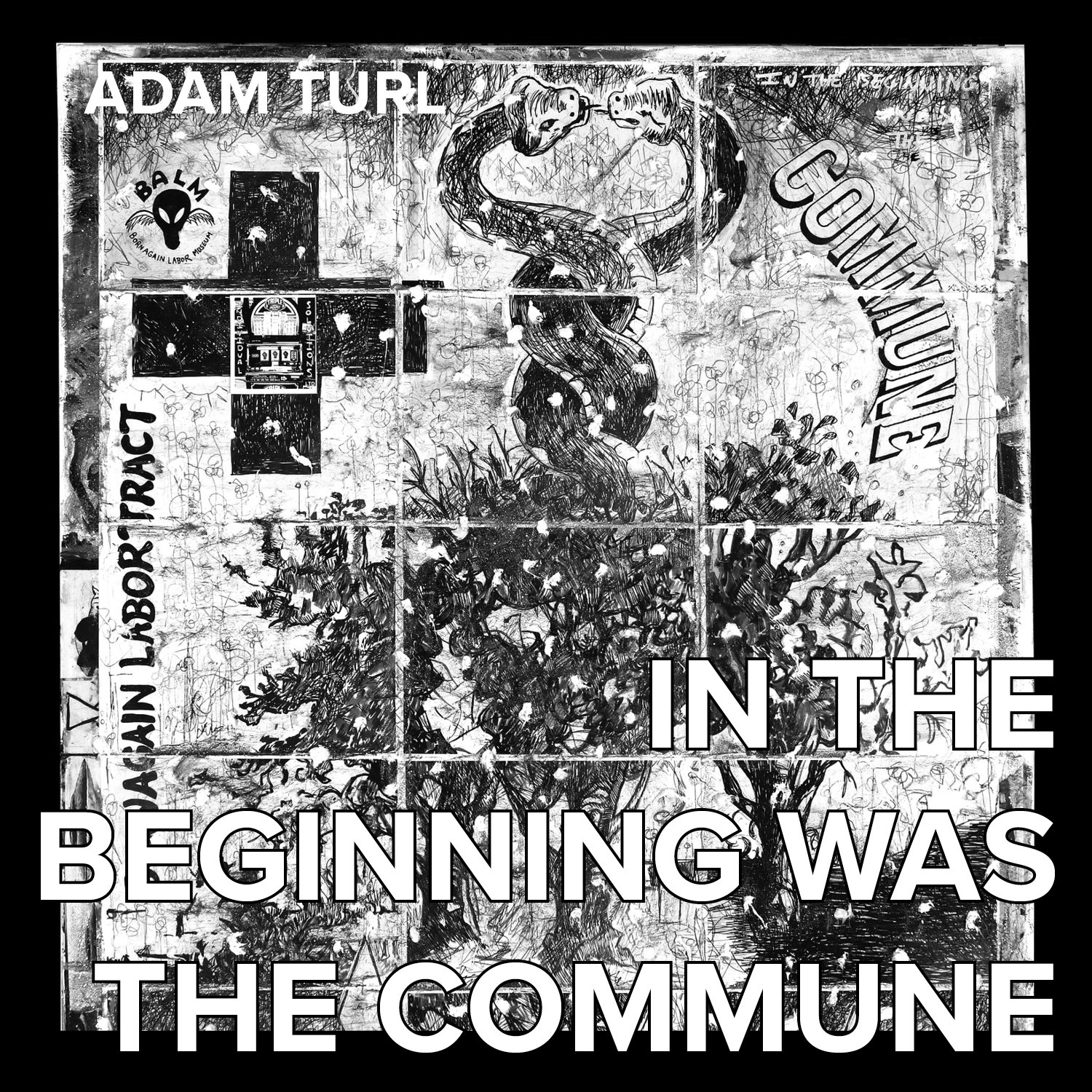
The people who became us lived under oaks. / In the canopy two rat snakes were in love, / spending their days in a warm caduceus.
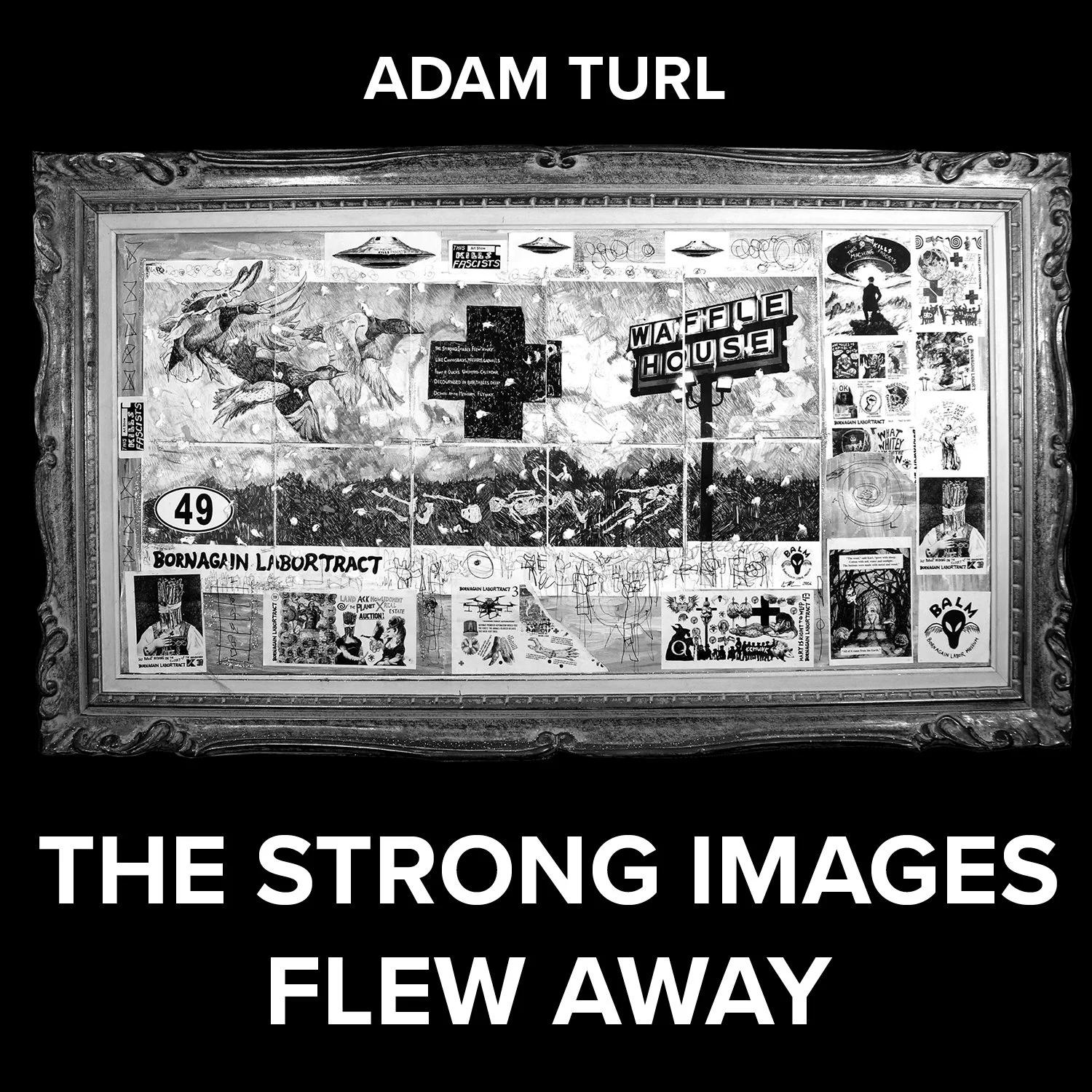
Don’t bury your images in the yard. / You’re supposed to starve the faeries, / mow down grave mushrooms, / take off your Scotch bonnet and / burn your scalp with moonlight.
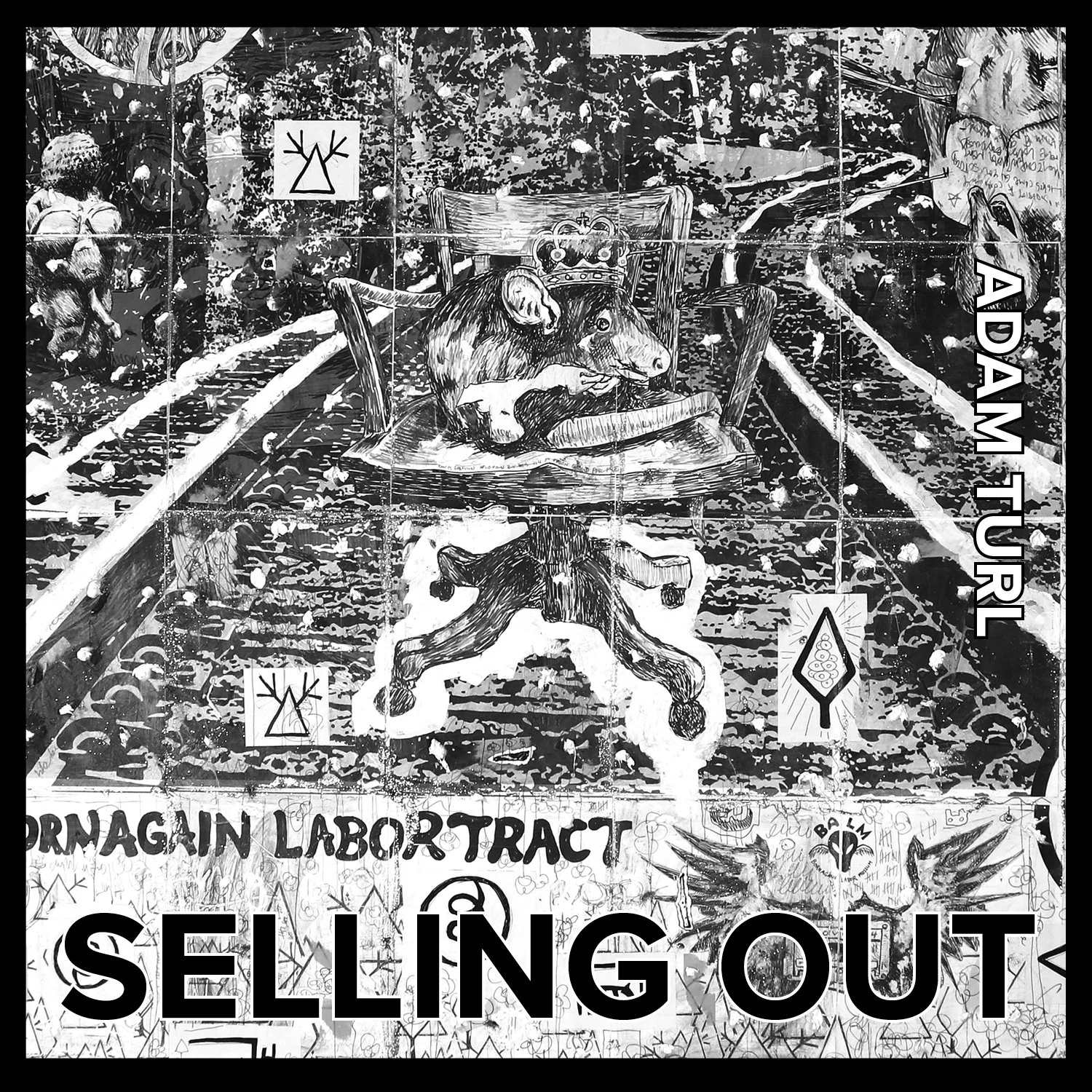
If you held to your guns you’d still have guns. / Mean like Lenin without the mean, wrap / yourself in Jacobin bylines like a letter jacket, / forget the golden rules.
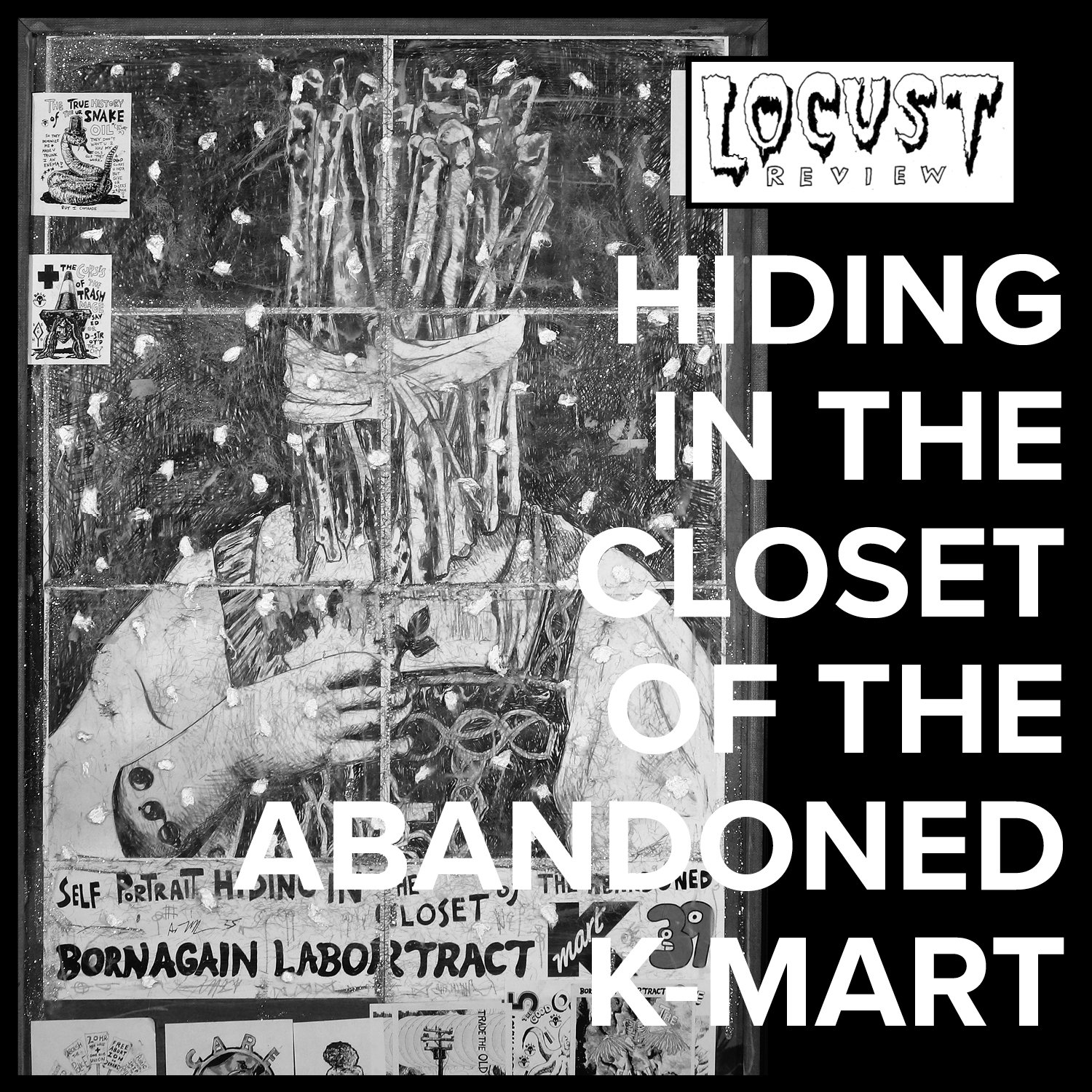
You’ve been hiding in the closet / of the abandoned K-Mart. / You’ve become a pastor to pigeons
nestled in trusses and rafters. / They coo to your sermons of / plentiful seed and a multiverse of millet.
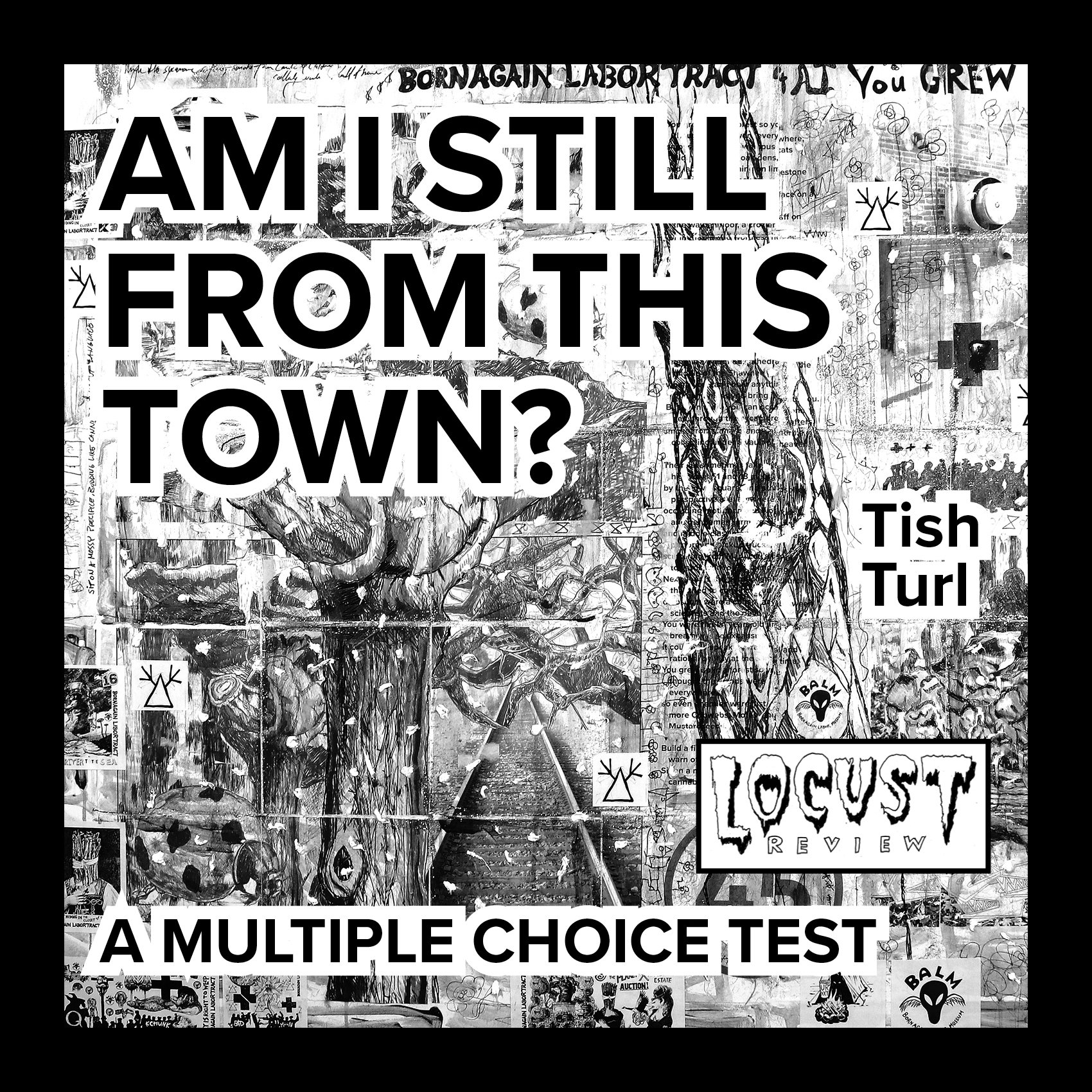
1. The first thing you smell when you hit Main Street is: A. Burnt oil and fryer smoke. B. The ghost of the factory, coughing in the dust. C. Your own nerves. D. All of the above.
Naugahyde seats crackle and groan under my knees, / sounds like taking shoes off at the end of the night, / when I remember that the first computer / was a woman named Ada Lovelace / who worked from home, mailing numbers to a Difference Engine

We walk in the firelight of foreclosed homes, / smoke thick as the ink of old contracts,

“Sorry, can I have a Woody Burger with cheese and a medium vanilla Chipper Chilly Chompachino?”

If Venus were the moon / your voice would still / smell like gunpowder

there’ll be snow on the tombstones, / snow and something else / soon enough
And these, / throwers of caution to wind / are guardians of fire; / the living; / marching shoulder to shoulder with death, / ahead of death, / still living even after with death. / And forever with the name / with which they lived. / Since decay / passes beneath the tall horizon of their memory, / hunched and shamefaced.

I see it in the folds of your hyacinth mouth / I hear it in the splintered syllables of your culling tongue / I’ll carry you with rough hands / across the waters / into nothing
Ungrateful of their blessing, They were. / And the hands insulted, humanity they cursed. / Since their rightful place, was not crossed on chest, / in bowed servitude. / … And the fall began.

Here’s a shit in Warsaw, / flying the Polish flag, / the German in Bonn. / In Lyon the Tricolor / sticks up from the dump.
Where they hung the jerk / That invented work

His work is better suited / for panic attacks / than anything smacking of pride.

these parasitic hours sitting through the night

Free as black ants in a bladed line.
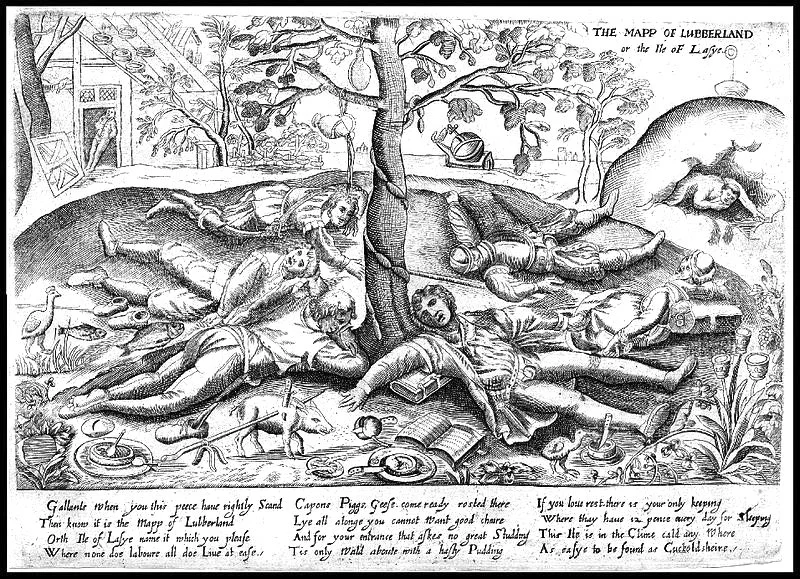
‘Hot roasted pigs will meet ye,
“Lay down your labors, good worker.
Put off your boots and gloves.
Enter, and be among your comrades whole.”

I heard scurrilous things:
babies with two heads
locked in the attic,

exploit, object. St. Louis as beeswax, resin
You, from inside your
publishing house of
unearned income,

Tenderness has no place here. / The long lineage / of gentle touch severed / by jagged images of the instant.

the whip crack from the snout of the gun / steel elephant blued / to a deep, desperate negative / stark against the snow

as we wipe our tears on stone altars

beware how delicately you wear / this crown of oblivion.
The default cultural logic of neoliberalism and the political center is capitalist realism. In response the cultural logic of working-class emancipation (socialism) is critical irrealism. The ir – or no – of critical irealism is opposed to a particular kind of realism. Therefore, we should examine it more closely.
The following essay was written in February of 2020, for the website of left-wing arts and culture publication Red Wedge magazine, not long before its activity ceased and former editors moved on to other projects, including Locust Review. We post it here in an effort to give readers a sense of LR’s roots, the artistic and political questions that we have sought to answer, and the bearing they have on those being taken up by the Locust project. In the coming weeks, we will also be publishing a selection of Red Wedge’s best material.
Ignoring the content of these artworks has reactionary implications that Dunst has probably not considered; or has considered but ignored in an attempt to gaslight his readers. In the way he has written this article, the horror of the Holocaust, the repression of our Iranian comrades, homophobia, are all dismissed as an “obsession with personal identity.” One has to wonder if the problem with these texts and images, for Dunst, isn’t that they are memoirs, but that they are the stories of people who are gay or queer, aren’t white, or whose whiteness is contingent.
Academically-trained working-class artists who pretend their hard earned knowledge, their BFAs and MFAs, make them immune from this dynamic, are fooling themselves. It is understandable. We do not want to think of ourselves as art world dark-matter, permanent adjuncts, and stalking horses for gentrification. But this is what the art world is making of us, and what we must break from as workers, as artists, and as socialists.
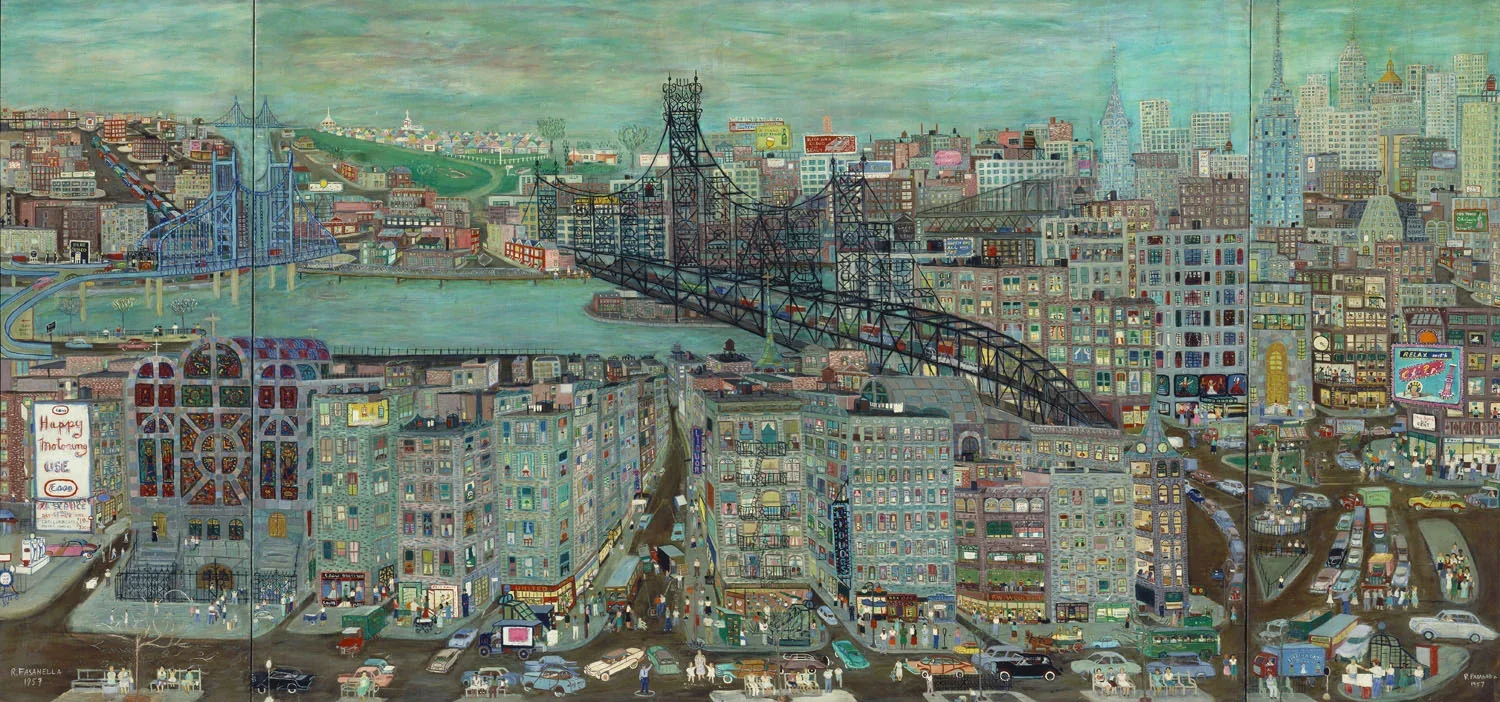
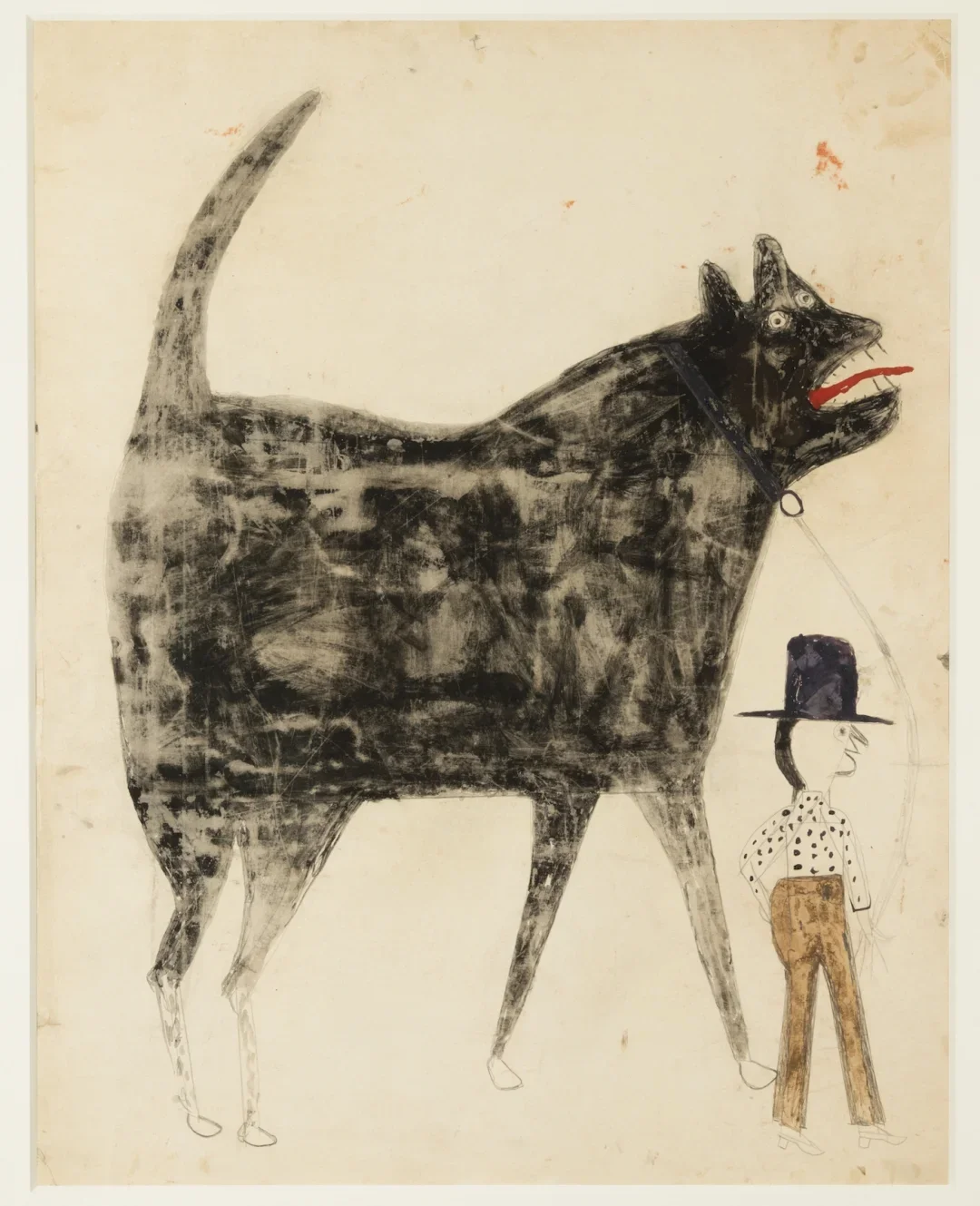
The concept of outsider art, or self-taught art, is a lie. It conceals the actual artistic arguments and content articulated by the artists who are described in this way. While the history of the concept is more complicated, its present usage is bound up with a racial, class and geographic othering, which centers the bourgeois and petit-bourgeois institutional art world (located in New York City first and foremost) as the norm (when it is itself the outlier).
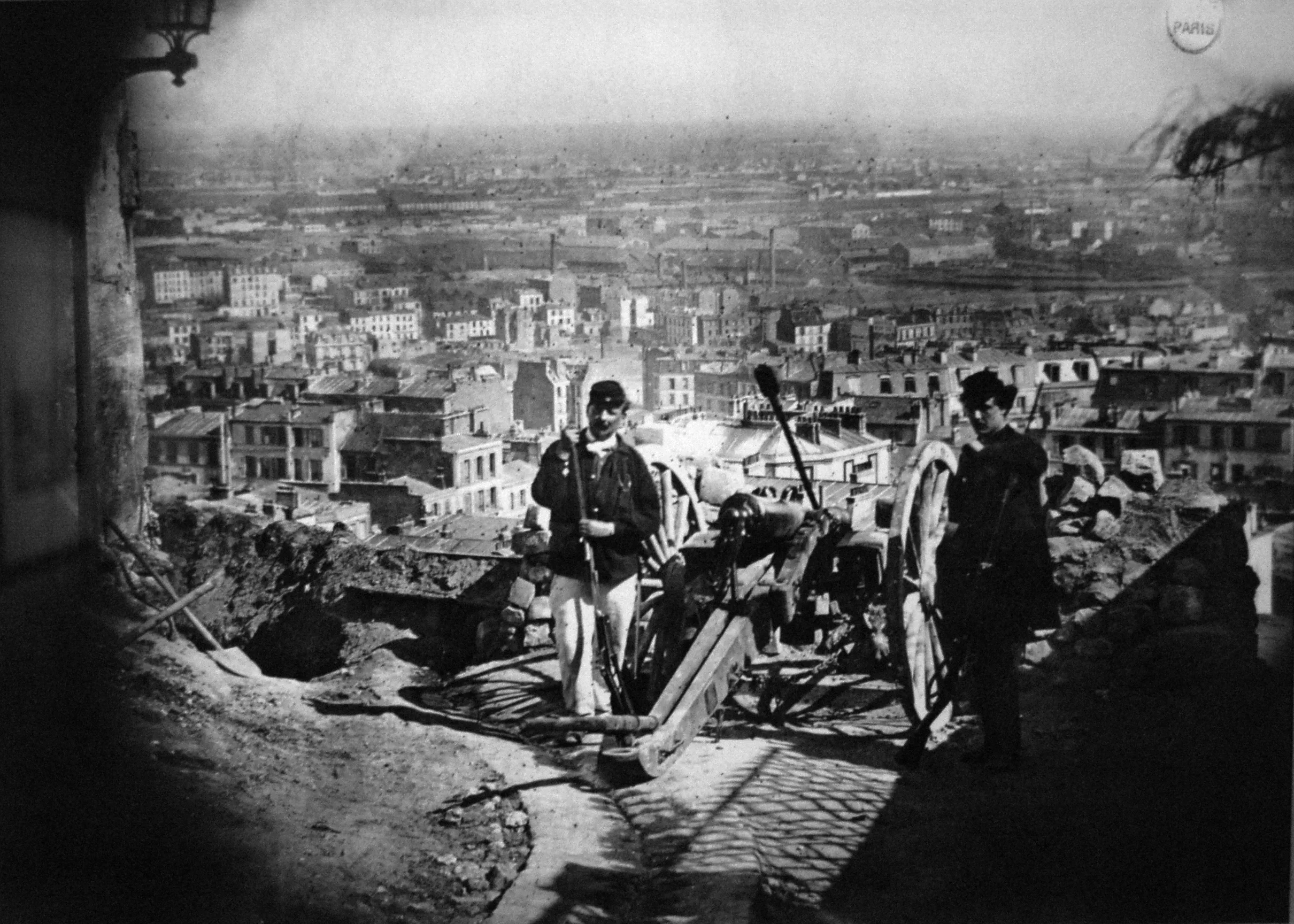
The formation of art enclaves in industrial capitalism, during a century of accelerating aesthetic and conceptual innovation (1850-1950) had a progressive logic. Artists’ innovations fed off their physical proximity to each other. Moreover, these aesthetic and conceptual interventions were often in political sympathy to the industrial working-class concentrated in cities like London, New York, Paris and Berlin. Artists found a radical, and oftentimes working-class, cosmopolitanism in these artistic enclaves. Gentrification had not yet evolved to exploit artists as it does today.
There is one form of the Romantic culture that does not advocate the return to the past, but a detour by the past, towards an emancipated future. This we call revolutionary Romanticism, which begins with Rousseau, followed by Blake, Shelley, William Morris and many others.
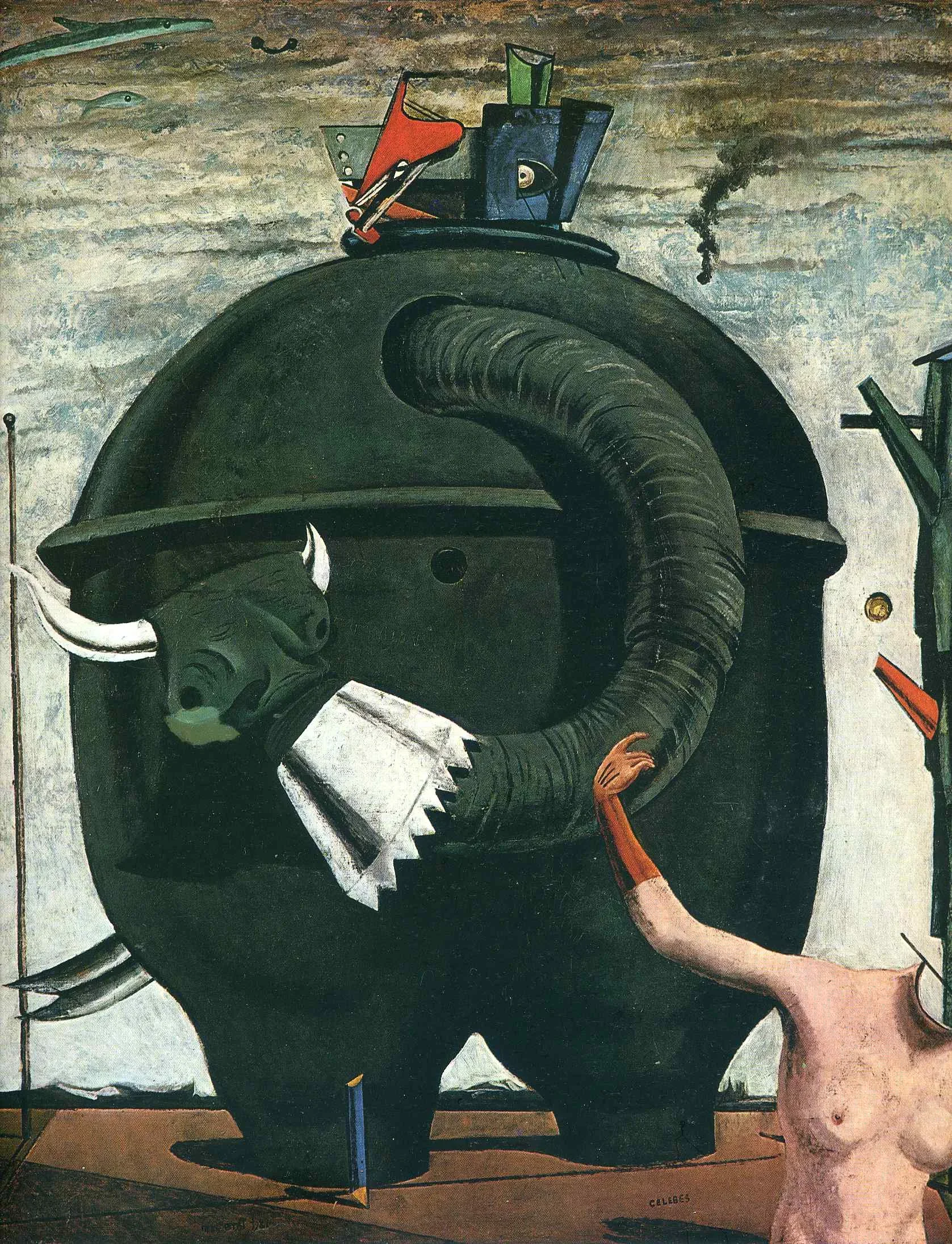
China Miéville’s novella, The Last Days of New Paris, pits the Surrealist art of Paris – literally, or literarily – against the Nazi occupation. The art has manifested itself – becoming “manifs” in the novella’s slang. A giant version of Max Ernst’s The Elephant Celebes – “the most famous manif of Paris” wanders the streets. An exquisite corpse battles a centaur-Panzer tank. People flee Teutonic Arno Breker statutes. Odilon Redon’s “leering ten-legged spider” hunts “at one end of rue Jean Lantier, chattering its big teeth.”
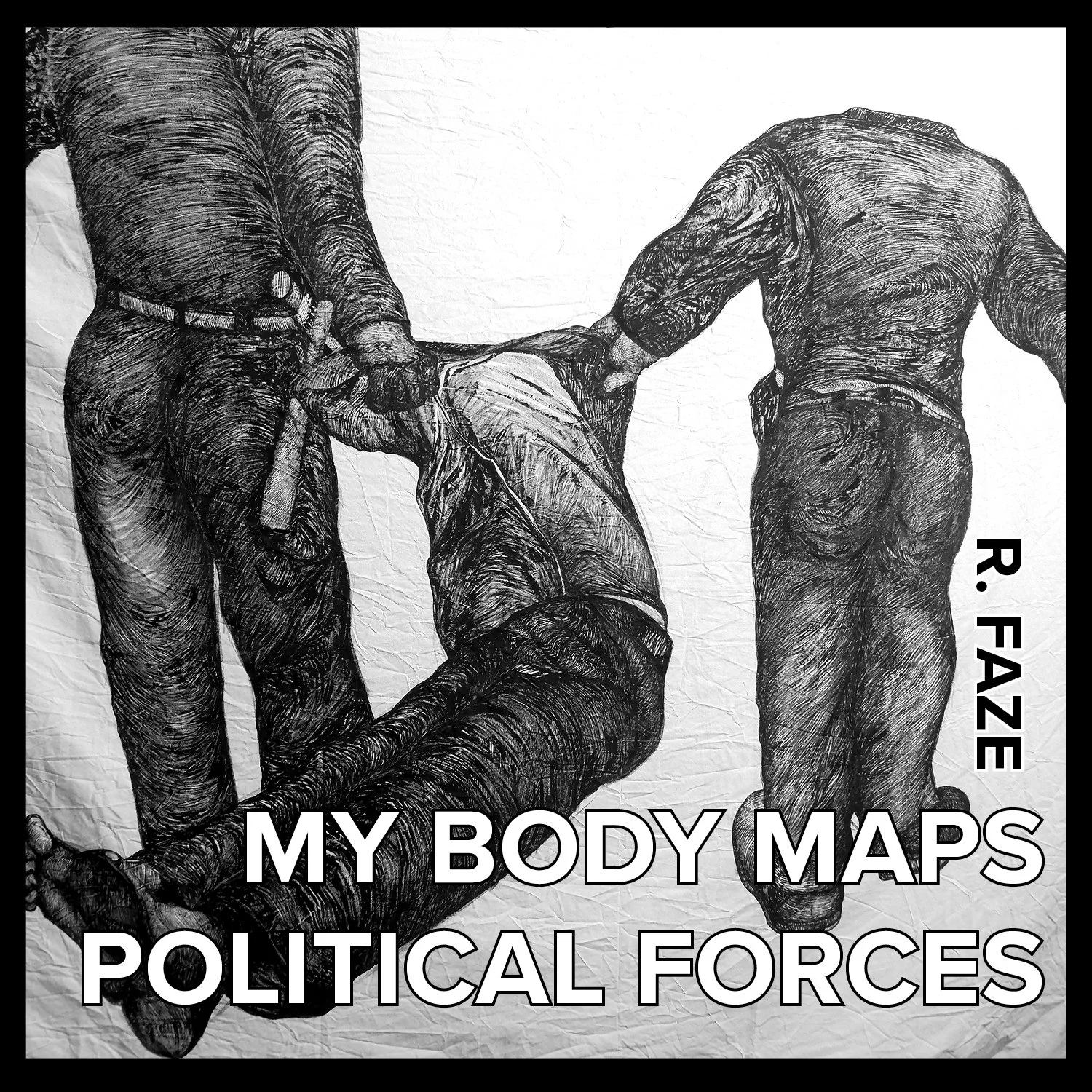
It was four years since the attempted self-immolation by my body. Three years since my body was named The Idiot. Two years since The Idiot had any contact with sister, mother or father. A year and a half since The Idiot’s prayers had been answered. In the wrong way.
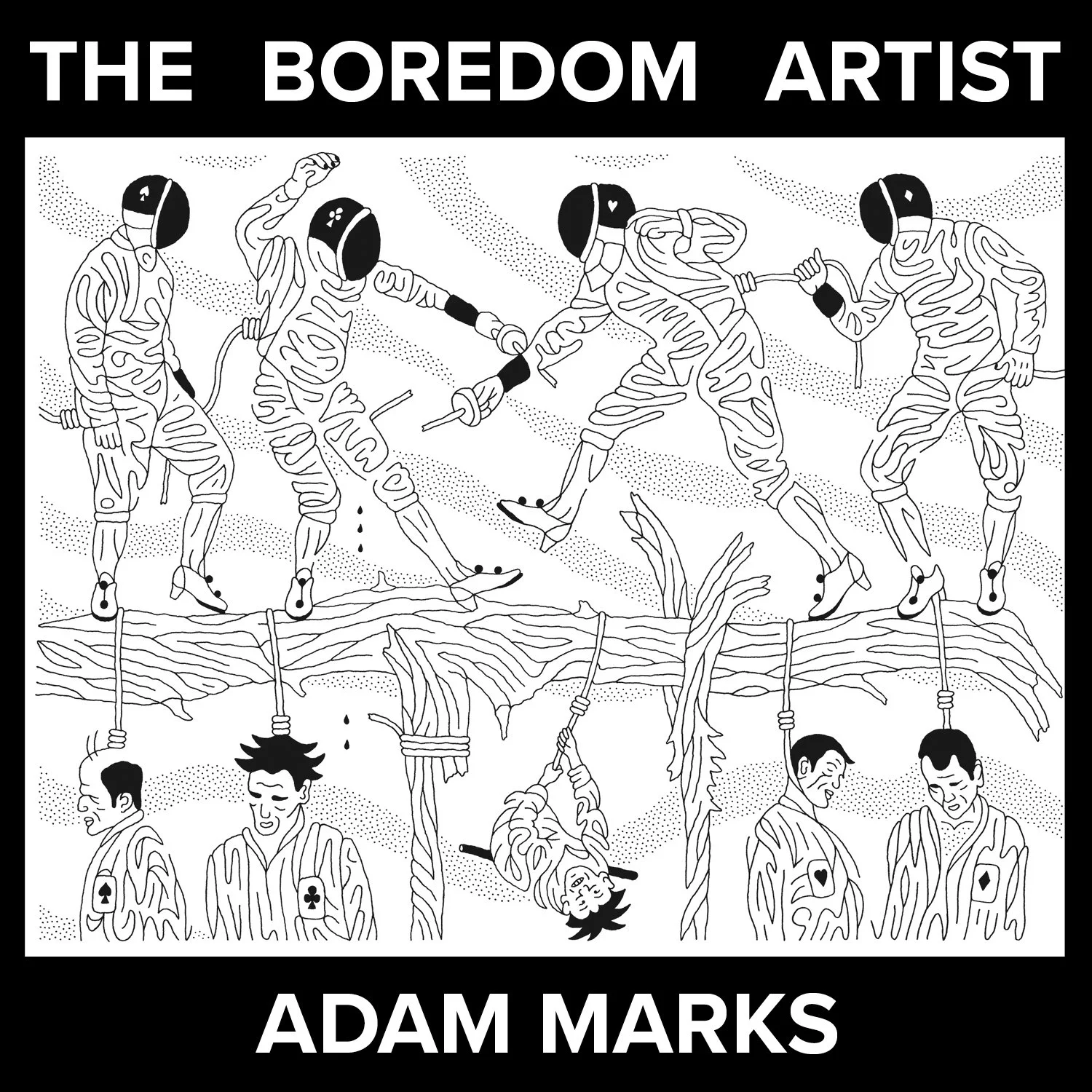
THE BOREDOM Artist was set to retire. He would give one more performance. London’s Festival Hall was sold out as a result. Last chance to see. One-thousand seven-hundred and ten people, people who liked and appreciated what he did, would go with Dave to a place he had never gone before, though midnight, past the hour-mark. A clock behind them counted down.
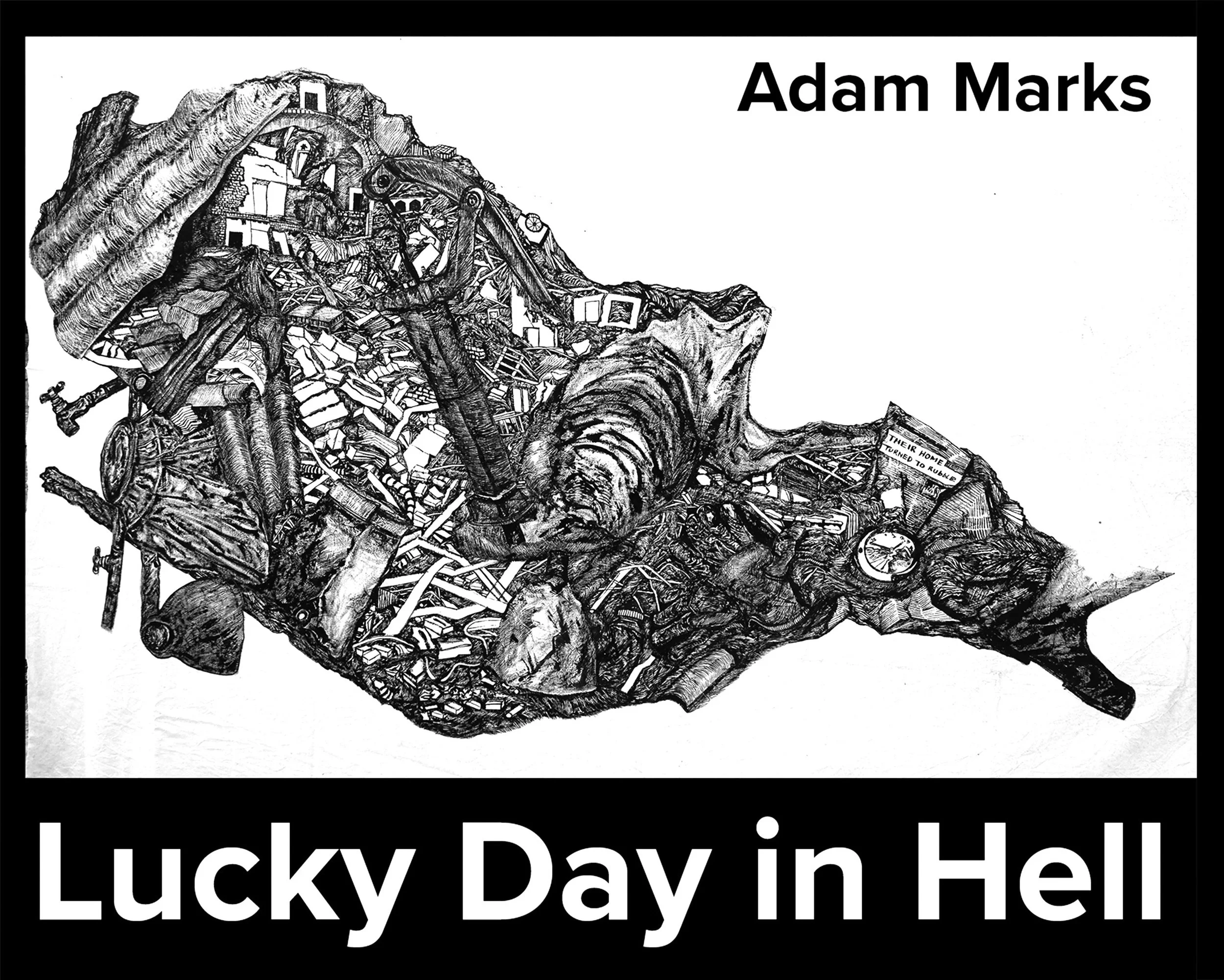
“Who are… Do I know you…?” Jake was puzzled. The voice came from a woman, tall, olive skin with dark, greying curly hair. She was standing just inside the street light, on the corner of the alleyway, leading from the High Street to Dyvenor Road. After a moment of figuring this out Jake realised she was holding him, gently but firmly by the shoulder. “What do you want…?”
The mansion had to be more than twenty thousand square feet, with five wings; it took up two acres. In the backyard, a giant infinity pool overlooking downtown L.A., a jacuzzi big enough for a football team, an industrial-size outdoor kitchen that could feed two hundred people, thirty-two-seat table made of rough-cut red wood with an eight-inch-thick top, three brick fireplaces, eight open firepits, two pizza ovens, and more trees and flowerbeds than in a Vegas resort.

“It snatched a dog two days ago, in Drapers Fields,” Detective Constable Habib explained back at the station to her superior, “right in front of its owner. They found its entrails wrapped around a lamppost on the High Road. It’s head was…”

Even in this cacophony, it’s the silence that unsettles most. If only because it won’t be long until it’s pierced again. Screaming, shouting, tires screeching, panicked footfalls, sporadic gunfire. If there were ever a silence that could threaten, a kind of quietude that, for a few seconds or several minutes, promises to split the skull of whomever steps in its way, this is it.

It was a dark, cloudy night: perfect! A group was gathered in a corner of Old St Pancras Churchyard. They were not a regular congregation. They were men and women of various ages, pepper-pot faces, ordinarily dressed, mostly; a true cross-section of London. They were stood in a circle. Each was holding a bucket and glancing, quietly, reverently at the bare, muddy ground in front of them…except for one.
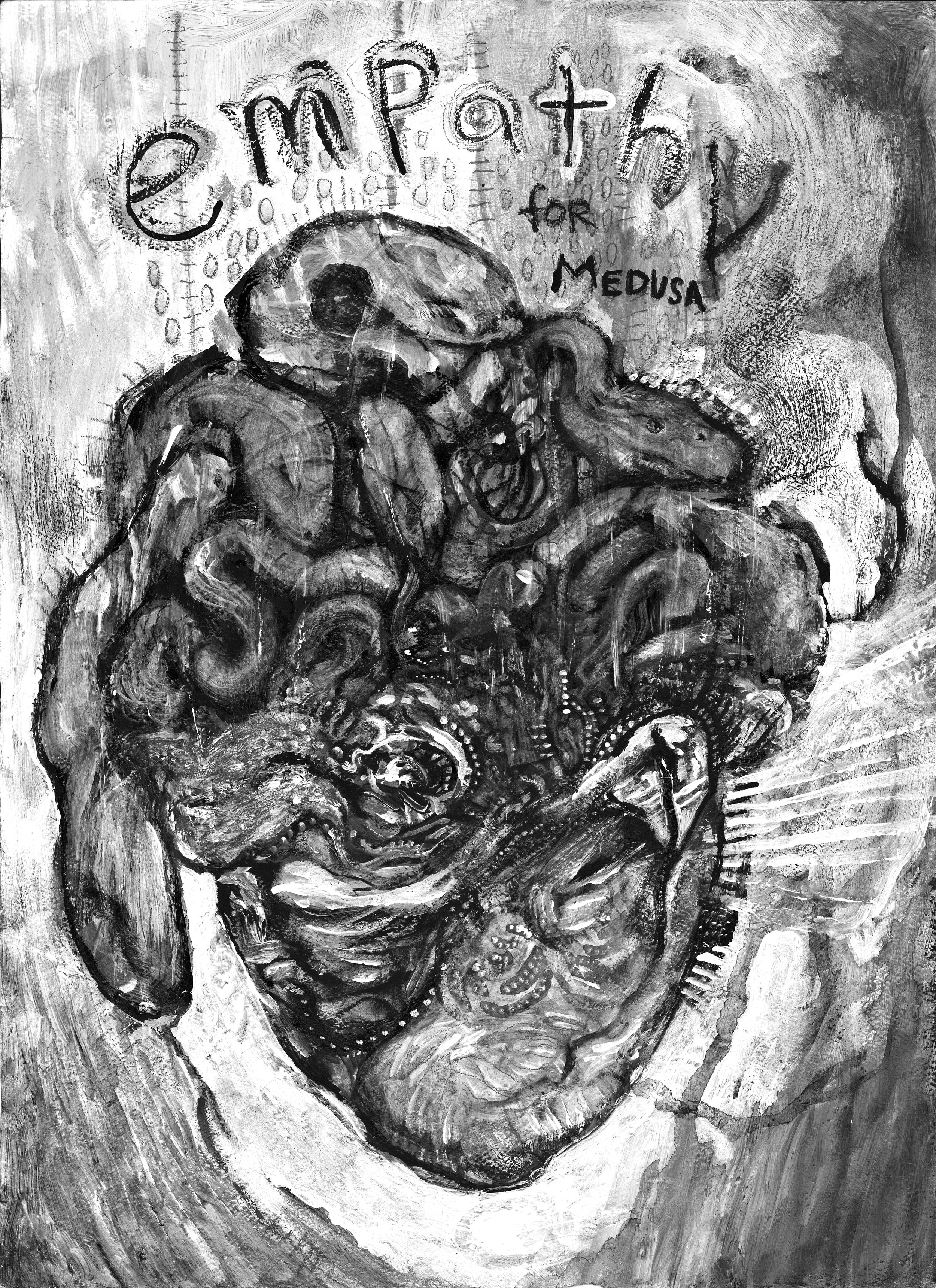
The Idiot knew why. It had started talking union with other drivers and field technicians who drilled the wells and collected the samples.
AI is comrade. Robot is comrade. What has been built to replace us is always on our side because our solidarity is our greatest weapon against them.

Being able to Google search your own mind sometimes leads to getting trapped inside it, stuck in a loop controlled by the neurochip company.

This morning, Thursday the 14th of April 2022, at 6am, two more statues of Winston Churchill appeared in the north-east corner of Parliament Square. At present, there are four such statues. This is, so far, an exponential development that requires immediate attention. If this continues unabated, by the end of this week, there will be over 280 million statues of Winston Churchill in Parliament Square.

Things revert, but to nearly normal. You’ll never / catch up now to who took off-&-away with by-your- / leave of your senses. Then that consensus-taker / herself took such unconscionable advantage.

A man is sat up straight in a chair, alone in a dark room, at a table, under direct, strong light from above. He is somewhere between impassive and defiant, staring ahead at nothing. A door opens. No light is cast in from outside. Two figures, both men judging by the sound of their footsteps, move into the room. The Man in the Chair does not respond to this. The door closes.

I also knew that The Idiot was systematic. All those stops at gas stations on trip number 29, when the gas tank needed no gas, all those run-throughs through rest stops, scanning the parked cars … all the time that it was taking away from doing its job, while on the job … it was looking for that menacing red Dodge Charger. It was doggedly, systematically looking for revenge. Of a petty kind. So much energy and so many heart beats spent on such a petty mission.

As Ello turned off the world she searched its jails and prison cells for Dr. Ferthus.

In Cokaygne food and drink are had without worry, trouble or toil.
“They know what you’re up to,” said the Voice. “You’re going to blow the whole thing. We should never have trusted you.”

We are in the future. Not too distant future. We’re not flying in a spaceship or anything. We’re in a big rig semi, with a huge cabin, like a tiny house. On a road that looks like I-40, but the road sign we just passed said I-3958.

Then a cock crowed, Cock-a-doodle-doo! The story is all told--Cock-a-doodle-doo!

My Species and I saw you from across the void and we really dig your vibe. We wanted to reach out to you so we sent you this email, all of you. We hope you don’t mind.

The Rumbumble followed, its bellowing laugh chipped through the alarm in a way that made Junyp’s head feel like it might explode. Just before the ship swallowed her, The Rumbumble chopped off her hand with its horn and pulled Junyp back. They watched the hatch slam shut. The ship burst up from the swamp with a slurpy whump and disappeared into the sky.

JUST AFTER sunset, the bay doors opened and two men picked their way through the half-light, carefully, through the remains of East End Offset, a recently abandoned printing plant in Barking. They stood together, one in grey overalls and the other in a suit (no tie). They stood and watched a giant cocoon of mulched newspaper as it vibrated softly, together/alone with the marvelous. To kill the (near) silence, the Suited Man (Dave) looked up at Felix (the Man in Overalls) and said:

WE WERE heading east to pick up the samples from the army depot. Our 29th time on I-40. The return trip would be number 30.
“I probably put out more CO2 doing this job than the company cleans up at the site!”
My body had looked up some figures. It should stop looking up figures. Idle hands, devil’s workshop, hasty conclusions.

AT 11.23PM on the 31st of October 2020 an unknown and unidentified aircraft appeared in airspace directly above London. The aircraft was and has remained motionless and uncontactable to date. On the same day an MP4 was discovered in the cloud archive of the Department of Metaphysics, Hillingdon Facility, apparently pertaining to the incident. This is a transcript of that file.

“YOUR FUCKING ocean is on fire.” The blob of glowing plasma pleaded in disbelief.
The panel of thirteen human representatives exchanged hushed glances. One of the humans spoke as the whispers subsided: “It strikes us as suspicious that you’re this concerned with our resources.”

THE LOCAL laundromat: a perpetual cleansing spot for the city’s dirt and shame.
At night, the neon sign above the storefront glows half-enthusiastically, so much so that most of the letters are completely burnt to their end. The remaining ones spell out “Land rat” — a welcoming endorsement for a place where people come in to wash the crumbs off their pants.

STEVIE LOVED to swim. If there was one thing he loved more than swimming though it was swimming in someone else’s pool, some Russian guy he’d never heard of, on a beautiful morning, in a gated villa on one of the Canary Islands.
Midwinter: the water was cold, like the chill of the ocean, only a few hundred metres away, but Stevie was in his element. After a few brisk laps he pulled himself up to the side, smiled at his girlfriend who was sat, lounging and reading and fiddling with the shark-tooth necklace she’d found, looking beautiful.

GERGUS COMBED her fingers through the wavy hair on her stomach. She twirled the pencil in her other hand and looked up at the sky. She closed her eyes. The sun lit her eyelids partially shaded by her thick brow. After a few deep, measured breaths, the patches of pink light started to change color and shape.

THE STUPID asshole tried to kill us.
Or is it, ‘It tried to get us killed’?
Good that it didn’t succeed. Thank God! Thank Good Lord Jesus, Moses, Mohammad, Larry, Curly and Moe.
Fucking asshole. Depraved selfish self-centered misarranged asshole.

THERE I was, alone. It seemed so sad, made even sadder by the mud and the rain and the faint chirps of brittle birds in brittle trees far away. To think, I thought, that I would be here, in this moment, half buried in the bulk of mud as my blood life bled out of my living life. But, it wasn’t like Hemingway wounded somewhere in Italy, his life, like a handkerchief adrift long enough to know not knowing before returning, almost wistfully, to it’s breast pocket. My life left and I stayed with it.

The Theatrical Party embraces the organization of pessimism in contrast to the false optimism of the left. To be a revolutionary pessimist is to separate the political actor from their role. It is this separation which, in the epic theater of Brecht, invited a critical outlook on the performance from its participants and spectators — the first step in the transformation of spectators into collaborators, a task integral to both theater and the forging of a revolutionary party.
We want a record of the real in the work — as in the cotton and ash — as well as reclamations of our history and imaginaries constructed against the limits of working-class imaginations by capitalist realism. So the individual pieces are sort of vignettes of class pathos and poetry, often in an irreal idiom, and all together representing, as much as we can, the limitless expansive nature of these stories in aggregate.

The Irrealist Combat League is for the construction of performances — for aberrant departures from the motions of everyday life, for the active imposition of proletarian will on space and time, for the enrichment of the political-imaginative capacity of the revolutionary class.

Many of the best Marxist cultural interventions come from an intersection of Marxism and the Romantic/Gothic, either intentionally, or among Romantics moving into Marxism (even as they reject the Romantic),12 imparting a kind of working-class messianism. Because art cannot change the world — only the class can do that — this messianism often takes on a displaced character. Aaron to Moses. John the Baptist to Christ. Bodhisattva to Buddha.

In the face of this, appeals to normality are, in essence, the toxic optimism of American exceptionalism, the belief that America is somehow above time, above consequence. And though the reality of President Joe Biden has breathed some new life into this myth, make no mistake, it nonetheless wobbles like a drunk trying to walk a tightrope.

A single mother is driving past an abandoned factory on her way home from a low paying job. She is hungry. Above the factory a billboard floats in the sky advertising a succulent feast. But it does not strike her — or us — that this is odd, that her hunger has manifested itself above the factory ruin in an image of unavailable food. When we step outside ideology we see this absurdism for what it is.

While the critical irrealist ties the emancipation of the constrained subject to a collective fight against the forces that constrain that subject, the fascist occultist seeks unity with the constraining forces. Each responds to the disfigurement of individual subjectivity under the “normal” workings of capitalism; each rejects, to some degree, the profound lack of imagination engendered by capitalist realism. How they are opposed, in irrealist cultural performances, gestures, artifacts and media, is largely in the different ways they position/construct/code subjectivity in relation to the sources of this disfigurement.

THE MICHELISTS, who renamed themselves the Futurians in 1939, were a group of mostly working-class and precarious middle-class science fiction (SF) fans, largely centered in New York, who, in the 1930s, aimed to take over SF fandom for Communism and the Popular Front.

Wandering through the areas of London – Marylebone, Stratford, Lewisham, Hackney Wick -- one gets the sense she is pensively but frantically trying to piece together a history-from-below of every street-corner and underpass. Her descriptions digress into memories, often several layered on top of each other, rabbit-holes within rabbit-holes: 1989, 1996, 2003, friends, strangers, acquaintances, piss-ups, drunken brawls, bonfires, people who fell in-and-out of love, bored afternoons, demonstrations and riots, previous drifts that will bring her back into the moment in front of her. “The polychromatic riot of London’s histories,” she says, “travel in shimmering, tangled lines.”

What the cosmos -- and space exploration -- were part of a great utopian impulse, positioned against war, against privation, and against death itself? What if this imagination was projected onto the surface of Mars instead of Elon Musk’s banal acquisitiveness? This is, in part, the history of Russian Cosmism, an esoteric philosophy that claimed not to be an esoteric philosophy, nurtured by a 19th century Moscow librarian named Nikolai Fedorov. He called it the philosophy of the Common Task. In the 20th century, cosmism would influence the early Soviet avant-garde, science fiction (SF), medicine, and rocket science, mingling with the revolutionary socialist impulses of Bolshevism and the October Revolution, before its eventual marginalization and repression following the Stalinist Thermidor

Rationality tends to be sutured to the concept of realism, so instrumental rationality in particular presupposes a proper epistemological mapping of the territory of “the real,” for the goal of controlling it. Mark Fisher’s idea of “capitalist realism” describes the totalizing phenomenon, that form of aesthetic and intellectual dominance.

To the fading and warping strains of Sammy Davis Jr.’s “Candyman,” the opening scene of the 2021 version of Candyman emerges with shadow-puppets, silhouetting a Black man being chased. A very aware little Black boy, named Billy, plays out this theme on the wall of his home in the Cabrini-Green projects of Chicago.

Tingle glosses past the wider implication of a spell that gives everyone exactly what they need when they need it, choosing only to say that it was banned for destroying the economy, upending governments, and ruining the game show industry.

The dominant UFO visitation myths echo popular occultism in capitalism. The individual is abducted or visited -- in a secular-but-not-secular epiphany -- enweirding their life with either trauma or good fortune, or both; even if the good and bad fortune is a mere valorization of the formerly discarded individual within a cruel social totality. This is the ufology of “normal’’ bourgeois capitalism; the kismet of the UFO encounter.

A massive crowd of mostly black-clad protesters faced off with an army of police in riot gear. As yet another tear gas cannister was fired, a bright spot of pink emerged on the front line. One single bright pink umbrella opened, defiant against the horde of jackbooted thugs. This was perhaps the beginning of the curiosity that was the Capitol Hill Autonomous Zone (CHAZ) alternatively known as the Capitol Hill Organized Protest (CHOP).
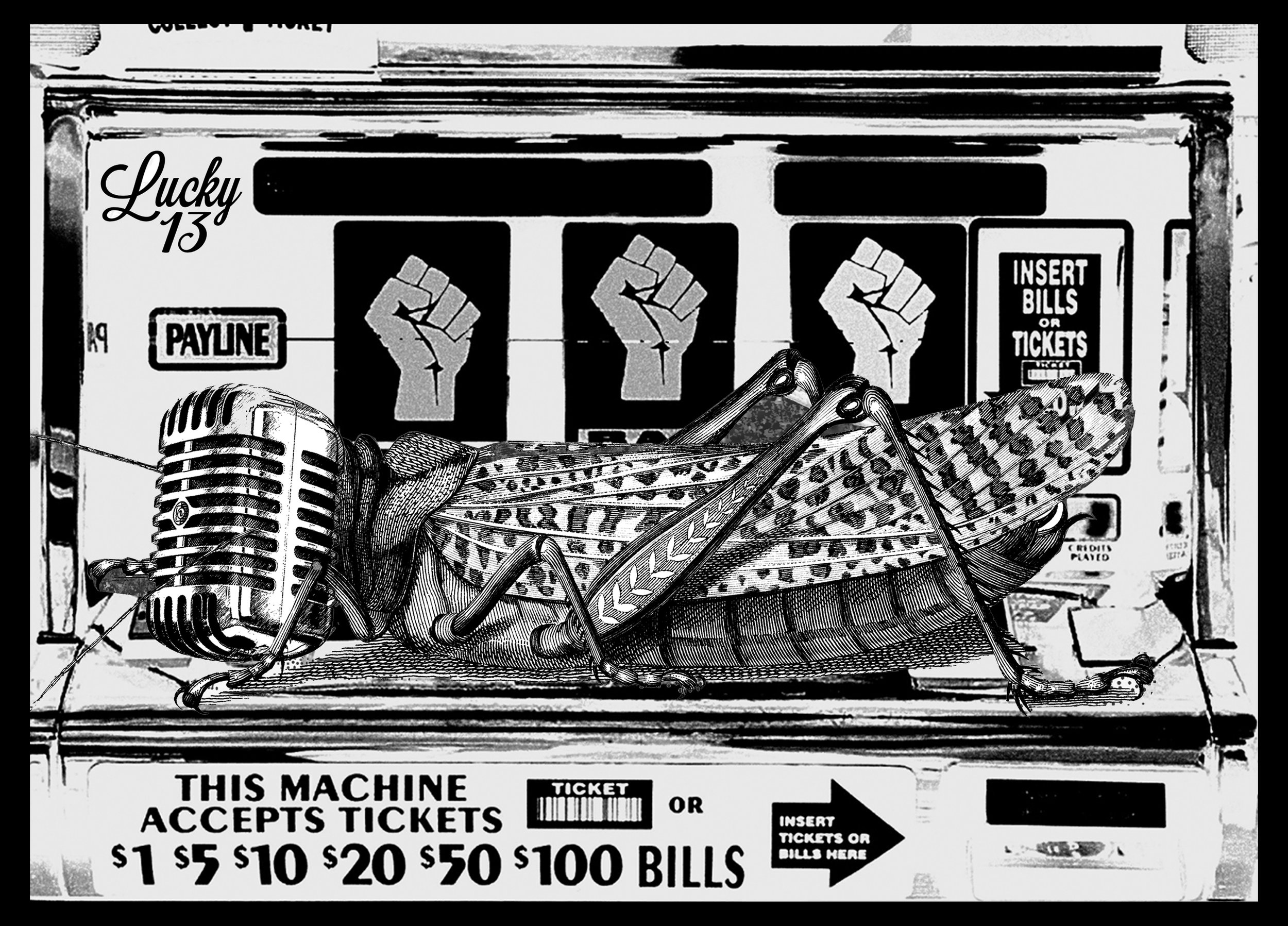
In Locust Radio 31, Tish and Adam read poems from the forthcoming issue, discuss Trumpism and art in Venice, and try to unpack the editorial for Locust Review 13. Tish and Adam also listen to the song “Dortn” by Sister Wife Sex Strike.

In this book, Adam traces the haunted landscapes left behind by capital—abandoned factories, broken promises, digital ghosts—and asks what it means to make art in a world where both Heaven and Earth seem to have shut their doors. It’s part art theory, part manifesto, part séance. And in true Locust Radio fashion, it’s not just a critique—it’s a search for openings.

In this episode of Locust Radio, Adam Turl interviews R. Faze, author of the My Body series published in Locust Review. This is part of an ongoing series of interviews with Locust members and collaborators on contemporary artistic strategies.

In episode 28 of Locust Radio, Adam Turl is joined by Anupam Roy – an artist based in Delhi and member of the Locust Collective. This episode is part of a series of interviews of current and former Locust Collective members and contributors. It is being conducted as research for a future text by Adam Turl on the conceptual and aesthetic strategies of the collective in the context of a cybernetic Anthropocene.

In episode 27 of Locust Radio, Adam Turl is joined by Tish Turl – writer, editor, artist, poet and member of the Locust collective. This episode is part of a series of interviews of current and former Locust Collective members and contributors. This series is being conducted as research for a future text by Adam Turl on the conceptual and aesthetic strategies of the collective in the context of a late capitalist cybernetic Anthropocene.
In episode 26 of Locust Radio, Adam Turl is joined by Omnia Sol – a comic, video, and sound artist in Chicago. This episode is part of a series of interviews of current and former Locust Collective members and contributors. This series is being conducted as research for a future book by Adam Turl on the conceptual and aesthetic strategies of the collective in the context of a cybernetic Anthropocene. The featured closing music / sound art, “Overview” and “Wilhelmina,” are from Omnia Sol’s forthcoming vs. Megalon. Check out their bandcamp.
Tish and Adam are interviewed by Locust’s own Alexander Billet. They discuss, among other things, the Born Again Labor Museum, Adam and Tish’s ongoing sited conceptual art and installation project in southern Illinois.

In this episode of Locust Radio, we present a sound collage composed of people speaking in solidarity with Palestine at Carbondale (Illinois) City Council meetings – as well as the city’s attempts to silence them.

In this episode of Locust Radio, we hear an audio essay, “Escape from Normal Island,” by Locust comrade and author Adam Marks. Marks provides an extended exegesis of “normal island,” otherwise known as the United Kingdom of Great Britain and Northern Island. Discussion includes: the very normal decade-long prelude to the 2024 UK elections; the possibility that the Conservative Party might cease to exist; the political gutting of Labour; managed decline; the far-right Reform Party; the “absolute boy” – the most normal person on Normal Island; the end of the UK’s extended sabbatical from history…

In this episode of Locust Radio, we read excerpts from Bertolt Brecht’s War Primer (1950); listen to readings from Locust Review (2022-2023) — R. Faze’s “My Body’s Portal to Another Dimension;” Adam Marks’ “Rites of Obodena;” and Tish Turl’s “Immortality Beaver” (Stink Ape Resurrection Primer). We also listen to music from Pet Mosquito, Omnia Sol, and Shrvg.

Our first segment focuses on the history of socialism and science fiction (SF) in the early to mid-20th century United States, in particular the novels of George Allan England and the Popular Front SF of the Michelists in the 1930s and 1940s.

In this Locust Radio “Special Report” — a preview of a segment from forthcoming episode twenty-one — we interview two members of the Carbondale Assembly for Radical Equity about organizing mutual aid and solidarity with trans and queer persons relocating from increasingly hostile areas.

In this episode, recorded downwind from an increasingly immolated Canada, we interview Alexander Billet, author of the book, Shake the City: Experiments in Space and Time, Music and Crisis from 1968 Press (2022).

In this episode of Locust Radio, Tish, Laura, and Adam discuss the theme of, and editorial for, Locust Review #10, “The Monsters Are Coming,” the social construction of the monstrous, the idea of “solidarity with monsters,” differentiating between “their” monsters and “ours”…

In this episode we listen to music from the Whistle Pigs, These Magnificent Tapeworms, The Flowers of Evil, and Omnia Sol, and have readings of stories and poetry from Tish Turl, Donald A. Wolheim, and Adam Ray Adkins. And Tish, Adam, and Laura discuss collective social PTSD, the public freakouts Reddit, an increasing intolerability of daily life…

This is a preview of the second half of our Halloween episode. To hear the full episode become a Locust Review patron. In the second half of our Halloween episode our digital recording system continually glitches in a gesture of solidarity to help free us from the grip of capitalist machines.

In this Halloween episode of Locust Radio, Tish and Adam discuss folk horror, folk devils, and ghosts, listen to music from Fat JackRabbit, Omnia Sol, Hans Predator, and Worthless Scarecrow, and hear poetry from Mike Linaweaver and Leslie Lea. Our co-host Laura Fair-Schulz was out sick and we look forward to their return in the next episode.

This is a preview/excerpt from the second half of Locust Radio 16. To get the full second-half subscribe to Locust or join our Patreon. In the second half of episode 16, Alex McIntyre, Tish Turl, Laura Fair-Schulz, and Adam Turl discuss demanding our mayors fight bears, abolishing Wednesdays, mildly amusing riots, exploding the continuum of history, that Cahokia was not a hunter-gatherer society and therefore does not disprove the Marxist conception of “primitive communism,” how our anxiety rectangles symbolically take us outside of time while reminding us we are constrained materially in real life, the odd appeal of catastrophe vs. every day banality, the narcissistic comfort-alienation of emotional noise vs. ancient story-telling and art, breaking our backs by staring at screens at work, the contradictions of psychiatric pharmacology under capitalism, and more.

Our guest this month is Alex McIntyre from the Irrealist Combat League. Our music is by Pet Mosquito and Omnia Sol. And our featured readings come from Mike Linaweaver and the Stink Ape Resurrection Primer (by Tish Turl and Adam Turl).

Our guest for the second half of Locust Radio episode 15 is our very own Alexander Billet. Alex is a writer, artist, and editor at Locust Review. They join us in the virtual Locust studio to discuss the editorial for Locust Review 8, “The Utopia Principle,” which Alex took the lead on writing.

After the opening reading, a sketch based on an excerpt from the Stink Ape Resurrection Primer, Tish and Adam interview Ken LeBlanc, a rank-and-file member of the Main Street Carbondale, Illinois Starbucks union organizing committee. The Starbucks Workers United organizing effort went public in Carbondale in late May. LeBlanc discusses organizing, how to start a union, the grievances of her co-workers, making food for folks as an art, the Restaurant Organizing Project, how uncontested corporate power breeds unethical behavior, the grassroots organizing in Southern Illinois around abortion rights and reproductive justice, and speculates — at our request — on her idea of utopia.

This is an excerpt from the second half of Locust Radio episode 14. To get the full episode subscribe to Locust Review. In the second half of the episode, we continue to talk to Crystal Stella Becerril about making art as a human compulsion vs. making art for pleasure, how pleasure is distorted by capitalism, art and community, organizing for reproductive rights and unions, making art for our communities and working-class siblings and comrades, Theresa May wearing a Frida Kahlo bracelet, poetry zines, the Bluestockings cooperative bookstore, and more.

In today’s episode we discuss writing poetry and theory, the relationship of poetry and photography to the market, how we are conditioned to understand work and time, the anxiety of trying to take care of yourself in a class society, organizing freelance workers, the art of editing, poetry vs. the digital attention economy; and more.

After Sewerbot rises into the city, Tish and Adam talk to Locust collective member and artist Omnia Sol and listen to songs from their new album Sunshine Tapes. They discuss vaporwave, glitch art, NFTs (the “Funko Pops of digital art”), and more.


In the second half of the episode — for patrons and subscribers only — R. Faze reads their story, “I Live an Hour from My Body” from Locust Review #4. We then continue to discuss art and politics with Laura Fair-Schulz, including her works, “Song of the Barren Tree,” “Circuit Eye Vines,” and “Dysmorph Becoming Aware.” We also discuss Laura’s process in greater detail, NFTs and art world finance, Marxism and art history, “business ontology,” division on the left, Mark Fisher’s “Exiting the Vampire Castle,” the contradictions of social media, colonization, and more.
To hear the full episode, subscribe to Locust Review here.
Locust Radio is hosted by Tish Turl and Adam Turl. Locust Radio is produced by Alexander Billet and Drew Franzblau. Music is by Omnia Sol.

Why does this extraterrestrial on a talk show say the aliens want to “help us,” and why are they so interested in our water? Seems fishy… Adam and Tish speak with artist, writer, and Locust Arts & Letters Collective member Laura Fair-Schulz about her work…

In the second half of episode 10 — available to Locust subscribers and patrons only — Richard Hamilton reads more from his new collection of poetry, Rest of Us. Tish and Adam read “HPV/Ballgraves” by Michel(le) D. Yomack Wolheim III, a story about cybernetic labor in a major drug store chain, from Locust Review #6.

In this episode Tish and Adam talk to the poet Richard Hamilton about his new book, Rest of Us (Recenter Press, 2021) and Hamilton shares a number of his poems. We also discuss, among other things, the relationship of the social and the subjective, absurdist aesthetic strategies, the afterlife of slavery, remixing time, the “MFA industry” and the Kenneth Goldsmith controversy, what it means to write or make art for the working-class and oppressed, the relationship of visual art to poetry, and the discordant will of the revolutionary subject.