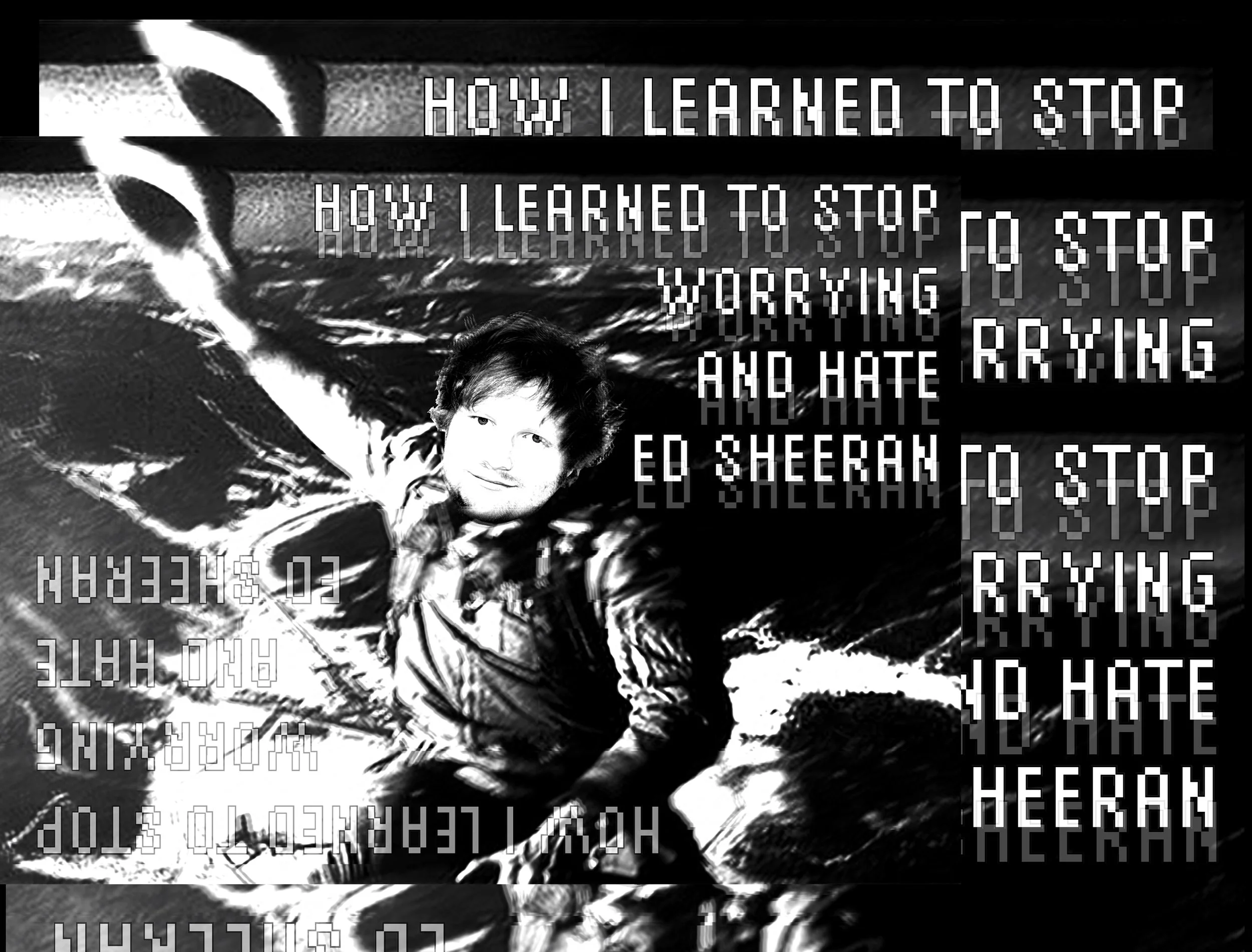
True story… Several years ago, my wife and I were driving through the San Fernando Valley, not far from our house in North Hollywood. From about a block away, I saw a man standing on a street corner, talking on his phone. He was a short, scruffy ginger, with a vaguely rat-like face. “Is that Ed Sheeran?” I asked in that nonchalant way Angelenos are accustomed to asking when they see a celebrity walking down the street.
As we drove closer, we got a better look, and our answer. Pacing on the corner, speaking into his mobile phone, we saw he was wearing a white t-shirt with the words I’m Not Ed Sheeran across the front. Which means one of two things. Either the man in question was, in fact, not Ed Sheeran, and wanted people to stop asking. Or he was Ed Sheeran and wanted to forget that he was Ed Sheeran. The second seems more plausible.
There’s a truism in Marxist cultural criticism, insisting that there is no such thing as politically pure art, that it’s all tainted in one way or another. That people’s aesthetic tastes ultimately don’t decide whether they’ll be progressive, reactionary, or revolutionary. That ultimately, people can like what they like, and socialists have no place crudely judging people’s politics based on what music they like, which TV shows they watch, or which sport teams they root for.
Still, to every rule, there are exceptions. Should there ever be another storming of the world’s Winter Palaces, a chance for working people to once again take the reins of history, there’s a safe bet there will be at least a smattering of people who love “The Shape of You” or “Bad Habits.” Events will hopefully show them how wrong their tastes were.
We may not have to wait for the revolution. Events have already shown Sheeran himself to be as bloodless and lukewarm as most of his music. When he caved to pressure from real estate mogul and Epstein-affiliate Robert Kraft and booted Macklemore from his slot as an opening act on Sheeran’s tour, he emerged in his fullest form as a musical avatar for capitalist realism.
Mark Fisher’s formulation is well-worn on the left, and for good reason. Though there’s plenty of reason to ask whether capitalist realism is on its way out, it seems not so much to be fading away as becoming something else, something meaner, more hostile to curiosity and imagination. If it is, then there will certainly be a great many who find themselves swept up and transformed into something more befitting this vague, much creuller other thing.
How could Ed Sheeran become one of those things? How could a man who has dedicated his whole public life to being a nice, affable guy, to being an inoffensive salve of everything to everyone, whose songs appeal to the broadest definitions of saccharine sweetness and gentility, become such a sterling example of this capitalist (but-not-quite-yet-fascist) realism? The answer is in the question.
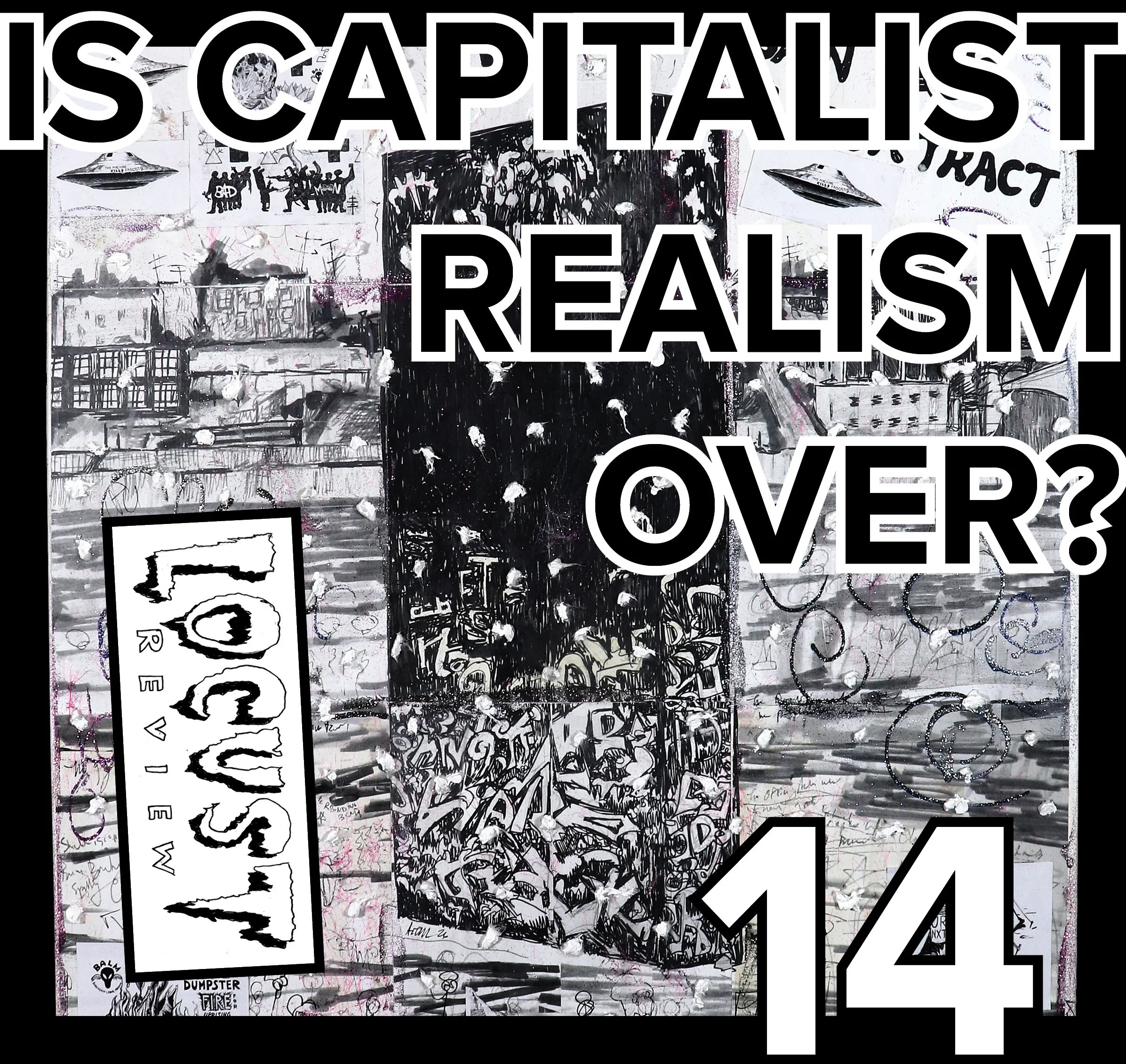
This article by Alexander Billet will appear in Locust Review 14, “Is Capitalist Realism Over?”
The greatest trick ideology ever pulled was convincing us that there are some areas in which it doesn’t apply. Hence Ed Sheeran. So milquetoast and inoffensive is he that mapping a political interpretation of him seemed futile to all but the most committed. We try nonetheless. We trot out Adorno quotes, railing against the standardization of popular music and how it exists to dull our critical faculties and content us with our exploitation. We point out that Sheeran’s portrayals of love and lust are so simplistic and vague as to be almost forgettable. We ask what is being done to the human imagination in celebrating such mediocrity. And we are swiftly called cranks, elitists, foolishly raising our tastes to the level of political principle. And perhaps these rebuttals are right.
Note, however, that I am not being so nearly vociferous in my descriptions of Macklemore. His take on hip-hop is one I find unimpressive, a white kid who ingested a bit too much of the “backpack rap” trope in the early aughts and calcified it through his imitation. Still, I’m more than willing to admit that, even in this characterization, there are such things as preference and opinion. What’s more, it seems quite clear Macklemore absorbed something of the consciousness promoted by the likes of Lupe Fiasco and Black Starr.
Hence “Hind’s Hall.” Whatever can be said of it musically, it’s an earnest and impassioned track, expressing solidarity with the people of Gaza and the campus protest encampments of 2023-24 (though rather quizzically fails to mention Hind Rajab, the five-year old girl murdered by the IDF whose name inspired protesters’ renaming of Hamilton Hall on the Columbia University campus). The point here is that there are many choices made in shaping an aesthetic posture. Some point in the direction of pushing a look or sound or genre forward, others backward, and more often than not there are plenty of choices whose meaning is up for grabs. Some are worth fighting over. Others not so much.
It’s rare that someone can make so many safely static choices in the creation of their art, but Ed Sheeran managed it. You could say it was in the interest of making his music widely marketable enough to make him a millionaire, enough everything to everyone, formulated of course in collaboration with record execs and focus groups. You could say all that, and more likely than not you’d be right.
The problem, however, is that history happens. Events unfold, some capable of radically reshaping our view of the world and how it should be, along with our expectations of what it means to be good, to stand on the right side. Some of us have been saying for a long time that Israel is an apartheid state, that it was only a matter of time until its steadily rightward-shifting political climate was going to look for an opportunity to wipe all vestige of Palestine off the map, that it would be disastrous for Arab and Jew alike, and that declaring all of this had nothing to do with antisemitism. Events proved us right. Tragically, they still do.
Sheeran is among those oblivious to these changes. When he caved to the demands of billionaire stadium owner (and Epstein associate) Robert Kraft by removing Macklemore from his opening slot on Sheeran’s Loop Tour, he probably thought it was a safe, commonsensical kind of move. Nobody wants to be offended, right?
Except what Macklemore said wasn’t as clear-cut offensive as Sheeran understood it to be. Kraft, a steadfast supporter of Israel, clearly thought it was, mostly because he doesn’t see the massive disproportionality between casualties as anything to question. Because he doesn’t see Palestinians as fully human, you see. And he surely sees them as less consequential to events than his own personal offense.
For Sheeran to give any credence to Kraft’s words belies the stubborn myth that modern music is simply a relationship between artist and listener, that the labels and streamers and performance venues are inert mediators waiting for fans and songwriters to give them life. It’s never really been the case, not in the modern age. It certainly isn’t in the moment when streaming moguls give hundreds of millions to develop AI weapons used in Gaza. Or when Sharon Osbourne can successfully urge for Kneecap’s American visas to be revoked.
Sheeran had no clue that he would piss even more people off than he would have had he done nothing. The rest of his opening acts withdrew from the tour. So did his backing band. More than a few have pointed out that most of these acts are of Irish heritage, and therefore have at least been raised with a very palpable sense of what it is to be colonized. It goes further than this, however. It reminds us that music isn’t something that just happens, wafting freely through the air until it finds a venue or recording studio to capture it. Music is made. It is written and re-written and rehearsed and revised and performed over and over until its makers find the form that reaches our ears.
Music, in other words, is labor, and those who make it can ultimately choose where they can contribute it. Forty years ago, dozens of artists decided that another apartheid regime – this one in South Africa – didn’t deserve to have its brutal practices softened with fun sounds. When South Africa tried to find its way around the boycott by declaring its region of Bophuthatswana nominally independent and offering massive financial incentives to play at the Sun City resort, these artists loudly stated that they wouldn’t.
Those who did, even as they claimed that their performances did not signal support for apartheid, soon found they had something to answer for. Words are nice, but actions are ultimately what matter. When you are a musician, where you choose to perform or not perform your music is what constitutes action.
Which brings us back to Sheeran. When he stepped onto the stage at Lincoln Financial Field in Philadelphia on September 19, he did so without a single opener, and with an entirely new backing band. He read a statement off the teleprompter that was ostensibly an apology, but ultimately shows he has learned nothing. In an attempt to “both sides” himself out of culpability, the only thing he said about Palestine was the following:
What happened in Israel and at the Nova Music Festival on October seventh was horrific and compounded centuries of Jewish pain. What is happening in Gaza is catastrophic and unjustifiable and disproportionate. My heart has been broken by the scale of devastation and loss of civilians' lives—of children's lives. And the systemic injustice we're seeing unfold in the West Bank cannot be overlooked. I am already speaking to people across the spectrum to work out how to make a contribution that helps victims of these terrible times, and listening and learning because I do not know enough. I honestly am so grateful that you're here with me.
The problem, of course, is that what’s happening in Gaza isn’t just “happening.” It is being perpetrated, deliberately and with impunity, by a regional colonial power that has kept Palestine under its thumb since 1947. Speaking about 75,000 dead by way of bomb and bullet — many of them children — in the same way you would victims of a freak earthquake speaks to the understanding of history his music attempts to soundtrack.
In his book A Spectre, Haunting, China Miéville insists that hate is an essential part of forging a better world. This naturally flies in the face of inoffensive liberalism, which seems to believe that simply big-hearting our way through life will be enough to bring down the most maliciously designed institutions. We’ve seen amply over the past decade how effective a strategy such vague and simpering appeals can be. (See Adam Turl’s takedown of the execrable “hopepunk” aesthetic in Locust Review in 2020 for a good summary.)
Miéville prescribes a particular kind of hate, however. He is not altogether dismissive of the idea that hate left to fester poisons our souls and minds, particularly when it is simply directed at the individual. Conversely, the author suggests we can indulge in a kind of hate that allows a “communism of love” to flourish. “ Hate should never be trusted,” he writes, “nor treated as safe, nor celebrated for its own sake. But, inevitable, it should not be ignored. Nor is it automatically undeserved. Nor, perhaps, can we do without it, not if we are to remain human, in a hateful epoch that pathologizes radical hate and encourages outrage fatigue.”
As he continues, he also says that this particular hate – hate of being dominated, of watching others like you be similarly dominated, and of the hypocrisies that make such domination possible – can be healthy, even necessary for sustaining our sanity. It can also be essential to seeing the world for what it is:
And hate may help not only with strength but intellectual rigor, and of analysis, too. The very flat abstractions of capital can generate their own seemingly implacable logic, against which an emotionally invested, a hating contrary eye, might prove necessary not only ethically but epistemologically.
Which is why, ultimately, Ed Sheeran deserves our hate. Not because he is somehow an exception to the caution against hating the individual, but because he is the rule that earns it. Whether the man on the corner of North Hollywood wearing the I’m Not Ed Sheeran t-shirt was in fact Ed Sheeran, his shirt was correct. Because Ed Sheeran doesn’t exist. Not really. He may have at one point, but the avatar that cried onstage in Philadelphia and wants you to cry for him isn’t, in the end, a human with their own wants and needs, separate from the system he’s spent so much effort ingratiating himself to. Make enough decisions that fail to mark where you stand in relation to history, and you eventually vanish completely. Incapable of love, of fairness, of courage or even a modicum of individuality. Just another piece of flotsam aimlessly drifting through the tepid flow of capital. When Sheeran is finally replaced by AI, will anyone notice?
About the author
Alexander Billet is a writer, artist, and cultural critic based in Los Angeles. He is the author of Shake the City: Experiments In Space and Time, Music and Crisis, published by 1968 Press (updated edition coming in autumn of 2026). Read and support his work at alexanderbillet.com.