
This article was originally posted on February 28, 2019 at Red Wedge Magazine, in a series that included two other articles, “No More Art Distrits,” December 20, 2018, and “We are All Outsiders Now,” May 1, 2019.
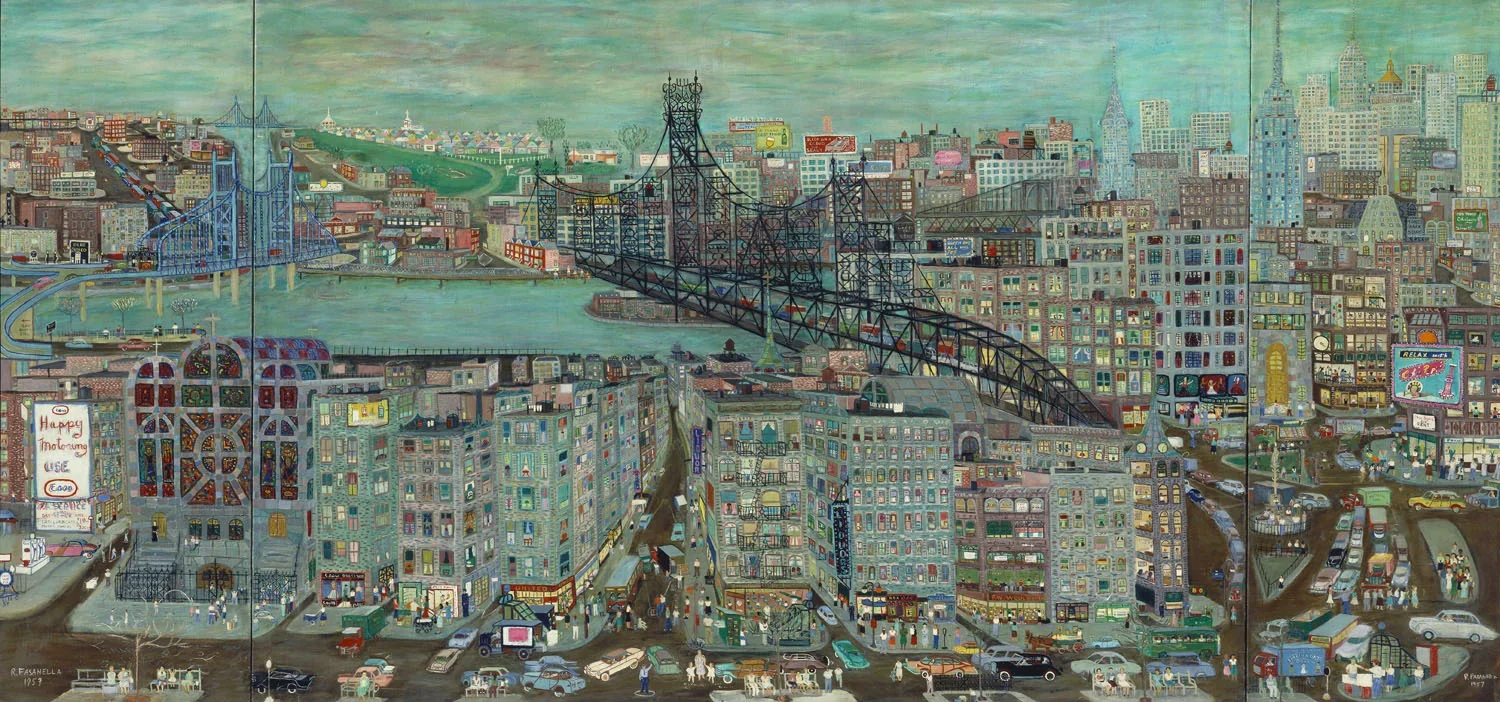
Ralph Fasanella, New York (1957)
The concept of outsider art, or self-taught art, is a lie. It conceals the actual artistic arguments and content articulated by the artists who are described in this way. While the history of the concept is more complicated, its present usage is bound up with a racial, class and geographic othering, which centers the bourgeois and petit-bourgeois institutional art world (located in New York City first and foremost) as the norm (when it is itself the outlier).
Reams of paper are spent in trying to articulate just what this, largely made-up, concept actually means. Unlike the genealogy of abstraction, performance, conceptual art or installation art, the genealogy of outsider, self-taught, or “folk art,” traces less the lineage of art and artists, instead mapping the evolution of the concept itself. The history of outsider art is a history of categorization.
As part of the modern art impulse to search out expressive inputs beyond the sclerotic academic art canon of the time, late 19th and early 20th century artists looked to folk arts, the arts of the European colonies and the art of “marginalized” or supposedly “pure” actors, like the mentally insane or children. These impulses were contradictory. On the one hand, artists were correct in seeking new inputs to rebel against the old aesthetic order. On the other, European artists often misunderstood what they were looking at, particularly in the case of “non-western” art, reading it through a distorting racial and orientalist lens. The least problematic of these appropriations were often done by consciously political, often Marxist, artists, who borrowed from folk, religious, and popular traditions in their own areas of geographic origin, with specific aesthetic and political goals in mind.
Two key figures in this history of “outsider art” are Jean Dubuffet and the surrealist André Breton.
Henry Darger, Realms of the Unreal, detail
Norbert Cox, Flour Child, acrylic on canvas (2016)
Jesse Clyde Howard
Breton’s surrealism, influenced by an interchange of Freudian psychoanalysis and Marxism, sought social excavations of the subconscious in art and literature. Many surrealists viewed the art of the mentally ill, of children, and of non-western artists as closer to the subconscious, and therefore, liberation. A case can be made for this idea regarding the art of children. But the idea that non-western artists, or the mentally ill for the that matter, are inherently primitive, is obviously problematic at best. There is, of course, western and non-western art that begins to fit this rubric. Shamanistic art involves a great deal of subconscious imagery and narrative brought to the surface. It would be wrong, however, to conclude this is/was an entirely intuitive process. Regardless, the assumption that the art of long-standing (non-European) civilizations and class-societies was closer to the “primitive” is an inversion of the dominant racist ideology of colonialism. If Breton sought art without complicity, social contradictions or cant, it was not to be found in non-western bodhisattvas, bunraku or imperial steles.
More important to the present-day art-world institutionalization and marketing of “outsider” art is the legacy of the artist Jean Dubuffet. Dubuffet promoted, in far simpler terms than Breton, the art of “outsiders,” the mentally ill, children, etc., under his rubric of “Art Brut.” While he emphasized such work’s “rawness, spontaneity, and individuality” he also insisted that an artist, to be categorized as such, be “socially isolated and exercise his or her creativity in complete isolation from external cultural influences.” [1] This is obviously not possible. First of all, even Roger Cardinal, who coined the term “outsider art,” observes the importance of scavenging (images, objects, etc.) by artists in question. This work literally incorporates “external” influences. Regardless, as James Elkins argues, the very idea of “outsider art” is an oxymoron. [2] Art was born alongside the rise of social consciousness in hunter-gatherer societies. While self-expression is an important aspect of art, so too is its social genesis and reception. There can be no art in “complete isolation from external cultural influences.”
In the United States, the modernist impulse to look outside the historic art academy was found in a focus on American “folk art.” In the 1930s the Museum of Modern Art (MoMA) organized two exhibitions of folk art curated by Holger Cahill. As Eugene Metcalf argues, “[f]olk art served to connect to artists of the twenties and thirties with a long tradition apparently unique to America, giving them not only historical and cultural roots but also a reply to the critics of modern art who claimed it was only another version of decadent European civilization.” [3]
Metcalf continues in his essay, “Black Art, Folk Art, and Social Control,” that the mainstream art world, in these historic folk exhibitions, and in the Corcoran Gallery of Art’s famous 1982 exhibit, “Black Folk Art in America,” flattened and decontextualized the meaning of the selected artists and artworks. Due to class and racial prejudices, albeit in their liberal form, work by poor, working-class, Black, southern and rural artists, was read as closer to nature, as primitive, as mysterious and unknowable, or as a continuation of lost craft culture (in the case of working-class and rural white artists), or as a continuation of a pure primitive African art (in the case of Black artists). [4] Art was presented this way even when there was substantial contradictory evidence.
Howard Finster, The Super Powers, tractor enamel on wood (1985)
This concealment of intent and meaning continues under the art world’s present-day categorization of outsider or self-taught art.
The artist Bill Traylor, an elderly African American man, born a slave, was “discovered” in the 1940s by a liberal white middle-class southerner named Charles Shannon. Shannon recognized the importance of Traylor's work, collected it and promoted it. But it never occurred to Shannon to ask Traylor what his work was about, what his motivations were, what he was chronicling in his thousands of drawings. Now, decades later, academics more or less try to guess what the work was about. The general art-world significance of Traylor's work is ascribed the dubious honor of authenticity; but an authenticity without agency; or an “unknowable” agency deemed somehow less conscious or deliberate than, say, a thousand polka dot paintings from Damien Hirst, or the latest formalist bullshit that is on offer.
Ralph Fasanella, Farewell Comrade/End of the Cold War, oil on canvas (1993-1999)
Bill Traylor (late 1940s)
William Thomas Thompson, Heaven and Hell, 9 x 12 ft. Acrylic on Canvas.
Or, take the work of the William Thompson. The (barely) beneath-the-surface anti-Semitism and right-wing lunacy of his art is almost actively concealed by art collectors, dealers and writers, in awe of his southern Gothic authenticity (and marketability). [5]
Or, Ralph Fasanella, a working-class union organizer turned artist is described as “self-taught” even though the content of his work reflects the lessons of decades of class struggle. Moreover, through his union, Ralph Fasanella organized art classes at city college for himself and other members. He is literally not self-taught -- in the most literal sense.
The labels are, not surprisingly, mostly meaningless.
That is not to say there is not a genuine appeal to work that has been categorized this way. The appeal of much of this so-called outsider art is that it, unlike the art world proper, aims to speak largely to audiences outside the art world, embraces the idea and ideal of individual artistic subjectivity, and presents a totality, a complete philosophical world vision, at a time when the majority of the art world has been trained to avoid such visions. Moreover, this totality is often expressed in opposition to the perceived status quo, albeit often in an esoteric and sometimes a right-wing manner. This work is often campaigning. In other words, such art is more Art, capital “A,” historically speaking, than much of the art of the contemporary weak avant-garde.
But we can only learn from this art if we treat it as genuine conscious work. The abstractions of authenticity and otherness conceal and reify what this work actually means, good or bad, in order to preserve market shares for different currents of artistic commodities, and to perpetuate the artificial shortage of “genius” on which the art world depends (both its academic canon and its market).
Endnotes
David Davies, “On the Very Idea of ‘Outsider Art,’” British Journal of Aesthetics 49 (January 2009), 26
Davies, 27
Eugene W. Metcalf, “Black Art, Folk Art, and Social Control,” Winterthur Portfolio Vol. 18 No. 4 (Winter 1983), 278
Metcalf, 271-289
For an accounting of this work, as well as other work, see Greg Bottoms, The Colorful Apocalypse: Journeys in Outsider Art (Chicago: University of Chicago Press, 2007), 57-121