Digital technology appears as naturally artificial when it is actually shaped by political economy and intensive ideological encoding. It appears as a phantasmagorical being — a neutral cloud of invention floating above everyday life.1 In actuality it is a product of social life, including its privations, exploitations, and oppressions — and it reinforces or undermines those aspects of life, usually for financial and political reasons. Contemporary digital technology has evolved quickly enough that we easily forget its origins and even recent iterations. As AI Slop — the glut of AI generated images and texts shared widely on social media — becomes more and more ubiquitous, it is easy to forget that it didn’t exist just a few years ago.2 Moreover, the sheer volume of digital and technological developments and products make their historicization difficult. However, there are common ideological and economic threads that help explain the dynamics at work. The early ideological motivation of Silicon Valley was, as Richard Barbrook and Andy Cameron put it, a messianic dream of “cyborg masters and robot slaves.” In other words, a dream of capitalism without human labor.3 The main economic motivation of Silicon Valley has mostly been the digital eradication of latency — lag or delay — in production, finance, and market information.4 As a result, work, discourse and culture are turned into a kind of mathematics that can almost instantly share its information — or remake information as a kind of Frankenstein’s monster.
The actuality of digital technologies can come into conflict with their ideologies. One of the difficulties for capitalist markets has been how the forces of production can conflict with the relations of production. In Marxism, the forces of production are the capacities of technologies that, in some cases, point outside of capitalism itself, creating a material basis for a more egalitarian and democratic economy and politics: The Internet makes sharing information largely free. The relations of production embody the interests of the capitalist class and its exploitative relations with labor: The digital can’t be free because the people who own it demand it be monetized. When these come into conflict, the contradiction is generally “revolved” in the interests of the latter (capitalism) — although this may produce class struggle, crises, or absurdities. For example, it took strident legal and industry action to curtail Hip Hop sound collage in the early 1990s — to turn freely flowing available samples into a high-cost market (thereby reducing the creativity and complexity of sound collage). AI generated images also attempt to turn the products of other people’s labor — scientific, artistic, literary — encoded into large language models and similar programs — into a kind of utility that can be controlled by the tech industry. This art, literature, and knowledge could be shared equally and for free with much of the entire human race. Instead it has been plagiarized by a small number of corporations to be sold back to us as a kind of cultural slop.
Something similar happened with the largely failed attempt to make freely available digital images in an artificially scarce commodity by coupling them with “Non-Fungible Tokens” or NFTs. Unlike AI Slop, which has been more successful in turning digital imagery into an ideological tool of capital — or the legal restructuring of digital music samples — NFTs acted as a kind of symbolic shibboleth of ownership. NFTs are a digital marker of uniqueness tied to a blockchain.5 Most were part of the Ethereum blockchain. As Mitchell Clark put it, “Ethereum is a cryptocurrency, like bitcoin or dogecoin, but its blockchain also supports … NFTs, which store some extra information that makes them work differently from, say, an ETH coin.”6 For those who don’t know, blockchains are special evolving lines of code with security backstops that are the basis of most cryptocurrency. As the late David Golumbia argued, much cryptocurrency flows ideologically from right-wing libertarian dreams of a non-state fiat currency, as well as historically anti-Semitic conspiracy theories oriented around central banks.7 In terms of material economies, cryptocurrencies function as a mechanism for money laundering, corruption, as a locus of pump and dump schemes — inflating value and then selling it off, leaving new investors with losses — and as a “place” to stow money in crises (similar to gold or precious metals).
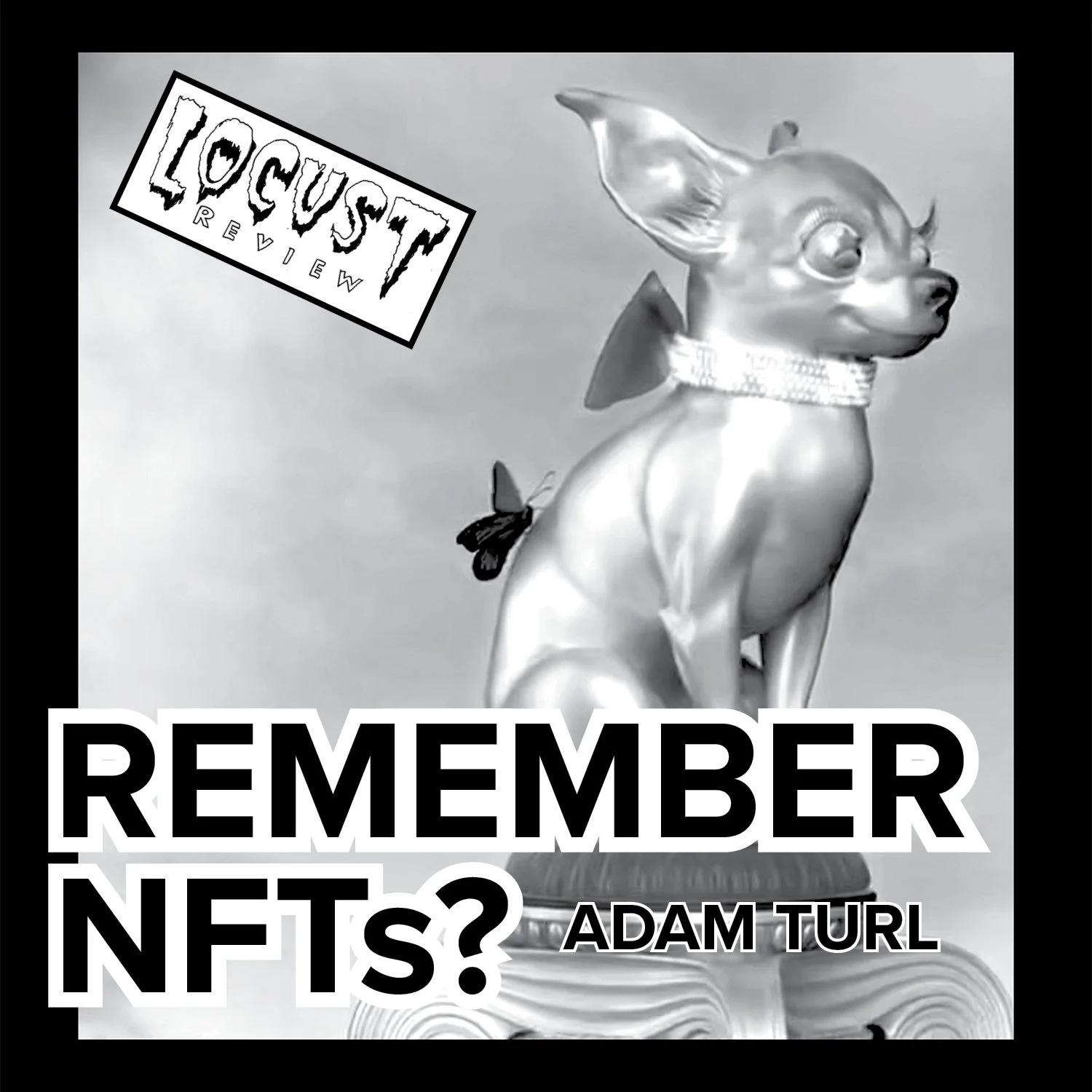
NFTs, unlike cryptocurrency, were almost entirely ideological, failing to hold much value even in limited terms. An NFT was/is a “unique token on the blockchain.” Or, as Rosanna McLaughlin put it in a pro-NFT article in The Guardian, “a digital token that is redeemable for a digital piece of art.” Of course, how one redeemed it for art was unclear. Given the drastic deflation of NFT valuation, one might be tempted to forget that the original founder of Twitter once auctioned off the first ever tweet (as an NFT) for almost three million dollars. William Shatner (aka the original Captain Kirk from Star Trek) sold a NFT tied to an X-ray image of his teeth.8 There were, at least for a time, computer games and virtual realities that incorporated NFTs. "Entrepreneurs" attempted to sell “digital pet rocks” — like the anthropomorphic stones that were sold in novelty shops in the 1970s, except without the actual geology.9 NFTs began, in large part, in the mid-2010s with the advent of CryptoKitties — where one could buy, sell, and breed virtual cats online via NFTs. Some of these “cats” cost over $100,000. Paris Hilton commissioned the artist Blake Kathryn to produce digital images via NFTs of her late chihuahua Tinkerbell. Hilton displayed these images in her house on large digital screens before reselling the NFTs.

Blake Kathyrn’s digital tribute to Paris Hilton’s late chihuahua Tinkerbell.
The main arenas that saw the most NFT action were the now largely forgotten metaverse and the visual arts. The digital image “represented by” the NFT was itself not sold, and could still be reproduced (depending on the disposition of the original at any rate). The NFT indicated a sort of metaphysical ownership of the image — Michael Roberts called it the ultimate financial derivative.10 But derivatives are usually agreements between two parties about the underlying value of actual commodities or financial instruments that represent commodities. The outcome of the derivative depends on the underlying value of an actual thing. For example, betting on the future value of oil, corn, rare earth minerals, etc. Not so much with NFTs. At one level the NFT was obviously a speculative asset, a sort of cryptocurrency with images/art attached to it. At another level it was the perfection of capital as fiction, of finance detached from any materiality: the performance of value dematerialized. This produced a treasure trove of absurdity. For example, during Miami Art Week in 2021, a brick from Frida Kahlo’s childhood home was put on display, along with information about how one could purchase (via NFTs) a virtual portion of said home in the “metaverse.” The art critic Ben Davis quoted a press release: “The physical brick and its NFT connect the foundation of the red house to the physical world with the metaverse in the digital world.” Davis added: “I don’t know what that means, in reality — but as metaphor it’s a bit on the nose, don’t you think?”11 In the heyday of NFTs you could buy a Gucci Ghost NFT for $3,600.12 A Brooklyn film director was able to sell audio of his own farts for $85.13 Davis also reported on the 2021 “NFT.NYC” conference held in New York City. He described a conference loaded with some desperate artists, bored upper-class cultural tourists, frenzied true believers, and financial scam artists.
In many ways the frenzy around NFTs was another iteration of the cathedral vs. bazaar dynamic. This binary was part of the framework of Silicon Valley early cyberutopianism, famously outlined by Eric Raymond in The Cathedral and the Bazaar (O’Reilly, 1999) and intimated in John Peter Barlow’s online paper “A Declaration of the Independence of Cyberspace” (1996).14 As I argued in Gothic Capitalism: Art Evicted from Heaven and Earth (Revol, 2025): “This tendency led to an aggressively middle-class conception of the Internet as a democratic ‘bazaar’ — a petit-bourgeois market, freed of its uncouth laborers — being counterposed to the ideological ‘cathedral’ of higher education, the mass-media, journalism, the State Department, etc. But, because the logic of capital is consolidation-over-time, the bazaar evolved into a weirdly anarchic counter-cathedral, albeit one even more susceptible to paroxysms of hate and conspiracy, and more directly influenced by capital. Over time, the right- wing ideology written into the script of Silicon Valley code would be expressed in AI generation — the wholesale theft and reconstitution of intellectual work by the ‘cyborg masters…’”15
This time the “cathedral” was the stodgy museums, art galleries, critics, and others who acted as gatekeepers to the art world. However, as Davis showed, much like the original Internet, the goal was not the eradication of gatekeepers but the displacement of one group of gatekeepers with another.16 At NFT.NYC artists begged other conference attendees to hook them up with billionaires like Elon Musk so they could sell their artwork. Speakers claimed NFTs to be “the most significant artistic development since the Renaissance.” Participants rambled on about community as well as the glories of suddenly getting rich. The business talks, Davis noted, “far outnumber the art talks…”17 Cheerleaders presented NFTs as an egalitarian alternative to the gallery system, but, again as Davis noted, of the (then) “$1 billion asset class known as NFTs, the top 32 artists have more than half that market.”18 A business talk presented by an artist named Ken Erwin was titled “I’m Rich.” At the end of his remarks, he reminded “the audience of how important it is to stay grounded, even in the face of crypto riches. ‘No amount of money can change your happiness,’ he says. He then concludes by announcing that he has purchased a Porsche 911 Turbo S.”19 In a presentation titled “The Master Formula for NFT Value,” a lecturer argued that the “formula for [NFT] success is: “Speculative Value * (Aesthetic Value + Utility) = NFT Value.” Of course this is staggering in its meaninglessness. Davis reported that conference goers raised their phones to photograph this “formula” lest they forget the enchanted path to crypto-success.
A late 2021 report by Jasmine Liu on Hyperallergic summarized a study from Nature Scientific Reports that proved the NFT ecosystem reproduced the same “elite” dynamics as the physical art world — without, of course, all the pesky critics, curators, art historians, and so on. As Liu noted, at that time, “ten percent of NFT buyers make as many transactions as the remaining 90 percent.” Far from a financial windfall for artists, “the average sale price of three-quarters of NFTs is just $15” and “only 1% of NFTs sell for over $1,594.” It was a highly concentrated market — at least for a time.20 And, because NFT sellers and buyers were disproportionately male, NFTs were, at one point, called Etsy for men. Much like earlier and later tech advocates, the NFT partisans railed against the established order of gallery owners and curators while working with large auction houses like Christie’s and Sotheby’s to hold NFT auctions.21 The artist Beeple made headlines selling an evolving digital collage as an NFT for $69.3 million dollars at an auction at Christie’s in March 2021. The Beeple moment set off a wave of artists clamoring to be accepted in a supposed new NFT pantheon. As Davis argued in another article, Ayn Rand — the libertarian “philosopher” — was often quoted by NFT supporters, and the slang involved echoed the utopian circular logic of the internet’s earliest days — such as “hierarchies to networks” — leading Davis to conclude: “It seems obviously a case where the cure you are being sold is more of what made you sick.” The hysterical celebrations about “the death of the gatekeeper” are “just so much hype from people bidding to be gatekeepers within this new crypto landscape.”22 Of the “Beeple wave,” Davis noted, while “big money and art have always been tied together, it is something of an historical aberration that an innovative artistic movement would start rather than end at the auction house.”23
What if the stock market bubble of the 1920s came with cat GIFs?
In tandem with a blockchain node representing fictional ownership of jpegs — NFTs — the tech industry attempted to create something it called the “metaverse,” pouring billions of dollars into a virtual real-estate scheme sans chattel real. Facebook even changed its corporate name to Meta — before largely abandoning the project. The New York Times reported a “land grab” in what was described as a virtual space for work and play. Justin Bieber held a metaverse concert. Digital office space was created and sold. As “in real life” (IRL) malls and concert halls shut down — for economic and epidemiological reasons — developers snatched up “concert venues, shopping malls and other properties in the metaverse.”24 Projections for metaverse “land value” were bullish. “[D]igital currency investor Grayscale” held that the “global market for goods and services in the metaverse will soon be worth $1 trillion.”25 Estimates of the metaverse’s current value — several years later — extend from a few hundred billion to just two trillion dollars. Most money in the metaverse was some form of cryptocurrency — “finance in the metaverse is powered by the blockchain,” Kamlin wrote, “a digitally distributed public ledger that [supposedly] eliminates the need for a third party.”26 Or as economist Michael Roberts noted, “financial assets stored on blockchains (digital codes).”27 One metaverse “platform” — Decentraland — offered 90,000 parcels of “land” (50 x 50 feet each). The Decenterland website still reads: “Close the Feed. Come Hang Out.” In another platform you could purchase a virtual chuck of any part of the real globe: “the Taj Mahal” or “most likely, your childhood home.”28
On the absurd edge of the cryptocurrency market and real world real estate, El Salvador announced plans to build a “Bitcoin City” powered by a volcano. “Mining” Bitcoin notoriously takes a massive amount of energy. Reports indicated, in 2020, that Bitcoin mining produced 35.95 million tons of carbon dioxide emissions each year, more than the country of New Zealand. Some estimates concluded that NFTs alone produce more carbon than the small country of Iceland.29 “A single NFT by one crypto artist,” Roberts wrote, “consumed electricity equivalent to an EU citizen’s average energy consumption over 77 years.” El Salvador,the first country to make Bitcoin legal currency, hoped geothermal energy would minimize the cost of mining the virtual coin and allow the new city to avoid most taxes. While there is a clear cultural and communicative aspect to these developments they are also financial, and as Roberts observed, “finance capital is ever-ingenious in inventing new ways of speculation and swindles.” These “investments” were exacerbated by the more than 10-years long “quantitative easing” of the US federal reserve and other powerful central banks, flooding the investment class with cash while “the ‘real economy’ based on profitability and investment in productive assets” stagnated.30

The Metaflower -- an NFT yacht that once sold for $600,000
The scale of investment in NFTs and the metaverse — as well as their cultural significance — has since been dwarfed by the current rush into AI, recently accounting for a third or more of all new capital investment in the US. The blockchain, and cryptocurrencies, however, remain important in capitalist terms. Roberts argued that cryptocurrencies became popular among some serious investors because they reduced transaction costs by “eliminating the need for financial intermediaries i.e. banks” but were unable to overcome “fiat currencies and become widely used in daily transactions.” Instead, cryptocurrencies are being used as an “alternative store of value” instead of gold. But because it is not backed by a government or central bank it is entirely and completely based on “trust” as it varies in price “relative to the fiat currency, the dollar.”31 Of course, the dollar’s status as the world’s reserve currency is itself under question following the relative decline of the US, especially after Donald Trump’s most recent Iran debacle. At the same time, Trump and his cronies have repeatedly used cryptocurrencies as a means of self-enrichment during his current tenure.
Ultimately, the NFT moment demanded a kind of participatory fidelity to Silicon Valley’s dream of capital without labor — of wealth without material roots. That dream has always been a kind of fiction. The early tech industry offshored the computer hardware industry early-on — moving production of actual CPUs overseas — following strikes in California. Now, with AI, Silicon Valley seeks to replace software engineers with robots that write code, to automate intellectual, artistic, and scientific labor. Whether or not AI can do so is another question. NFTs and the metaverse, however, required a public belief in the notion that capitalism was somehow “magic;” that a symbol could have value without genuine commodities or labor involved. In the wake of immiserating inflation, genocide, the rise of a new fascist-right, and the pandemic, that is a pill few can swallow. The NFT was a conceptual performance of how capitalists see themselves: inexplicably valuable but free from any material substance (human or otherwise).
About the author
Adam Turl is an artist, poet, writer, and editor at Locust Review, who lives in southern Illinois in the United States, and has exhibited work at Project 1612, ArtSpace 304, The Cube, the Brett Wesley Gallery, and Gallery 210. They are a member of the Locust Arts and Letters Collective (LALC), and organize, with their partner Tish Turl, the evolving visual and conceptual art space and project, the Born Again Labor Museum (BALM). They are the author of Gothic Capitalism: Art Evicted from Heaven and Earth (Revol Press, 2025), which has been nominated for an “On the Brinck” book award. In 2016 Turl was awarded a fellowship and residency at the Cité internationale des arts in Paris, France. Turl has an MFA in studio arts from the Sam Fox School of Design and Visual Art at Washington University in St. Louis, and a PhD in media arts from Southern Illinois University in Carbondale. They are currently working on an MFA in poetry. Turl is also a member of the Southern Illinois Democratic Socialists of America.
Endnotes
1. See Antonio Gramsci — from “The Modern Prince”: “Furthermore, it should be recognised that, since a deterministic and mechanical conception of history is very widespread (a common-sense conception which is related to the passivity of the great popular masses), each individual, seeing that despite his non-intervention something still does happen, tends to think that there indeed exists, over and above individuals, a phantasmagorical being, the abstraction of the collective organism, a kind of autonomous divinity, which does not think with any a concrete brain but still thinks, which does not move with specific human legs but still moves, etc.” Selections from the Prison Notebooks (London: ElecBook, 1999), 414. Available here: https://abahlali.org/files/gramsci.pdf
2. See Gareth Watkins, “AI: The New Aesthetics of Fascism,” New Socialist (February 9, 2025)
3. Richard Barbrook and Andy Cameron, “The Californian Ideology,” Science as Culture, Vol 6 (1996), 1-10
4. Edemilson Paraná, Digitalized Finance: Financial Capitalism and Informational Revolution (Chicago: Haymarket Books, 2018), 66-67
5. Mitchell Clark, “NFTs, explained,” The Verge (August 18, 2021)
6. Mitchell Clark
7. David Golumbia, The Politics of Bitcoin: Software as Right-wing Extremism (Minneapolis: University of Minnesota Press, 2016)
8. Mitchell Clark
9. Mitchell Clark
10. Michael Roberts, “Financial Fiction Part 2: The New Ones (SPACs, NFTs, Cryptocurrencies), TheNextRecession.wordpress.com (April 9, 2021)
11. Ben Davis, “Why’s Frida Kahlo’s Family Dismantling Her House for an NFT?,” ArtNet (November 30, 2021)
12. Clark
13. Rosanna McLauighlin, “‘I went from having to borrow money to making $4m in a day’: How NFT’s are shaking up the art world,” The Guardian (November 6, 2021)
14. Eric S. Raymond, The Cathedral and the Bazaar (O’Reilly: 1999); John Perry Barlow, “A Declaration of the Independence of Cyberspace,” online paper (1996), distributed widely online in the 1990s, accessed here on March 10, 2022: https://www.eff.org/ cyberspace-independence.
15. Adam Turl, Gothic Capitalism: Art Evicted from Heaven and Earth (Revol Press, 2025), 63-64
16. Ben Davis, “Inside the NFT Rush: Entrepreneurs Promise NFTs will Destroy the Gatekeepers, While Jockeying to Become the New Gatekeepers.” Artnet (November 25, 2021); Ben Davis, “Inside the NFT Rush: Speculators Offer Up the Literal Formula for Success, Puls Other Lessons from Crypto Coachella,” ArtNet (November 30, 2021)
17. Ben Davis, “Inside the NFT Rush”
18. Davis
19. Davis
20. Jasmine Liu, “New Study on NFTs Deflates the ‘Democratic’ Potential for the Medium,” Hyperallergic (December 3, 2021)
21. Rosanna McLauighlin
22. Davis
23. Davis
24. Debra Kamin, “Investors Snap Up Metaverse Real Estate in a Virtual Land Boom,” New York Times (November 30, 2021)
25. Debra Kamin
26. Kamin
27. Roberts
28. Kamin
29. Michael Roberts
30. Roberts
31. Roberts