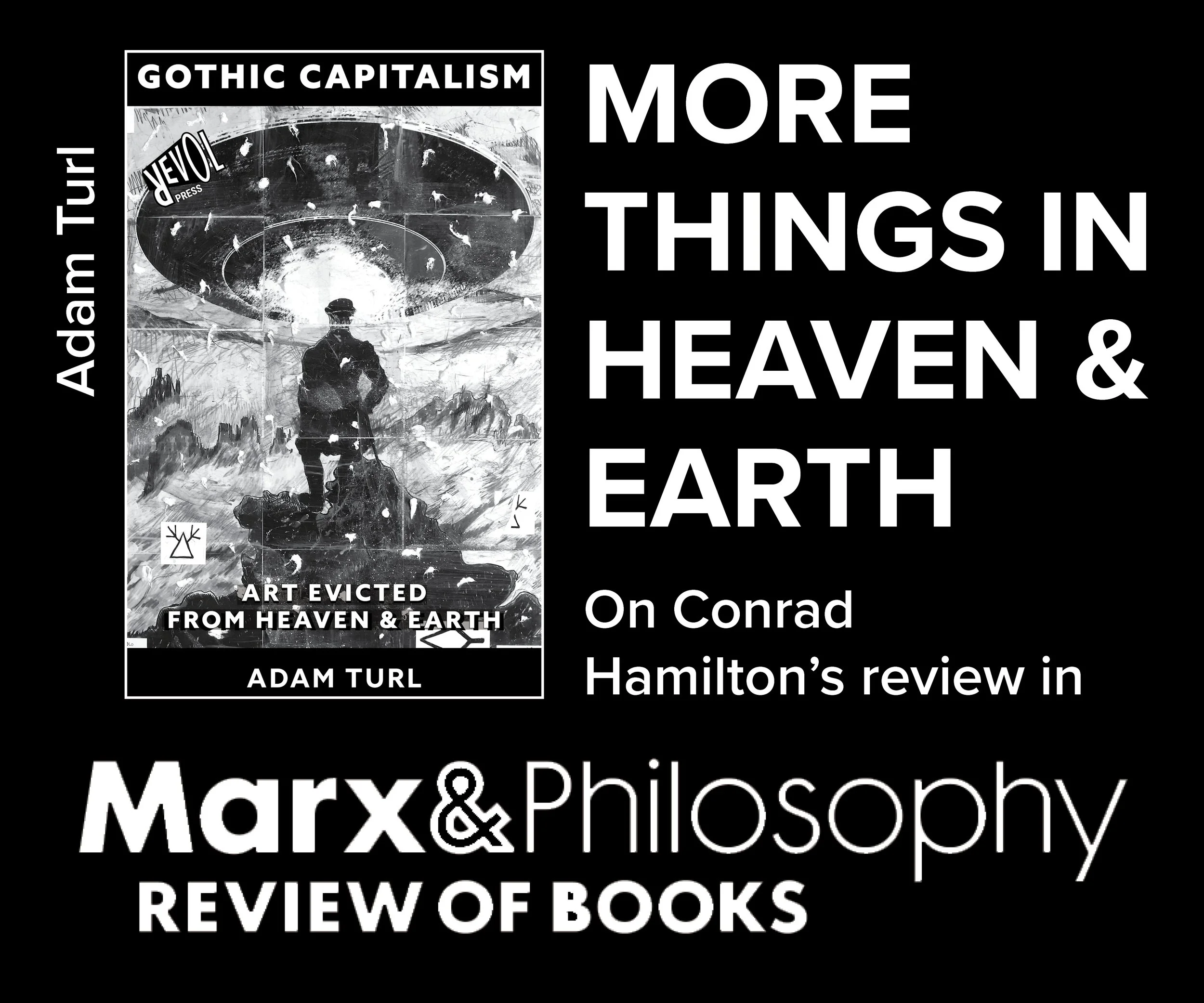
On Conrad Hamilton’s Review of Gothic Capitalism
I really appreciate Conrad Hamilton’s thorough and thoughtful review of my book, Gothic Capitalism: Art Evicted from Heaven and Earth (Revol Press, 2025), despite disagreement and debate. In fact, I appreciate many of these divergences as useful points of discussion for Marxists. I also appreciate Hamilton’s areas of agreement and nuanced engagement. And, as an artist I am usually disinclined to respond personally to reviews. However, there is one point that I have to take issue with. Hamilton writes:
“But it does mean that – with the cornerstone that supports Turl’s defense of the ‘individual artistic tendency’ (27) jettisoned – we would need to take seriously the idea that there is no clear distinction between socialist political art and socialist political control; that, in other words, what appears as artistic spontaneity is in large part the downstream effect of systems that, so far as they have to contend with capitalism, are inevitably coercive. That may sound stultifyingly conservative, like a defense of Stalin, even. But it’s worth considering that a book using the likes of [Edmund] Burke and [Martin] Heidegger to browbeat political rationalism may not be devoid of a conservative strain itself.”
Putting aside, for now, the question of “political control” of the arts, Joseph Stalin, and to what degree artistic activity is the product of determinist forces, I want to be clear that I in no way use Burke and Heidegger to “browbeat political rationalism."
In Gothic Capitalism, I mention Burke in relation to the concept of the sublime, historically important in the arts, and ask how the sublime may be related to the experience of social revolution and struggle (as Hamilton touches on elsewhere in his review).
While there are different conceptions of the sublime in the arts and philosophy, I believe Burke’s more closely resembles the motivations of 19th century European and North American landscape painters and other artists, attempting to capture, often quixotically, a feeling of overwhelming emotion, usually brought about by nature — a storm on the horizon, a churning sea, a mountain vista.
I mention Heidegger far more briefly (in a few sentences at most) as I discuss other writers’ work on how subjects experience overwhelming social and “natural” phenomena (in things like climate change, the Internet, etc.) — Georges Bataille’s excess, Timothy Morton’s hyperobjects, Félix Guattari and Gilles Deleuze’s rhizome, Burke’s sublime. I relate these to Karl Marx and Friedrich Engels’ conception of “department III” in Capital Vol. 3, the diversion of capital reproduction into luxury and war.
Unfortunately, as a link between Edmund Husserl (the “father” of modern phenomenology) and Herbert Marcuse (who helped bring modern phenomenology to the US), Heidegger will come up. Phenomenology became important in cultural criticism because it centers a subject’s experience of material life and ideology.
To be clear, I despise Heidegger. For those who are not aware, Heidegger joined the Nazis, betraying not only humanity-in-general, but his mentor Husserl, and his students, Marcuse and Hannah Arendt — all of whom were Jewish. He concealed this fact after World War Two, and tried to rehabilitate his image.
At the risk of sounding “irrational,” if we had the chance to resurrect him just to shoot him in the head, I’d be seriously tempted. I am even open to the idea that we banish his name from all discourse — although that might get complicated.
Regardless, in my book I refer to Heidegger (again, in a few sentences) because of his influence on thinkers identifying related phenomena, as I critically summarize their ideas. For example, I describe Morton as observing an actual lived experience in so-called “object oriented ontology,” but note that he seems to over-naturalize his conclusions — that it feels like objects have agency (our smartphones) but this is a capitalist phantasmagoria (the smartphones are enacting ideology and economies programmed into them by actual human beings).
The passage in question is basically part of a literature review, presented before I sketch possible democratic and self-determined approaches to overwhelming phenomena and political combinations in the arts, a Marxist approach inspired in part by Soviet scholar Mikhail Bakhtin, among others — the carnivalesque, “differentiated totality” (Locust Review), discordant will (Richard Hamilton), and so on.
I admit it is a quick sketch, and should be unpacked more. However, I do not use Burke or Heidegger to “browbeat political rationalism.”
I believe that practical politics must be rational — although this is also somewhat contingent because practical socialist politics are made up of actual working-class human beings who are complicated and have feelings, identities and finite existences, as well as sectional interests.
Ultimately, the socialist political response to overwhelming oppressive phenomena must include social combination, organization, strikes, protests, riots, direct democracy, and rebellion, building to the crescendo of revolution; an overwhelming but self-determined class conscious phenomenon of our own.
Part of what I do try to lay out in Gothic Capitalism, however imperfectly, is that the arts are an aspect of being that, while political, cannot be reduced to rationalism, much like falling in love, or mourning the death of a close friend, or being moved to tears by a symphony.
To do that, I mostly use the work of other Marxists and critical theorists influenced by Marxism — Mikhail Bakhtin, Bertolt Brecht, Michael Löwy, Walter Benjamin, Mark Fisher, Ernst Fischer, among others.
The socialist politics of art is, in part, centering both the rational and ineffable aspects of being on the actuality of a living revolutionary subject; the working-class both as it is, and as it could be. This includes the aspects of life that resist categorization, mapping, utility and rationality.
Accepting this is not a concession to superstition. It is placing a working-class claim on all that it is to be human.
0,10 Exhibition, Petrograd 1915; The Petrograd Soviet in 1917.
Adam Turl is an artist and writer in southern Illinois.They are an artist and editor at Locust Review, an irrealist journal of art and literature, and a member of the Locust Arts and Letters Collective (LALC). They have had exhibitions at the Brett Wesley Gallery (Las Vegas, Nevada), Gallery 210 (St. Louis, Missouri) the Cube (Las Vegas, Nevada), Project 1612 (Peoria, Illinois), and Artspace 304 (Carbondale, Illinois). Turl works on the Born Again Labor Museum with their partner Tish Turl, a writer and fellow LALC member. They are the author of the recently published Gothic Capitalism; Art Evicted from Heaven and Earth (Revol Press, 2025).
Subscribe to Locust Review for as little as $1 a month.
Submit work to Locust Review by e-mailing us at locust.review@gmail.com.