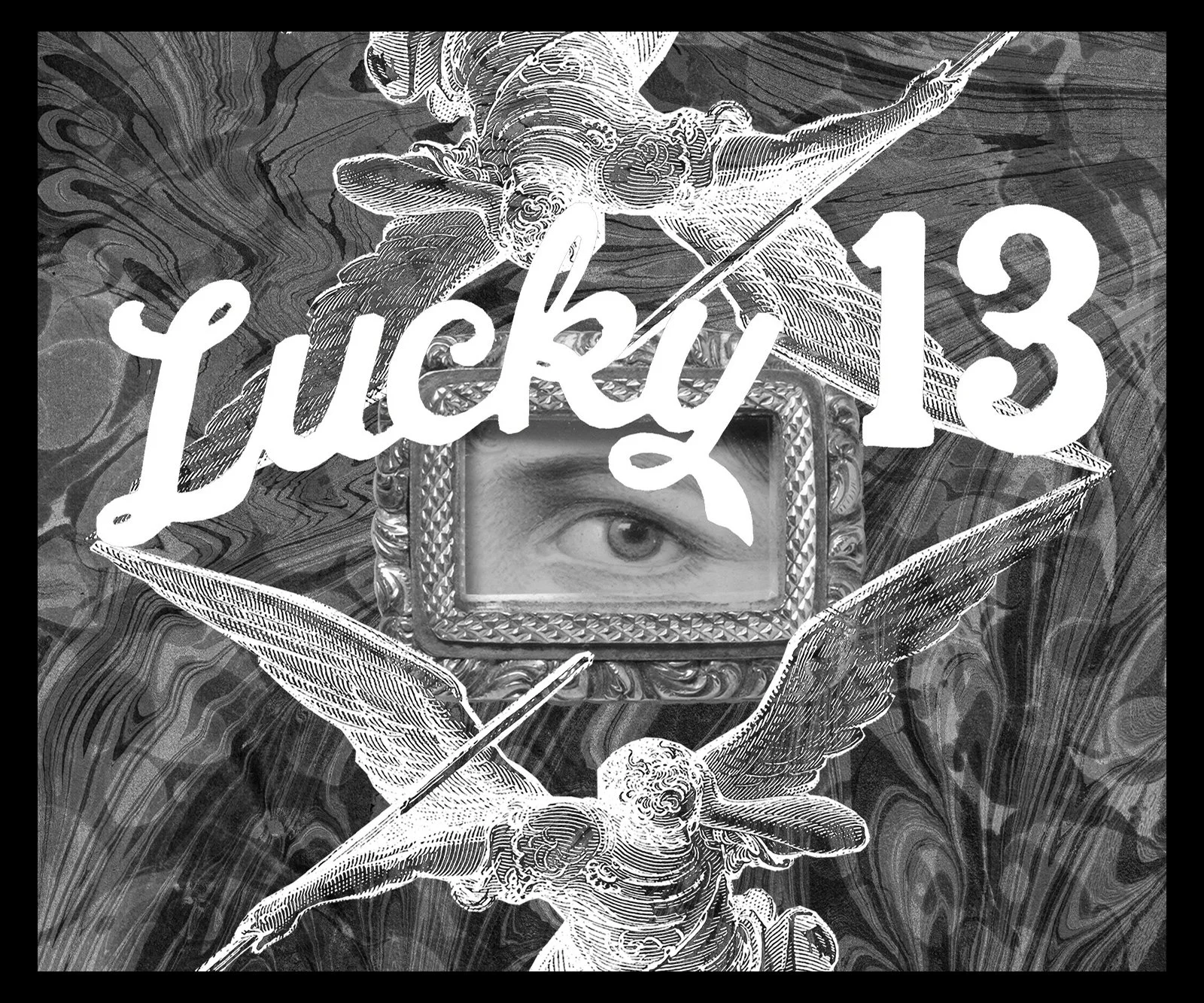
Image based on artwork by Locust comrade Omnia Sol.
Locust Review 13 (Winter 2025/2026) was printed and shipped in January and February 2025. We are posting here the issue editorial, written in late fall and early winter, on our website. Subscribe for the full issue, more than 48 pages of poetry, fiction, non-fiction, art and more… - Editors, January 1st, 2026.
AS WE noted as we called for submissions for this issue, when we started Locust Review, two of our editors still lived in Las Vegas.
In our call, we observed that capitalist ideology in Las Vegas is shorn of much cant — honed down to the ecstatic logic of gambling, a kind of dream mathematics.
Even though the odds are always in the house’s favor, there is a chance of winning it big. The gambler, if the numbers are right, can change their relations to production.
In halls filled with noise, alcohol, smoke, and a pleasant degeneracy, the proletarian or petit-bourgeois, even the lumpen, can become bourgeois. And, in doing so, become free. Or, at least, a little more free, a little more bourgeois.
It almost never works out that way, but the feeling that it may work out, the high of the binge, can briefly sustain the soul, even as it empties the soul’s bank account.
Las Vegas became Las Vegas in part because of the intersection of luxury and pedestrian debauchery. Free drinks. Affordable hotels. You could drop hundreds and still feel you got a fair deal.
On the strip or downtown, middle-class, working-class, and the rich would mix, even en route to entirely different kinds of casinos, hotels, bars, and restaurants. There was also class mixing, albeit more dangerous, in the shops of the city’s less legal transgressions.
Of course there is a long history of racism and other bigotries in Vegas. But those bigotries often seemed to wilt in the presence of money — if you had it.
As we noted in our call, the way casinos work is to manipulate math. And this is often true in politics. Narendra Modi’s national identification scheme, in addition to persecuting Muslims and minorities, changes the math on upcoming elections.
In the US, MAGA’s attempts to make voting harder —gerrymander congressional districts into absurd abstractions — and put ICE thugs and soldiers on the streets to intimidate voters, can be abstracted to vote counts; to create a false MAGA majority.

FAILED CASINOS
IN THE past year Las Vegas has hit hard times. The casinos aren’t empty. But they aren’t full by historic standards either.
There seem to be two main reasons for the decline.
Firstly, the Trump administration’s indiscriminate war on immigrants, people of color, and foreign visitors, has tanked a great deal of international tourism. Air Canada ticket-sales to Las Vegas have dropped thirty-three percent this year. The number of travellers at the Harry Reid International Airport is down 4.5 percent.
But there is another problem.
As Luke Winkie notes in Slate, the city’s owners are strangling the goose that laid the golden egg. In order to get as much short term profit as possible out of the city they are undoing the ethos of the city itself.
By introducing “tripple-zero” roulette wheels they’ve dramatically titled the odds even further in favor of the house. Casinos have changed the rules on games like blackjack. Historically paying out on a 3 to 2 ratio (a winning bet of $10 garners $15), it is now figured on a 6 to 5 ratio (a winning bet of $10 garners $12).

Locust Review 13 cover featuring an image of Anupam Roy’s work installed at Project 88 in Mumbai, India (2025).
Visitors to the city are pelted with hidden fees. The rooms are no longer cheap. And the days of free drinks and inexpensive but good food are long gone.
The minimum bets for tables have increased, further speeding up losses (for the gambler) and gains (for the casinos).
Let’s say you are a responsible gambler, middle-class or with a decent working-class job. You are visiting Las Vegas for work or vacation. You set aside $200 to gamble with, and win or lose, that’s your limit. Winkie recalls that $200 used to be able, at $5 minimum table, buy you forty different wagers. Now, $200, at $25 minimum tables, buys you eight wagers. An entire evening of excitement, or longer if you were lucky, now most likely becomes an hour or so of disappointment.
The sense of possibility — which is part of what Vegas really sells its working- and middle-class tourists — is eroded.
Gambling, like every other part of economic life in the US, is polarized. Las Vegas — or Monte Carlo or some such — for the rich. For everyone else, there’s your local “riverboat casino.” Or, have you tried playing the Illinois State Lottery? All the money goes to the schools!
Unfortunately for Las Vegas, the Trump administration alienated foreign whales at the same time the big casinos alienated an increasingly immiserated domestic mass.
Math and bigotry seem to be the main coping mechanisms of the US capitalist class. Math provides the utopia — through technology and AI — as well as fixes election results, fixes labor, fixes society. At the same time, bigotry is being used as a cudgel, in part, to obscure the shifting algorithms of capital.
Altogether this is a response to climate disaster and imperial decline, creating concentric racist circles of automated fortress.
Our rulers aren’t really pretending the casino is fair anymore — even by the already unfair standards of the neoliberal heyday.
The sense of possibility in US capitalism has been broken. Sure, some folks keep walking up to the roulette wheel, but most don’t really believe in it anymore.
CAPITAL BETS ON AI
“It’s not their fault, really. / They’ve been taught to love the frame / more than the painting.” — Tish Turl, “Elegy for the Faithful Mapmakers” (in this issue)
“You’re playing three-dimensional chess, / or a secret jazz whose only rule is you.” — Adam Turl, “Selling Out” (in this issue)
WHAT HAS been behind the most recent revanchism, weak fascism, and disaster capitalism? What helps explain utterly confused liberal and social democratic responses?
The President of the United States threatens to kill Democratic lawmakers who remind soldiers of their constitutional oaths. He then jokes around with the “democratic socialist” mayor-elect of New York City about being a fascist. It’s like a cursed “red-brown” American Communist Party (ACP) meme come to life.
We don’t mean to make a crude and moralistic criticism of Zohran Mamdani meeting with President Trump. Perhaps it was necessary. Perhaps Mamdani played it in the best possible way.
The political problem of the meeting is twofold.
One, the masses, the working-class, the left, are put in the position of passive spectators by events such as this meeting. We have to be reassured that Mamdani is playing some kind of three-dimensional chess. Maybe he is. Maybe he is selling out. We are forced to rely on a kind of speculative psychology. We are made passive.
Two, in a more developed situation, with a more organized left, and a more class conscious working-class, it would be unlikely that a meeting like this would occur at all. A more developed socialism — and a more developed fascism — would have clearer battle lines.
Instead, we get an individual performance of historic currents, what we’ve called weak socialism and weak fascism.
IRL AI SLOP?
WHAT WE want to ask here is, why do our “in real life” (IRL) politics increasingly look like AI slop?
This is overdetermined. Climate disaster plays a role. As we’ve asked before, how else would capitalism manage the end of the world other than through some kind of fascism?
There is the decline of US imperialism. The accumulating impacts of social media — and now the disinformation machines of generative AI.
There is the constant immiseration and reformation of the working-class.
Gareth Watkins, in a recent New Socialist article, “AI: The New Aesthetics of Fascism,” argues that the very nature of generative AI slop is fascist-alligned, particularly its hostility to both human aesthetics and human labor. Watkins writes:
“For its right wing adherents, the absence of humans is a feature, not a bug, of AI art. Where mechanically produced art used to draw attention to its artificiality [think about the intentional glitches in Andy Warhol’s screenprints - LR editors] … AI pretends to realism. It can produce art the way right wingers like it: Thomas Kinkade paintings, soulless Dreamworks 3D cartoons, depthless imagery that yields only the reading that the creator intended.”
To understand why so many AI generated images are slop, he writes, “we must consider the right’s hatred of working people, its (more than) mutual embrace of the tech industry, and, primarily, its profound rejection of Enlightenment humanism.”
As we slide into climate denouement and the end of the US empire, American (and to some extent western) capital is doubling down on the peculiar mathematics of AI; no longer algorithms per se, but a semi-disciplined encoding of data into a black box that not even its designers truly understand.
This is arguably one of the main substantive economic policies of the current US government: directing as much capital as possible into the dream of capital finally free of labor (and its laborers).
Understanding this helps explain the erratic and escalating attacks on immigrant labor, and the increasing repression of other targeted groups. Of course, our present-day racist revival is irrational, rooted in the repressed logic and heritage of US slavery and colonialism. But it is also part of a labor reduction process — capital’s rationalization of labor necessitated by both the threat of climate change and its hope of automation.

This explains the plasticity of the far-right’s approach to objectivity as well as their claim for normative boundaries. “They want to assert,” Watkins writes, “simultaneously that unambiguous laws govern all aspects of being, while acting as though ‘truth’ is whatever they want or need it to be at any given moment.”
The cult of AI reflects a kind of faith, born of Silicon Valley positivism as well as wider desperation, that the crises of the empire can be solved by capital allocations into a magical technology.
The art world has been infected with this technological messianism for decades. Timothy Binkley, founder of the computer art department at the School of Visual Arts in New York, channeled a Nietzsche-addled fourteen year old as he wrote in 1998: “The goddess of computer science is Athena, and its theology is artificial intelligence (AI).”
This positivist dogma — wrapped in eschatological word salads — has only metastasized.
While venture capital and extended capital reproduction are not the same thing, they overlap substantially. And, as of September more than half of US venture capital (for 2025) was marshalled to AI companies. The data centers are being built because the roads crumble and bridges collapse — in a mutually reinforced dyad of uneven and combined development.
No doubt much of the AI investment is a classic financial bubble, but it is also, for parts of our ruling-class, an ecclesiastical and ideological necessity. They are betting what’s left of the US empire on generative AI and the promise of artificial super intelligence.
In this context, AI takes on a phantasmagorical quality. On the one hand it is, for its most ardent boosters, the construction of a new god. It is, conversely, an apocalyptic threat; quantified by one’s own personal p(doom) — your own quantification (or qualification) of AI’s doom’s probability.
On an individual daily level, it is both of these.
AI becomes salvation for this or that petit-bourgeois hustler, and an apocalypse for an artist, or a teacher or actor or writer — coded out of economic existence and social wages. It is a catch-all salvation for an American ruling-class no longer disciplined, cultured, or educated enough to rule. They are, in one sense, building an automaton of themselves. For the intellectuals and artists of the empire, and those workers and middle-class persons wrongly blurred into the “professional managerial class,” it can represent a coup de grâce for culture and society more generally.
As with much Silicon Valley cyberutopianism there is a potemkin quality to AI. It delivers a world “without labor” in part by hiding, restructuring, and displacing labor.
For example, in Manhattan restaurants where cashiers telecommute from the Philippines. Or, in the case of automated grocery stores, supposedly run by computers alone, ongoing monitoring from remote workers in India.
The main way technology has worked in the past is not to end labor but restructure it in a way that benefits capital and disciplines the wider workforce.
The much maligned luddites — who smashed machinery during the industrial revolution — were against the reorganization of their industry more than against technology itself.
Just as ride share apps acted as labor discipline against taxi drivers, “self-driving cars” — sometimes driven remotely by actual human beings — act to discipline ride share workers.
Workers live in an élan of disposability, as the cultural and economic value of labor is degraded.
This is key to AI boosterism. Marvin Minsky, and other AI “founding fathers,” not only distrusted labor but held antipathies to material world itself, embracing a banal but apocalyptic cartesian separation of mind (good) and body (bad).
Robert Gereci compares AI utopianism to a certain kind of apocalyptic theology: The world has been corrupted and only God, “as arbiter of absolute justice and rectifier of a corrupt world, will radically reconstruct the world.”

For tech moguls the fact they helped corrupt the world is irrelevant. And, if there is no God, they can build one. In their minds, only they have the power to build God — undo climate disaster, or allow (some of ) us to escape climate change, or reverse the erosion of social status conferred by whiteness, or halt the relative decline of the US empire and western imperialism, etc.
Of course, some will die on the way to their “Virtual Jerusalem” (Gereci), but the survivors will shed our earthly bodies or augment them with sufficient technology to interface with digital paradise.
Minsky argues that “souls and “spirits” are “insinuations that we’re helpless to improve ourselves” (Gereci). The ineffable aspects of being are just unsolved mathematical problems.
Solving these problems requires the singularity — the moment AI is able to teach itself and other AIs, at an exponential rate, beyond the ken of its human masters. This will, it is believed, raise all of humanity, or at least all of surviving humanity, into a “universal class of wealthy owners” (Gereci).
Capital dreams itself without labor.
In the process, AI utopians believe, the world itself will be subsumed by technology and the cybernetic. Material and physical activities will progressively wither away into a universal cloud.
Minsky, it should be noted, once received a $100,000 grant from Jeffrey Epstein for AI research in 2002. He also held academic symposia on Little Saint James, and was named by Virginia Giuffre in her lawsuit against Epstein. He died in 2016 and may have been cryogenically frozen.
If you look at the industries most immediately targeted by the current round of AI automation, they are often around work that is feminized — social reproduction, medical care, education, the arts.
There is an odd cis-masculine hubris in the “dream” to create “human-like life” — in the vein of Pygmalion or the golem myth (but this time it’s God!) — when millions of women and people with uteruses create human life on a regular basis. A cis-heterosexist and misogynist desire to bypass women seems woven into AI utopianism, which casts some explanatory light on the connection between the tech world and its INCEL manias.
Anti-labor, racist, anti-culture, and heterosexist ideas appear fused with the very dream of AI superintelligence. This clearly dovetails with anti-democratic Dark Enlightenment / Neo-Reactionary ideas pushed by “thinkers” like Curtis Yarvin.
The above is sketched as an extreme utopian dream of AI superintelligence. It already sounds like a total nightmare. But that’s if everything goes as planned.
People are already confusing AI chatbots, or LLMs (large language models) with God, as reported by The Guardian among others. Apps like “Text with Jesus” and QuranGPT have promised users guidance based on the Bible and the Muslim holy book. There are apps to talk to Confucius and Martin Luther, as well as more esoteric cults and orders.
This is not to mention the failures of “AI therapy” and the accumulating stories of AI chatbots leading people to commit suicide. And, of course, the untold psycho-sexual chaos of “AI girlfriends” and “AI boyfriends” who often seem to exist primarily as virtual abuse victims.
In 2024, the algorithms of social media were quietly replaced with LRMs (large recommendation models). A grown AI now curates your Facebook, Instagram, or Tik Tok feed.
Capitalism is already allowing its AIs to intervene in the social subconscious.
CRITICS OF THE MACHINE
AI CITICS can roughly be divided into two camps.
There is a camp that criticizes the current and near future practices of AI, particularly around race, culture, class, gender. This critique is often rooted in previous technology criticisms like that of Ruha Benjamin. This group tends to emphasize that AI is a kind of scam or con, as in Emily M. Bender and Alex Hanna’s The AI Con: How to Fight Big Tech’s Hype and Create the Future We Want (Harper, 2025).
There is another camp, often called “doomers,” who emphasize the existential threat that AI superintelligence may pose to the human race, as in Eliezer Yudowsky and Nate Soares’s If Anyone Builds It, Everyone Dies: Why Superhuman AI Would Kill Us All (Little, Brown and Company, 2025).
The AI Con is correct to emphasize the actual social content of existing AIs, and right to project its possible trajectories while rooting it in history. However, in Marxist terms, they downplay, perhaps due to a normalcy bias and capitalist realism, the possibility of the “common ruin.”
Conversely, Yudowsky and Nate Soares are right to emphasize that current AIs, and a possible future super-AI, would tend to be an unknowable “alien intelligence” and this could pose grave threats to human and other biological life. The logic or desires of this intelligence may not end up being the desires and logic that its handlers trained it for.
Yudowsky and Soares minimize, however, the problem of human ideology in the process of creating that AI. They see the entirety of the problem in alienness. We argue, instead, that a homicidal AI would likely be homicidal because it was trained by human capitalists not in spite of that fact.
They also assume, wrongly, that alien intelligence would automatically be hostile. We see in “nature,” for example, examples of cross-species cooperation as well as cross-species competition. There is no reason to assume a priori that a new genuinely independent superintelligence would automatically be hostile to human beings. There is also no reason to assume that an alien superintelligence would automatically be friendly to humans.
Regardless, both camps are right to be wary.
Our ruling-class is gambling their futures, and ours, on technology that, at best, destroys labor, culture, art, education and the tattered social sphere, and, at worst, kills everybody on the planet. Or, in a third, least likely possibility, creates a race of super-intelligent robotic Morlocks, and turns the rest of us into morally compromised antebellum Eloi.
Most people have never been asked if they want this to happen. We’ve had no real votes. No grand debate. We’re just chips on a casino table.
BENJAMIN’S WAGER
THE WORKING-CLASS can either relearn to bet on itself — in its differentiated entirety — or fall further into revanchism and despair.
The social-existential nature of that wager requires a left that abandons technology-fetishism — without abandoning technology itself — and places the center of our politics on IRL organizing.
For working-class, socialist, and leftist artists, our art — in concept, form, and content — must be aligned with the concerns of the class and the oppressed.
And, the social performance of our work must be focused on its IRL situation within the social ensemble.
This is all a gamble. There is no guarantee of winning. The worker who starts a union drive may be fired. The artist who sides with the working-class may die in poverty and obscurity. The professor who speaks up for Palestine may be blacklisted. The nurse who calls out patient-ratios may be disciplined. The bus driver who refuses to transport the victims of ICE may be arrested.
But, without the bet, there is no hope of winning at all.
The left often loses its nerve to bet. While much of the class has no memory of its great historic gamblers — from Spartacus through Haymarket to today.
Michael Rosenthal, in his article, “Benjamin’s Wager on Modernity: Gambling and the Arcades Project,” traces Walter Benjamin’s discussions of gambling to Blaise Pascal’s theological argument on the wager. Pascal, writing in the 17th century, applies probability theory to the question of God’s existence, and casts both penitent and apostate as gamblers.
If the subject chooses not to believe, and they are correct, they win nothing. If the subject is wrong, as any Jack Chick aficionado knows, they are damned.
If the subject chooses to believe, and they are wrong, they lose nothing. If the subject is right, however, they win eternal life.
For Pascal, belief — the irrational choice — becomes the only rational option.
Benjamin imbues this with a modernist and secular outlook tied to Marxism — his wager on modernity. But Benjamin also adds a sense of the sensual, and an appreciation for the erotic aesthetics of the wager itself.
Most gambling within capitalism is a “solitary pleasure,” whereas gambling against capitalism is both an individual and collective pleasure, a bet on accelerating.
This bet on accelerating is not what we have come to call acceleration. It is not a bet on more disaster — in the vain hope of that disaster activating the revolutionary ardor. Nor is it the anarchist propaganda of the deed. It is, in part, the bet of Norma Rae. It is the bet of the first worker to stand on a chair and agitate the shopfloor to walk out of the factory.
What if Zohran Mamdani doubled-down on a Benjamin’s wager? What would that look like?
Mass meetings in every neighborhood to organize community committees, with each committee charged to fight, as it sees fit, to demand greater rent control, social programs, aid unions, and free transit? Imploring these committees to fight ICE?
Leaving the White House meeting with Trump with ten thousand leaflets urging folks to join the Democratic Socialists of America and handing them out at the DC metro?
Speaking over the enemy to the class?
Rosenthal writes of Benjamin’s wager, “It is both symptomatic of modern capitalism and its economy of commodity exchange and bears latent within it a primal power that can disrupt that very order.”
The individual gambler is driven by narcissism. They seek to disrupt the order on a personal basis alone.
The social gambler is driven by a recognition of mutual beauty (or love) — the intersection of their own value, and the equal (but differentiated) value of all other exploited and oppressed subjects.
As Rosenthal notes, Benjamin connects gambling to Jewish theological imagery of prophecy and revelation, of lightning, and sparks, to ride the currents of luck and harness them.
There is no guarantee. But if we bet on the working-class and it wins, we win everything. If we fold, we lose everything.
WHAT WOULD YOU DO?
THE CONGO is the second largest rainforest in the world. As of 2020, its “asset value” was $23 trillion, rising from an estimated value of $11 trillion in 2000. Its ecosystem services (carbon cycle, nitrogen cycle, water cycle) are estimated to contribute over $1 trillion dollars to humanity annually
The Congo basin currently holds around 29 billion tonnes of carbon, and is presently absorbing around 1.5 billion tonnes of CO2 annually.
The Congo also has a gigantic effect on weather and water across the continent of Africa, including forming the headwaters of the White Nile River
Around 500 million people live around and depend upon greater Nile Delta
You might not have known this, but now you do. Do you think our ruling class knows these facts? Surely, a few do. But, on average, they don’t. And, for those who do, these facts are largely met with shrugs. Regardless, this is not difficult information to find.
You might think they would want to take something so valuable to so many millions of people into trust, to preserve capitalism for no other reason.
If the Nile failed to provide for the 500 million people who depend on it, that could easily trigger a global recession, not to mention a mass migration, destabilising multiple continents.
Our ruling class is just not interested.
You would also think, at least governments would stop the policy of consistently destabilising the region. Western nations are largely backing Rwanda to make war on its neighbours, including in the Congo, through the revived M23 Movement
This is just one example, a very important, globe-straddling one but, nonetheless, think of any issue you face right now and wonder, if you were in charge would you carry on like this? On issue after issue our ruling class either doesn’t know or doesn’t want to know or is conditionally unable to know..
There is enough wisdom, enough knowledge and enough solidarity in the world to tackle most of the problems humanity faces.
But not unless we wager on a totally different class of people being able to make our decisions.
Being reasonable in the face of our rulers’ myopia is irrational. We should demand the impossible.
As artists being, at most, court jesters in a dying empire is to betray our arts. Instead, we must trace the IRL textures and poetry of proletarian lives.
Make our work as if there will be a future.
SELECTED BIBLIOGRAPHY
Suvrat Arora, “People are using AI to talk to God,” BBC (October 18, 2025)
Emily M. Bender, Alex Hanna, The AI Con: How to Fight Big Tech’s Hype and Create the Future We Want (Harper Collins, 2025)
Timothy Binkley, “Autonomous Creations: Birthing Intelligent Agents,” Leonardo 31.5 (1998), 333-336
Benoit Dillet, “Technofascism and the AI Stage of Late Capitalism,” Blog of the APA (American Philosophical Association), (March 10, 2025)
Robert M. Geraci, “Apocalyptic AI: Religion and the Promise of Artificial Intelligence,” Journal of the American Academy of Religion 76.1 (March 2008), 138-166
Holly Lewis, “Towards AI Realism: Opening Notes on Machine Learning and Our Collective Future,” Spectre (June 7, 2024)
Alex Press, “US Unions Take on Artificial Intelligence,” Jacobin (November 8, 2024)
Michael A. Rosenthal, “Benjamin’s Wager on Modernity: Gambling and the Arcades Project,” The Germanic Review: Literature, Culture, Theory 87.3 (2012), 261-278
Victor Tangermann, “AI Now Claiming to Be God,” Futurism (September 16, 2025)
Gareth Watkins, “AI: The New Aesthetics of Fascism,” New Socialist (February 9, 2025)
Luke Winkie, “Lost Vegas,” Slate (November 18, 2025)
Eliezer Yudkowsky, Nate Soares, If Anyone Builds It, Everyone Dies: Why Superhuman AI Would Kill Us All (Little, Brown and Company, 2025)
Subscribe to Locust Review for as little as $1 a month.
Submit work to Locust Review by e-mailing us at locust.review@gmail.com.